Google Ads has changed dramatically over the last two decades.
The paid search industry once rewarded extreme keyword-level control. Advertisers built Single Keyword Ad Groups, duplicated match types, maintained enormous negative-keyword lists, and manually adjusted bids to control almost every part of the account.
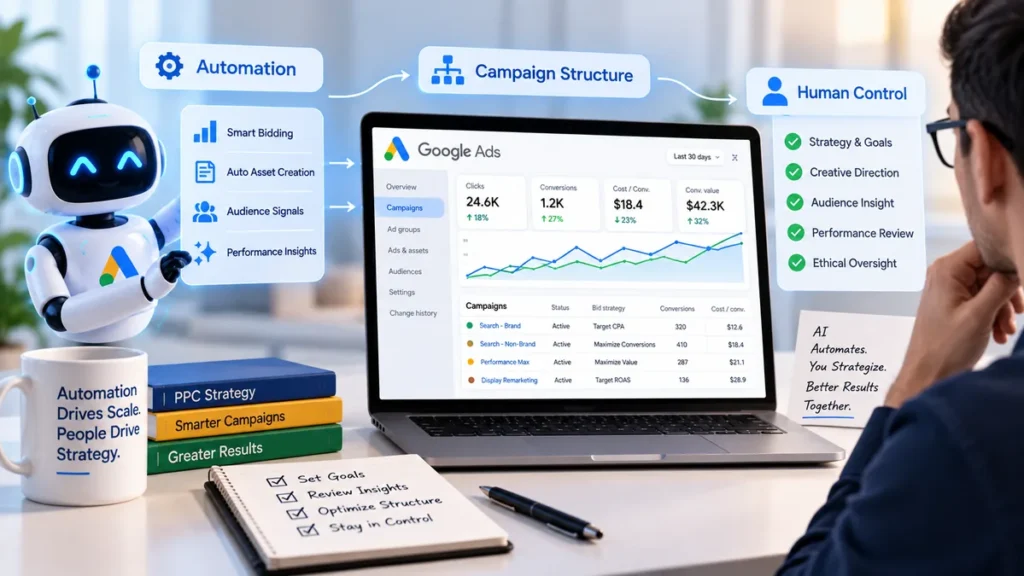
Today, much of that work has moved toward automation.
Machine learning, automated bidding, broad matching, algorithmic targeting, and increasingly consolidated campaign structures have changed what PPC managers actually need to control.
The question is no longer simply how to optimize individual keywords.
It is:
How has Google Ads automation changed PPC strategy, campaign structure, and human control?
The answer is a fundamental shift from manual micro-management toward algorithmic oversight, business data, strategic constraints, and human guardrails.
What Changed in Google Ads Over the Last 20 Years?
What changed in Google Ads over the last 20 years?
The biggest change is the movement from manual keyword management toward Google Ads algorithmic automation.
Earlier PPC management depended heavily on human intervention. Advertisers controlled bids, match types, ad groups, negative keywords, and campaign segmentation.
Modern systems can make many of those decisions automatically.
This has changed the role of the PPC manager.
| Earlier PPC | Modern PPC |
|---|---|
| Keyword-level control | Algorithmic optimization |
| SKAGs | Themed structures |
| Manual bidding | Automated Google Ads bidding |
| Match-type segmentation | Broader intent matching |
| Large negative lists | Strategic exclusions |
| Manual optimization | PPC automation |
| Keyword metrics | Business-value metrics |
| Tactical control | Algorithmic oversight |
This is why how Google Ads automation works is now a more important question than simply knowing how to manually adjust thousands of bids.
The modern advertiser needs to understand the system, its inputs, its objectives, and its limitations.
How Has Google Ads Automation Changed PPC Strategy?
How has Google Ads automation changed PPC strategy?
The role of the advertiser has moved upward.
Instead of manually controlling every auction, advertisers increasingly manage the environment in which the algorithm operates.
A modern Google Ads automation strategy can be understood through five layers:
- Business objective.
- Data quality.
- Campaign structure.
- Automation guardrails.
- Continuous oversight.
The algorithm handles many tactical decisions.
The advertiser defines what the algorithm should optimize toward.
This is the foundation of Google Ads Automation and Algorithmic PPC Management.
Why Did Micro-Granularity Stop Being the Main PPC Advantage?
Why did micro-granularity stop being the main PPC advantage?
Micro-granularity made sense when advertisers needed to manually control relationships between keywords, ads, bids, and landing pages.
But excessive segmentation can create unnecessary complexity.
An account divided into hundreds of tiny campaigns may produce:
- Fragmented data.
- Smaller learning pools.
- More maintenance.
- Campaign overlap.
- More management overhead.
- More opportunities for inconsistent decisions.
The objective of modern Google Ads optimization is therefore not maximum complexity.
It is maximum useful control.
That distinction is critical to understanding PPC automation.
What Happened to SKAGs and Other Granular PPC Tactics?
What happened to SKAGs and other granular PPC tactics?
Single Keyword Ad Groups, or SKAGs, were built around an earlier PPC environment where advertisers wanted maximum control over the relationship between keyword, ad copy, and landing page.
They were not irrational.
They solved real problems at the time.
But automation changed the environment.
Modern systems can evaluate many signals simultaneously, making the old requirement for extreme keyword duplication less important.
This is why SKAGs and Modern Google Ads should be understood historically rather than treated as a universal modern best practice.
The same applies to excessive match-type duplication and over-engineered negative keyword structures.
The lesson is not that historical tactics were always wrong.
The lesson is that PPC tactics must evolve with the system.
What Is the Modern Google Ads Campaign Structure?
What is the modern Google Ads campaign structure?
A modern Google Ads campaign structure should organize campaigns around meaningful business objectives and coherent themes.
The structure should help the system understand:
- What the campaign is trying to achieve.
- Which customer intent matters.
- Which conversions are valuable.
- Which searches are relevant.
- Which traffic should be excluded.
A practical Google Ads account structure can therefore be organized around:
Business objective → campaign → theme → search intent → conversion → customer value
This is more useful than creating additional campaigns simply because another segmentation dimension exists.
The modern PPC campaign structure should provide enough control without unnecessarily fragmenting the account.
How to Structure Google Ads Campaigns?
How to structure Google Ads campaigns depends on the business model, conversion volume, customer value, and strategic objectives.
A useful framework is:
Campaign
Define a meaningful business objective.
Ad Group
Group closely related intent and themes.
Search Terms
Understand the actual queries entering the account.
Conversion Data
Feed reliable outcomes into the system.
Business Rules
Define what should and should not be pursued.
This approach makes Google Ads campaign structure a strategic framework instead of a purely technical exercise.
Is Google Ads Broad Match Still a Problem?
Is Google Ads broad match still a problem?
Broad match should not be treated as automatically good or automatically bad.
The more useful question is whether the advertiser has an appropriate Google Ads broad match strategy.
Broad match can expand the range of searches associated with a keyword.
That creates both an opportunity and a risk.
The opportunity is discovering relevant demand that exact keyword lists might miss.
The risk is paying for traffic that is semantically related but commercially irrelevant.
Therefore, Google Ads Broad Match Strategy should be built around relevance, conversion quality, and business boundaries.
What Should a Google Ads Broad Match Strategy Actually Control?
What should a Google Ads broad match strategy actually control?
A strong Google Ads broad match strategy should control the boundaries within which automation operates.
These boundaries can include:
- Search intent.
- Geographic relevance.
- Customer type.
- Product relevance.
- Commercial relevance.
- Conversion quality.
- Known exclusions.
Advertisers can use broad match keywords while still maintaining strategic control through Google Ads negative keywords, search-term analysis, conversion data, and business rules.
The objective is not to prevent discovery.
It is to prevent known irrelevance from becoming paid experimentation.
Why Does Automation Need Human Guardrails?
Why does automation need human guardrails?
Because algorithms can optimize the signals they receive, but they do not automatically possess every piece of business knowledge held by the advertiser.
A company may already know that certain searches are irrelevant.
For example:
- Students are not customers.
- Job seekers are not customers.
- Free-product searches are not commercial opportunities.
- Certain locations cannot be served.
- Certain customer segments are unprofitable.
- Certain products have strategic restrictions.
There is little reason to spend money teaching the system something the business already knows.
This is why Google Ads automation guardrails are important.
What Are Google Ads Automation Guardrails?
What are Google Ads automation guardrails?
Google Ads automation guardrails are rules, exclusions, data signals, and business constraints that keep automated systems aligned with actual business objectives.
Examples include:
| Guardrail | Purpose |
|---|---|
| Google Ads negative keywords | Exclude known irrelevant searches |
| Conversion validation | Improve signal quality |
| CRM data | Connect leads with revenue |
| Customer-value data | Identify valuable customers |
| Budget limits | Control financial exposure |
| Search-term analysis | Detect intent problems |
| Geographic exclusions | Prevent irrelevant traffic |
| Business rules | Protect strategic constraints |
This is also what Google Ads business guardrails are designed to accomplish.
The principle is simple:
Let the machine optimize, but define what the machine is allowed to optimize.
How Can Advertisers Control Google Ads Automation?
How to control Google Ads automation is one of the most important modern PPC questions.
The answer is not to manually control every bid.
Instead, control the system through:
- Better conversion data.
- Customer-value information.
- Search-term monitoring.
- Strategic exclusions.
- Campaign architecture.
- Budget constraints.
- Business objectives.
- Performance evaluation.
This is a better form of control because it focuses on the system’s inputs and outcomes.
It is also central to how to use Google Ads automation safely.
How Human Expertise Improves Google Ads Automation
How human expertise improves Google Ads automation comes down to business context.
Google may know that two searches are semantically related.
The advertiser may know that only one produces profitable customers.
Google may see a conversion.
The advertiser may know that the conversion is an unqualified lead.
Google may see volume.
The advertiser may know that the volume comes from the wrong customer segment.
This is why PPC human oversight remains important.
The objective is not to compete with machine learning.
It is to supply the machine with information that the auction itself cannot provide.
How to Add Guardrails to Google Ads Automation
How to add guardrails to Google Ads automation starts with documenting business knowledge.
Create a clear list of:
- Permanently irrelevant searches.
- Unserviceable locations.
- Unprofitable customer groups.
- Low-quality conversion actions.
- Low-value products.
- Restricted commercial categories.
- Poor-quality lead sources.
Then connect those rules to campaign management, conversion tracking, negative keywords, CRM data, and reporting.
This creates a controlled form of automation rather than unrestricted discovery.
Is Google Ads Automation Creating Wasted Spend?
Is Google Ads automation creating wasted spend?
Automation itself is not necessarily the cause of waste.
The more useful question is whether the system is optimizing toward signals that represent real business value.
Google Ads wasted spend can result from:
- Poor conversion tracking.
- Weak lead qualification.
- Irrelevant search expansion.
- Low-value customers.
- Duplicate campaign objectives.
- Incorrect conversion actions.
- Invalid traffic.
- Poor customer-value data.
Therefore, Google Ads Wasted Spend should be analyzed beyond individual keywords.
How Can Advertisers Reduce Google Ads Wasted Spend?
How can advertisers reduce Google Ads wasted spend?
Start with the conversion layer.
Ask:
- What is counted as a conversion?
- Is every lead valuable?
- Are offline outcomes connected?
- Are poor-quality leads being excluded?
- Is customer value being measured?
Then analyze search behavior.
Google Ads search term analysis can reveal:
- Irrelevant queries.
- Low-value intent.
- Unexpected search themes.
- New opportunities.
- Areas where exclusions are required.
Finally, examine the PPC data quality feeding the automated system.
Poor data can cause good automation to optimize the wrong objective.
How to Reduce Wasted Google Ads Spend
How to reduce wasted Google Ads spend requires looking at the complete acquisition system.
The sequence should be:
Search → Click → Lead/Transaction → Qualification → Revenue → Customer Value
If the system stops at “conversion,” the advertiser may optimize for activity rather than business value.
That is why Google Ads customer value matters.
A lead worth $50 and a customer worth $10,000 should not necessarily produce the same bidding signal.
What Still Matters in Google Ads After Automation?
What still matters in Google Ads after automation?
Automation has not eliminated the fundamentals.
The important areas now include:
Data
Google Ads conversion data must be accurate.
Customer Economics
Google Ads customer value must be understood.
Search Intent
Semantic relevance does not guarantee commercial relevance.
Structure
The Google Ads campaign structure must make strategic sense.
Guardrails
Automation needs Google Ads automation guardrails.
Measurement
Advertisers need to identify Google Ads wasted spend and incremental business value.
These are the foundations of modern paid search automation.
How Does Google Ads Machine Learning Change PPC?
Google Ads machine learning allows the platform to process signals and make decisions at a scale that manual optimization cannot replicate.
That changes the advertiser’s role.
Instead of manually calculating every bid, advertisers can focus on:
- Signal quality.
- Customer value.
- Conversion quality.
- Search intent.
- Business constraints.
- Budget allocation.
This is why automated bidding strategy is now fundamentally different from traditional manual bid management.
The question becomes less about controlling every bid and more about ensuring the system receives the right information.
How Automated Bidding Affects PPC Campaign Structure
How automated bidding affects PPC campaign structure is a central issue in modern account design.
When bidding becomes algorithmic, excessive campaign segmentation can reduce the amount of useful data available to each individual campaign.
That does not mean every campaign should be merged.
It means segmentation should have a business reason.
A campaign split should exist because there is a meaningful difference in:
- Objective.
- Budget.
- Geography.
- Product economics.
- Customer value.
- Business constraints.
This is the strategic purpose of PPC campaign structure.
How to Optimize Automated Google Ads Campaigns
How to optimize automated Google Ads campaigns requires optimizing the system rather than manually fighting the algorithm.
A practical process is:
- Validate conversion tracking.
- Review customer quality.
- Analyze search terms.
- Establish exclusions.
- Review campaign structure.
- Evaluate budget allocation.
- Measure incremental value.
- Test platform recommendations.
This is modern algorithmic PPC management.
How to Improve Google Ads Campaign Performance
How to improve Google Ads campaign performance depends on the business outcome being optimized.
For some advertisers, that may be revenue.
For others, it may be qualified leads, profit, customer lifetime value, or pipeline.
Therefore, performance should not be reduced to one platform metric.
A stronger framework is:
Traffic quality → conversion quality → customer quality → economic value
That is the foundation of meaningful Google Ads optimization.
How Does Google Ads Automation Change PPC Management?
How Google Ads automation changes PPC management can be summarized as a shift from execution toward governance.
The PPC manager increasingly manages:
- Data.
- Structure.
- Guardrails.
- Algorithms.
- Measurement.
- Customer economics.
This is algorithmic PPC management rather than traditional keyword micromanagement.
How AI Automation Changes Google Ads Strategy
How AI automation changes Google Ads strategy is ultimately about where human attention is most valuable.
Humans should focus on:
- Business objectives.
- Customer economics.
- Strategic exclusions.
- Conversion quality.
- Market knowledge.
- Risk management.
Automation can focus on:
- Auction-time decisions.
- Bid adjustments.
- Signal processing.
- Large-scale optimization.
The combination is more powerful than either extreme.
How to Control AI-Driven Google Ads Automation
How to control AI-driven Google Ads automation does not mean disabling automation.
It means controlling:
- Inputs.
- Objectives.
- Constraints.
- Conversion signals.
- Exclusions.
- Budgets.
- Evaluation criteria.
That is a much more scalable form of PPC management.
How Advertisers Can Control Automated Google Ads Systems
How advertisers can control automated Google Ads systems is therefore a governance question.
Advertisers should define:
What should the system optimize?
What should it avoid?
What data should it trust?
What outcomes should count?
What business rules cannot be violated?
These questions create a practical framework for automation.
How to Optimize Google Ads Automation for Business ROI
How to optimize Google Ads automation for business ROI requires moving beyond platform metrics.
Business ROI should connect advertising cost with actual business value.
That means measuring:
- Qualified conversions.
- Revenue.
- Margin.
- Customer lifetime value.
- Pipeline value.
- Incremental outcomes.
This is where Google Ads Intelligence and Paid Search Intelligence become important strategic disciplines.
The goal is not simply more automated activity.
The goal is better business outcomes.
How Business Data Improves Google Ads Automated Bidding
How business data improves Google Ads automated bidding is one of the biggest opportunities in modern PPC.
The more accurately the advertiser can communicate:
- Customer value.
- Lead quality.
- Revenue.
- Offline conversions.
- Product economics.
the more meaningful the optimization objective becomes.
The system should not merely learn which users convert.
It should learn which users create business value.
Why Should Advertisers Question Google’s Default Recommendations?
Why should advertisers question Google’s default recommendations?
Because default settings are designed for broad platform applicability, while individual businesses have unique economics.
A recommendation should therefore be evaluated through questions such as:
- What problem does it solve?
- What assumption does it make?
- What data supports it?
- What business risk does it create?
- How will success be measured?
- What guardrails are required?
This is not anti-automation.
It is responsible automation management.
What Is the Difference Between Platform Optimization and Business Optimization?
Platform optimization focuses on the signals available to the advertising system.
Business optimization focuses on the economic outcomes that matter to the company.
Those objectives can overlap.
But they should never be assumed to be identical.
That is why advertisers need algorithmic oversight.
The platform can optimize the auction.
The advertiser must define what winning means.
How AI-Driven Advertising Affects Google Ads Strategy
How AI-driven advertising affects Google Ads strategy is therefore not simply about adopting more AI.
It is about deciding where AI should operate and where business judgment should remain in control.
The winning architecture is:
AI execution + human strategy + business data + guardrails
This is the core principle behind AI-Driven Google Ads.
How to Prevent Wasted Spend From Google Ads Automation
How to prevent wasted spend from Google Ads automation requires proactive constraints.
Do not wait until a report shows thousands of dollars of irrelevant traffic.
Use existing knowledge to establish:
- Negative keywords.
- Geographic exclusions.
- Customer exclusions.
- Conversion validation.
- Lead-quality rules.
- Budget limits.
- Search-term monitoring.
This converts Google Ads wasted spend from a reactive problem into a controlled risk.
How to Combine PPC Automation With Human Oversight
How to combine PPC automation with human oversight is the central operating model for modern paid search.
Automation should handle tasks where machine learning has a scale advantage.
Humans should handle:
- Strategy.
- Business rules.
- Customer economics.
- Risk.
- Data validation.
- Incrementality.
That combination creates stronger Human Oversight in PPC.
How Google Ads Broad Match Automation Affects Wasted Spend
How Google Ads broad match automation affects wasted spend depends on whether the resulting traffic is commercially useful.
Broad matching can expose an advertiser to searches that are related in meaning but different in business intent.
Therefore, search-term monitoring and exclusions remain important.
The objective is not to eliminate broad matching.
The objective is to ensure the Google Ads broad match strategy is aligned with actual business value.
How AI Changes Google Ads Campaign Structure
How AI changes Google Ads campaign structure is one of the clearest examples of the shift from manual control to algorithmic management.
When automation handles more tactical optimization, campaign segmentation should increasingly be justified by meaningful business differences.
The result is a simpler but more strategic Google Ads campaign structure.
What Is the New Role of a PPC Manager?
What is the new role of a PPC manager?
The PPC manager is increasingly becoming an algorithmic governor rather than a keyword operator.
The role includes:
- Designing systems.
- Defining objectives.
- Managing data.
- Establishing guardrails.
- Evaluating automation.
- Auditing search behavior.
- Measuring customer value.
- Managing budgets.
The manager does not disappear.
The manager moves upward.
Can Google Ads Automation Work Without Human Oversight?
Can Google Ads automation work without human oversight?
It can execute many decisions automatically.
But effective business optimization still requires human judgment.
The key distinction is:
Automation can decide how to optimize within the system.
Humans decide what the system should optimize for.
That is why PPC human oversight remains strategically important.
What Is the New Role of a PPC Manager?
What is the new role of a PPC manager?
It is to manage the relationship between business objectives and algorithmic execution.
The modern PPC manager needs to understand:
- Advertising technology.
- Data.
- Customer economics.
- Search intent.
- Conversion quality.
- Automation.
- Business strategy.
This is the evolution from tactical PPC execution to algorithmic oversight.
How Should PPC Managers Work With Automation?
How should PPC managers work with automation?
Use automation for scale and human judgment for strategic control.
A practical workflow is:
1. Define the objective.
2. Validate the data.
3. Build the campaign structure.
4. Establish guardrails.
5. Activate automation.
6. Monitor search behavior.
7. Measure customer value.
8. Audit wasted spend.
9. Challenge assumptions.
10. Reallocate budget.
This is the operating model of modern PPC Automation.
What Is the Role of Google Ads Customer Value?
Google Ads customer value helps advertisers distinguish between conversions that look identical inside the platform but produce very different economic outcomes.
Consider two leads.
Lead A becomes a $200 customer.
Lead B becomes a $20,000 customer.
If both are treated as one identical conversion, the bidding system receives incomplete information.
Customer-value signals can therefore improve automated Google Ads bidding.
This is particularly important for B2B companies and businesses with long customer lifecycles.
How Does Paid Search Intelligence Improve Automation?
Paid Search Intelligence connects advertising data with business economics.
Instead of asking only:
Which keyword converted?
the better questions are:
- Which query generated qualified demand?
- Which customer produced revenue?
- Which campaign created incremental value?
- Which traffic produced low-quality outcomes?
- Where is budget being wasted?
This makes Paid Search Intelligence a strategic layer above basic campaign management.
What Is the Role of Google Ads Intelligence?
Google Ads Intelligence provides the analytical layer required to understand increasingly automated advertising systems.
It can involve:
- Search-term intelligence.
- Conversion-quality analysis.
- Customer-value modelling.
- Budget analysis.
- Campaign portfolio analysis.
- Algorithmic monitoring.
- Business-rule enforcement.
The goal is not to replace automation.
It is to make automation more accountable to business outcomes.
How Should Businesses Think About Google Ads Automation Strategy?
How should businesses think about Google Ads automation strategy?
Think of automation as an operating system rather than an autopilot.
A mature Google Ads automation strategy has:
Objective
What business outcome matters?
Signal
What data should the algorithm learn from?
Structure
What campaign architecture makes strategic sense?
Guardrails
What should the system never pursue?
Oversight
How will the business detect errors, waste, and changing behavior?
This is the complete framework.
What Is the Future of Google Ads Campaign Structure?
The future of Google Ads campaign structure is likely to be less about manual fragmentation and more about strategic differentiation.
Campaigns should exist because there is a meaningful reason to separate:
- Budgets.
- Objectives.
- Products.
- Customer values.
- Locations.
- Business constraints.
Not simply because an advertiser wants more control.
That is the difference between complexity and intelligence.
How Google Ads Automation Changes PPC Management
How Google Ads automation changes PPC management can ultimately be summarized in one sentence:
The advertiser controls the system; the algorithm controls much of the execution.
That is the fundamental shift.
The old PPC manager optimized keywords.
The modern PPC manager optimizes the environment around algorithms.
Final Takeaway: What Changed, What Disappeared, and What PPC Still Gets Wrong
Twenty years of paid search evolution have changed what it means to be good at PPC.
The industry moved from manual keyword control toward algorithmic systems.
SKAGs, excessive match-type duplication, and extreme micro-management have become less central.
At the same time, automation does not mean advertisers should surrender control.
The modern PPC framework is:
Business strategy → quality data → campaign structure → automation → guardrails → human oversight → business outcome
The strongest Google Ads automation strategy is therefore not “let Google do everything.”
It is:
Give the algorithm the right objective, the right data, the right structure, and the right boundaries.
A strong Google Ads campaign structure should provide strategic clarity without unnecessary fragmentation.
A strong Google Ads broad match strategy should allow useful discovery without paying indefinitely for known irrelevance.
Strong Google Ads automation guardrails should encode business knowledge before wasted experimentation occurs.
And disciplined monitoring of Google Ads wasted spend should ensure that automation remains connected to actual business value.
The future of PPC is not human versus AI.
It is:
Human strategy + business data + algorithmic execution + continuous oversight.
That is the real evolution from manual keyword optimization to Google Ads Automation and Algorithmic PPC Management.