
Ecommerce Marketing Intelligence: Computational Growth for DTC Brands
Ecommerce generates more behavioural data per customer than almost any other industry. Most brands use a fraction of it.
Revenue looks healthy until margin erosion from blanket discounting becomes visible. Acquisition cost is within target until customer LTV reveals systematic under-investment in high-value segments. ROAS is green on every dashboard until independent attribution shows a large share of credited conversions would have happened anyway. The gap between what ecommerce dashboards show and what is actually happening is where margin lives.
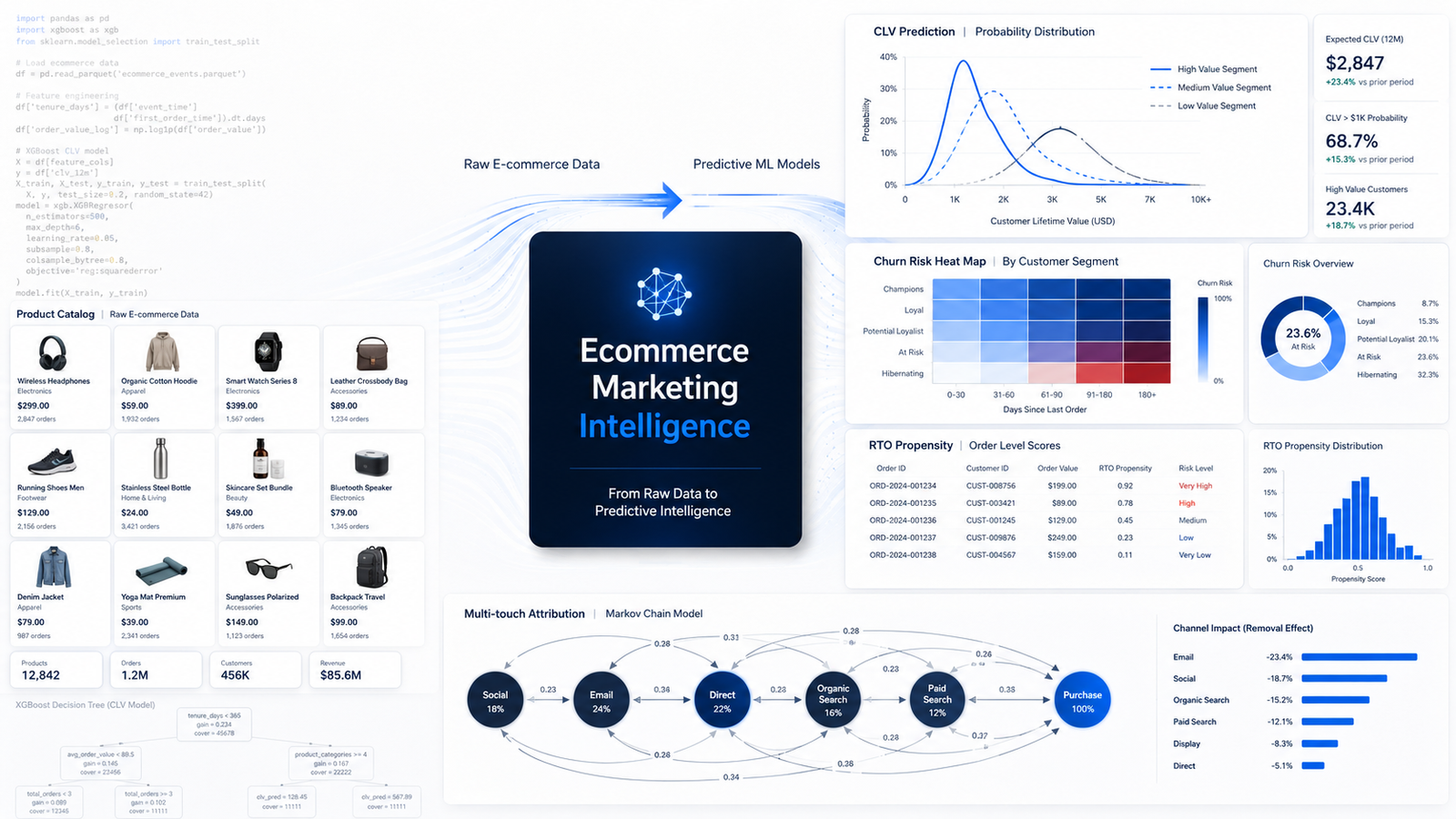
Why the standard ecommerce playbook leaks margin
Standard ecommerce practice has not fundamentally changed in a decade: acquire through paid channels, recover carts with discount sequences, retain through email flows, win back with blanket campaigns, A/B test conversion rate, report ROAS, repeat.
Every component has a mathematical problem that standard practice either ignores or cannot detect.
Discount automation destroys margin systematically
Retention campaigns target the wrong customers
Attribution models lie
Inventory and advertising are disconnected
RTO economics are unmodelled at order level
Markets served
Ecommerce behaviour differs sharply by market. COD dynamics, privacy regulation, CPC levels and logistics complexity all change what the modelling has to account for.
- Tier 1 English-speaking — United States, United Kingdom, Canada, Australia, Ireland. DTC brands, subscription ecommerce, marketplace sellers and omnichannel retailers in high-CPC environments where margin protection and LTV-based acquisition are survival requirements.
- Gulf & Middle East — United Arab Emirates, Saudi Arabia, Kuwait, Qatar, Bahrain. Rapidly growing markets with specific COD dynamics, cross-border logistics complexity and multilingual segmentation requirements.
- European markets — Germany, Netherlands, France, Sweden, Denmark. GDPR-compliant intelligence with privacy-safe attribution modelling and cross-border audience management.
- Asia-Pacific — Singapore, Malaysia, Hong Kong, New Zealand. Businesses scaling into English-speaking APAC markets with cross-timezone campaign management and regional behavioural modelling.
- South Asian markets — India, Pakistan, Bangladesh. COD-dominant markets with high RTO rates, price-sensitive segments and behavioural patterns that require market-specific modelling.
Nine ecommerce problems this practice solves
Real problems observed across 12+ years and 100+ client engagements — not hypothetical scenarios.
- Margin erosion from blanket discounting — Cart abandonment sequences, flash sale mechanics and loyalty discounts applied without understanding which customers genuinely need an incentive. Invisible on revenue dashboards, catastrophic to long-term profitability.
- High RTO rates in COD markets — Return rates averaging 25–45% in South Asian and Middle Eastern markets are the single largest driver of logistics cost. Individual-order prediction before dispatch turns this from an unavoidable cost into a manageable variable.
- Attribution confusion across channels — Meta claims credit, Google claims credit, TikTok claims credit. Budget decisions built on these numbers over-invest in the most aggressive attribution claimant rather than the most genuinely incremental channel.
- Creative fatigue acceleration — Paid social creative fatigues faster in ecommerce than almost any other vertical. Standard management replaces assets after fatigue is already visible — after CPMs have risen and conversion has fallen.
- Inventory-advertising misalignment — Spend continues toward products approaching stock-out while high-inventory, high-margin products stay under-funded, because historical conversion volume does not trigger a budget increase under standard optimisation logic.
- Acquisition without retention infrastructure — Acquisition is optimised while retention runs on generic email flows. Acquiring a customer costs 5–7× more than retaining one, so this builds a leaking bucket at significant expense.
- Seasonal demand forecasting failures — Inventory planning and budget allocation driven by last year’s pattern rather than mathematical forecasting — producing stock-outs at peak, excess inventory off-peak, and consistently mistimed spend.
- Flash sale data corruption — High-traffic promotional events generate cart manipulation, bot activity and behavioural anomalies that corrupt downstream ML models if the data enters training sets without real-time cleaning.
- Under-used behavioural data — Ecommerce platforms generate sequence-level behavioural data that standard analytics flattens into snapshots — losing exactly the signal that predicts lifetime value.
How ecommerce intelligence differs from ecommerce marketing
Placeholder — no video yet. Delete this box and drop in the Elementor Video widget when the recording is ready, or hide this whole section from Advanced → Responsive until then.
The Cognitive Marketing Engine applied to ecommerce
The four-loop framework powering this practice, applied with ecommerce-specific diagnostic logic, data sources and optimisation targets.
Ecommerce diagnostics
Ecommerce causal strategy
Ecommerce programmatic execution
Ecommerce continuous optimisation
AI agents in ecommerce: which decisions need a model
Marketing AI agents come in two architectures. Workflow agents — n8n, Make.com, Zapier — run a sequence defined in advance when a trigger fires. Autonomous agents decide their own next step from live data, which requires a model underneath. Two capability layers serve both: MCP for governed access to Shopify, BigQuery, the ads APIs and the CRM, and skills for packaged, repeatable expertise.
Ecommerce is where confusing the two gets expensive fastest, because the wrong choice shows up directly in margin.
| Decision | Architecture that fits | Why |
|---|---|---|
| RTO risk on a COD order | Autonomous — the model scores each order at placement from clickstream and checkout signals | A rule can flag orders over a value threshold; it cannot rank risk |
| Creative refresh timing | Autonomous — fatigue predicted at feature level per creative-audience pair | A rule can rotate on a schedule; it cannot see fatigue forming |
| Discount eligibility | Autonomous — uplift modelling identifies who is genuinely persuadable | A rule gives everyone the same code, which is the margin problem |
| Stock-out bid pause | Workflow — days-of-supply crosses a threshold, bids drop, buyer is alerted | Ideal for a rule; no model needed |
| Flash sale anomaly alerts | Workflow — velocity spike triggers a data-quality hold and a notification | Ideal for a rule, with autonomous cleaning behind it |
| Review and win-back triggers | Workflow — delivery confirmed, request fires on a defined delay | Ideal for a rule; targeting comes from the model |
What is deliberately not automated
- Discount policy itself. A model can identify who is persuadable; what the brand is willing to discount, and how often, is a commercial decision.
- Spend reallocation above the agreed threshold. A model can recommend it. A person signs it off.
- Customer service escalation. A high-RTO flag routes an order for review; it never cancels a customer’s order on its own.
- Product claims and brand voice. Generated at scale these become a compliance liability faster than they become a saving.
The full channel-by-channel breakdown sits in the AI agents section.
Ecommerce marketing intelligence solutions
The complete solution suite across six intelligence categories, mapped specifically to ecommerce application.
Predictive intelligence for ecommerce
- Ecommerce CLV prediction — BG/NBD + Gamma-Gamma. True future revenue value of every customer, enabling LTV-based acquisition bidding, retention prioritisation and discount eligibility modelling.
- Ecommerce churn prediction — LSTM sequence modelling. Identify customers mathematically at risk weeks before standard behavioural signals appear. Proactive micro-intervention instead of reactive win-back.
- Conversion rate prediction — XGBoost + behavioural signals. Predict which users will convert before they show explicit purchase intent, enabling proactive personalisation rather than post-hoc optimisation.
- Customer segmentation — DBSCAN + hierarchical clustering + RFM. Behavioural clusters derived from actual purchase sequences, not demographic assumptions. Segments that update as behaviour evolves.
- Sales forecasting — Temporal Fusion Transformer + Prophet. Demand forecasting accounting for seasonality, promotional effects and behavioural patterns, integrated with inventory planning.
- Recommendation systems — Neural collaborative filtering + hybrid content. Individual-level product recommendation at scale, based on behavioural history and mathematically similar customers.
- Uplift modelling — CausalML two-model + X-learner. Identify the genuinely persuadable segment and target discount spend only where intervention creates incremental value.
- RTO prediction — XGBoost on clickstream + checkout signals. Individual order return probability before dispatch, enabling proactive intervention on high-risk COD orders.
- Dropout estimation — BG/NBD P(Alive) distribution. Distinguish genuinely churned customers from those in normal inter-purchase variation, so win-back targeting is precise rather than recency-based.
- Flash sale intelligence — Sequential Isolation Forests + velocity analysis. Real-time detection of cart manipulation, bot hoarding and promotion gaming, protecting genuine customer access and data integrity.
Organic growth intelligence for ecommerce
- Ecommerce SEO intelligence — SBERT + embedding centroid tracking. Search intent vector drift detection across category pages, brand content and editorial assets, catching semantic misalignment before rankings decline.
- Search intent analytics — Agglomerative hierarchical clustering. Topical cannibalisation detection across category pages and content assets, identifying where organic authority is split between competing pages.
- Crawl optimisation — Random Forest on server log data. Crawl budget modelling for large URL footprints, particularly filtered product pages, pagination and dynamically generated category URLs.
- Content intelligence — Graph theory + eigenvector centrality. Authority leakage mapping across internal link architecture, showing where equity flows to low-value pages instead of priority categories.
Paid search intelligence for ecommerce
- pCLV bidding — BG/NBD + Smart Bidding API. LTV-weighted conversion values fed into Google Ads Smart Bidding, teaching the algorithm to optimise for long-term value rather than immediate cost.
- PMax deconstruction — Unsupervised clustering on placement logs. Performance Max transparency restoration, extracting placement-level data the dashboard hides.
- Paid search portfolio — Markowitz frontier + Bayesian optimisation. Mathematically optimal distribution across Shopping, Search, PMax and Display, accounting for diminishing returns curves.
- Bot fraud filtering — Isolation Forests on clickstream velocity. Invalid click and conversion detection, removing fraudulent traffic from the signals Smart Bidding optimises against.
Media buying intelligence for ecommerce
- Creative intelligence — CLIP + ResNet computer vision. Creative fatigue predicted at feature level for each creative-audience combination, enabling proactive refresh scheduling.
- Meta Ads intelligence — Jaccard distance vectors + graph analysis. Audience overlap and self-competition mapping across ad sets, quantifying CPM inflation from self-bidding.
- TikTok Ads intelligence — Thompson sampling + multi-armed bandit. Creative testing budget reallocated toward winning variants as statistical evidence accumulates, not after a fixed test period.
- Social signal engineering — Bayesian probabilistic CAPI matching. Post-iOS14 signal quality restoration, recovering attribution and optimisation signal beyond standard CAPI implementation.
- Attribution latency modelling — Time-to-conversion hazard functions. Capturing revenue that falls outside platform default attribution windows for longer consideration cycles.
Content marketing intelligence for ecommerce
- Content attribution — Markov chain pathing + Shapley value. Fractional conversion credit across every content touchpoint, moving beyond last-click to causal contribution.
- Content intelligence — UMAP + HDBSCAN density clustering. Topical saturation mapping across category content and editorial assets, showing over-saturation and genuine demand gaps simultaneously.
- Content decay detection — LDA + temporal drift analysis. Linguistic and topical drift detection, catching pages drifting from current search intent before rankings reflect it.
- Micro-engagement dropout — Survival analysis on BigQuery data. Reader dropout modelling on editorial content, identifying the structural points where attention is lost.
Omnichannel data intelligence for ecommerce
- Attribution intelligence — Shapley value + Markov removal effect. Platform-agnostic cross-channel attribution, replacing self-reported credit with defensible fractional attribution.
- Cross-channel intelligence — Bayesian Marketing Mix Modeling. Privacy-safe macro budget allocation independent of individual-level tracking that is progressively degrading.
- Cross-device intelligence — DBSCAN entity resolution + graph neural networks. Connecting mobile discovery, desktop research and purchase completion into coherent customer profiles.
- Incremental lift — Synthetic controls + CausalML + matched markets. True incremental lift validation — genuine marketing-caused revenue versus demand that would have converted anyway.
- Ad fraud detection — Isolation Forests + velocity analysis. Programmatic fraud detection across display and native, quantifying waste and removing fraudulent signals from optimisation data.
Ecommerce technology stack
The platform and tool infrastructure applied to ecommerce engagements. Selected per engagement, never applied as a checklist.
- Ecommerce platforms — Shopify, Shopify Plus, WooCommerce, Magento/Adobe Commerce, BigCommerce, PrestaShop, custom headless (Next.js + Shopify)
- Email & retention automation — Klaviyo, Omnisend, Drip, ActiveCampaign, Postscript, Attentive
- Analytics & attribution — Triple Whale, Northbeam, Rockerbox, Google Analytics 4, Google BigQuery, Mixpanel
- Subscription & loyalty — ReCharge, Bold Commerce, LoyaltyLion, Yotpo, Gorgias
- Paid media — Google Shopping, Performance Max, Meta Advantage+, TikTok Shopping, Snapchat Dynamic Ads, Pinterest Shopping, Amazon Ads
- Data & ML infrastructure — Python, Pandas, XGBoost, PyTorch, TensorFlow, Scikit-learn, Prophet, dbt, Apache Airflow, Google BigQuery
Ecommerce client results
Outcomes from live engagements. They are shown because they are real, not because they are promised — every account starts from a different data position.
UK natural products brand
Fashion brand, Pakistan
International DTC clients
Ideal client profile
This engagement model is built for a specific kind of ecommerce business. Saying so plainly saves both sides months.
- Brands generating $300,000+ annual revenue, where margin optimisation, retention economics and LTV-based decisions directly affect profitability, not just top-line revenue
- DTC brands in competitive categories where acquisition costs are rising and long-term profitability depends on retention and lifetime value rather than continuously scaling spend
- Businesses in COD-dominant markets where RTO is a primary driver of logistics cost, requiring individual-order prediction and intervention
- High-SKU retailers where inventory management, seasonal forecasting and inventory-constrained advertising create real optimisation opportunity
- International businesses requiring privacy-safe attribution, cross-device identity resolution and incrementality validation under strict data privacy regimes
The honest answers to ecommerce client questions
We already have Klaviyo and Meta campaigns running. Why do we need this?
Klaviyo and Meta campaigns are execution infrastructure. This is the decision-making layer above them — which customers to target, with what offer, at what discount level, through which channel, at what bid, with what creative, based on mathematical evidence rather than best-practice templates. The execution infrastructure is not the problem; what informs it is.
Our ecommerce ROAS is above target. Why would we need this?
Above-target ROAS on platform-reported numbers is evidence that the measurement system is reporting favourable numbers, which every platform’s attribution model is engineered to do. The question it cannot answer is what share of those conversions would have happened without the spend. Only incremental lift measurement answers that, and it frequently shows optimal investment is below current spend on certain channels.
We are a growing brand — is this too advanced for our stage?
The underlying problems — margin erosion from undifferentiated discounting, weak retention economics, attribution confusion, RTO waste — exist at every stage. Addressing them earlier builds a stronger unit economic foundation. Businesses that wait until they are “big enough” usually find the habits built during growth are the hardest to change later.
What makes this different from hiring a performance marketing agency?
An agency manages campaigns inside platform interfaces, using platform-provided data and platform-approved methods. This operates on raw transactional and behavioural data extracted from APIs, applies ML and causal inference models no standard agency workflow includes, and produces recommendations backed by evidence of cause and effect rather than correlation between activity and reported conversions.
Can AI agents handle our ecommerce marketing on their own?
Partly, and the split matters. Workflow agents built on n8n, Make.com or Zapier handle stock-out alerts, review triggers and flash-sale monitoring well. Discount eligibility, RTO risk scoring and creative fatigue need autonomous agents with a model underneath. Discount policy, threshold approvals and brand claims stay with a person — those are commercial decisions, not optimisation problems.
Do you work with Pakistani ecommerce brands or only international ones?
Both. South Asian COD markets are explicitly part of the practice, and RTO prediction exists precisely because of them. The qualifier is data volume rather than geography: modelling needs enough transaction history to be statistically meaningful, and where it is not, that gets said directly.

Usman Saeed
AI-Driven Digital Marketing Intelligence Consultant & Growth Engineer in Pakistan. Usman Saeed specializes in engineering resilient digital growth architectures — helping enterprise brands eliminate tracking data drops, secure conversion signals, and maximize profitability through E-commerce Engineering, server-side Signal Engineering, and Predictive Intelligence. With 12+ years of experience and advanced data science expertise, marketing guesswork is replaced with mathematical precision — automated systems that bridge execution with business intelligence, ensuring your investment delivers measurable scale.
Where to go next
The ecommerce engagement starts with your raw data, not your dashboard
The first conversation is about Shopify exports, BigQuery access and attribution gaps. If your data cannot support the modelling, you will be told that directly.