
Predictive Intelligence Solutions: Marketing Decisions Backed by Probability
Predictive Intelligence is the application of supervised learning, deep learning, probabilistic models and causal inference to marketing decisions — so that what to bid, whom to retain and where to allocate budget are answered with a probability rather than a pattern from last month. It does not eliminate uncertainty. It reduces it mathematically, to the point where a decision can be defended.
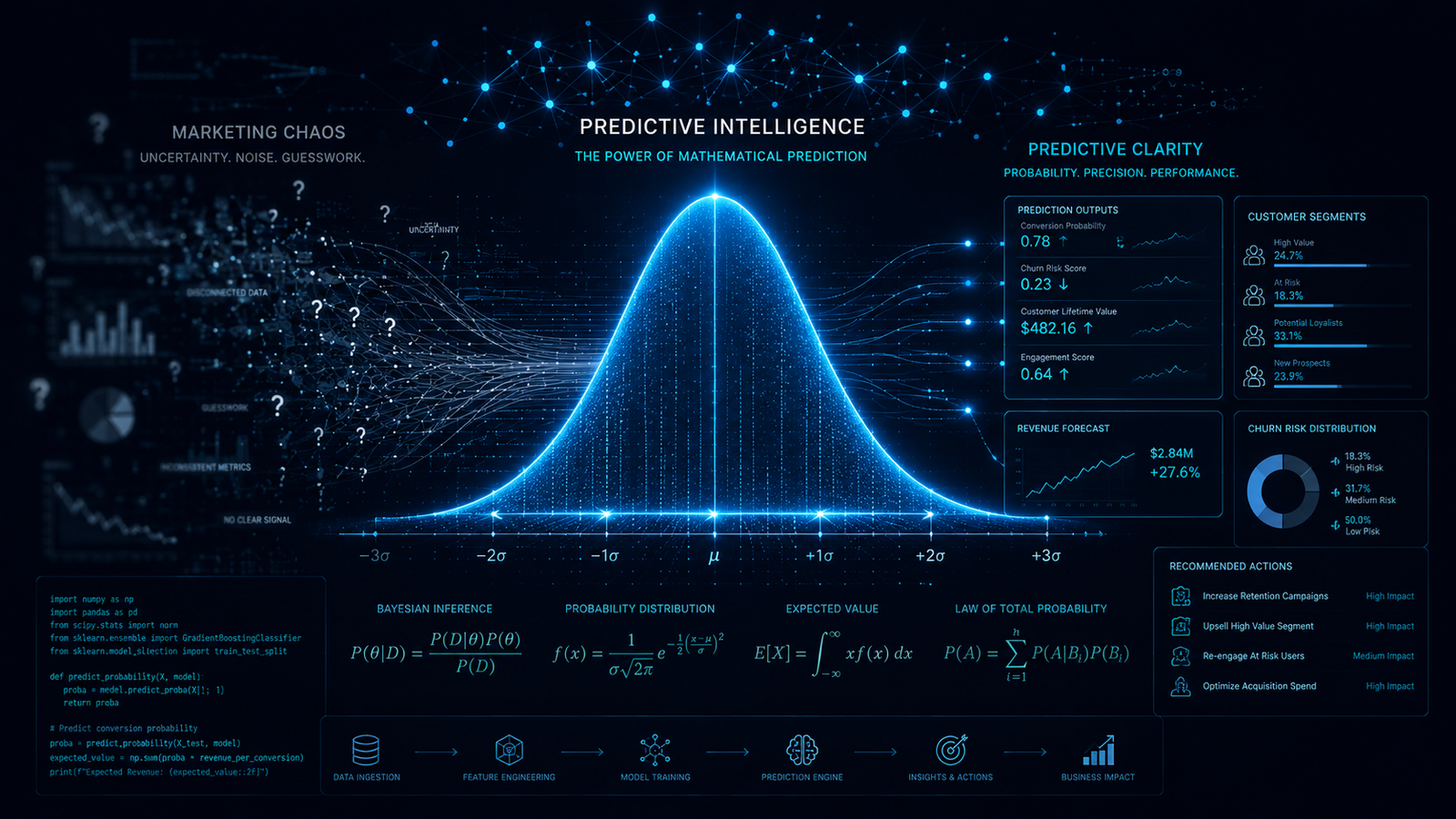
Reactive Marketing Is Expensive Pattern-Matching With a Delay
Most businesses run marketing using the rear-view mirror: last month’s traffic, conversions, churn and revenue decide next month’s plan. The problem is not that the numbers are wrong. It is that by the time they appear, the decision they should have informed has already been made and paid for.
- By the time churn appears in a retention report, the customers have already gone
- By the time lifetime value drops, the wrong customers have already been acquired at full cost
- By the time conversion rates decline, budget has already been spent on traffic that was never going to buy
- By the time campaign returns fall, the creative has already fatigued past recovery
Reactive marketing does not just waste money — it wastes it confidently, because the dashboard always has a number on it, and a number always feels like evidence. Moving from reactive to predictive is not a tooling upgrade. It changes where in the sequence the decision gets made.
What Predictive Intelligence Actually Means Here
Not AI tools. Not dashboards with “predictive” in the marketing copy. Not machine learning mentioned in a pitch deck. In this practice it means four specific families of method, used together — and the combination is what separates it from the “AI-powered” label applied to every SaaS product in the last three years.
Supervised learning
Deep learning
Probabilistic models
Causal inference
What Happens When the Results Disappoint
Data science does not control market outcomes. It reverse-engineers them. That distinction is the most important thing on this page, and it is the thing most practitioners will not say out loud. If a model is deployed correctly and performance still underperforms, the value of the model is not diminished — that is precisely the moment it becomes visible.
“The market was difficult.” “The algorithm changed.” “Competition increased.”
No mathematical evidence. No causal proof. An explanation that cannot be checked, which is another way of saying an excuse.
Show why. Was it a pricing problem? A server issue suppressing conversion? A demand shift no marketing intervention could have overcome? The data separates these, and each one implies a different action.
In a boardroom, an investor meeting or a budget review, a proven reason is worth more than an optimistic guess.
This is not a consolation prize, and it is worth being precise about what is being claimed. No specific outcome is promised — marketing results depend on product, pricing, market conditions and competition, most of which sit outside any marketing system. What the mathematics can supply is a defensible diagnosis either way, which is what protects a marketing budget from being cut for reasons that were never marketing in the first place.
Why AI Prompts Cannot Replace a Data Pipeline
People reasonably ask why this work cannot be done with prompts in ChatGPT or Claude. The answer is architectural, not a comment on how capable those models are. A large language model generates statistically probable text from what it was trained on. That is a genuinely powerful thing, and it is a different category of thing from an infrastructure that processes your data.
- Extract raw server logs and run anomaly detection across tens of thousands of clickstream rows
- Pull Search Console API data and compute embedding centroids across it
- Fit BG/NBD probabilistic models on a live transaction database
- Deploy gradient boosting classifiers trained on your own behavioural signals
- Run uplift models against experimental holdout data
A prompt is an instruction. A pipeline is infrastructure that runs on a schedule, against live data, with monitoring and validation attached to it.
Marketers talk about data. Growth engineers build the systems that process it. Confusing the two is exactly what keeps most businesses operating at reactive speed while their data sits unused.
Language models genuinely are part of the toolkit — they sit inside agent architectures that operate these pipelines, which is covered further down this page. The point is about where they fit, not whether they are useful.
The Predictive Intelligence Solution Suite
Seven solutions have their own dedicated build pages, grouped by the business question they answer. Each page covers the models used, how accuracy is proven, what data is required, and where the outputs are activated.
Customer retention and lifecycle
Churn Prediction
Customer Lifetime Value Prediction
Conversion and revenue prediction
Conversion Rate Prediction
Sales Forecasting
Customer understanding
Customer Segmentation
Recommendation Systems
Budget and channel intelligence
Marketing Mix Modeling
Further Capabilities That Do Not Have Their Own Page
These are applied inside engagements rather than sold separately, and they are listed here because they are frequently the highest-margin work in a project. Several are specific to markets and business models that generic predictive tooling ignores entirely.
Order return (RTO) propensity
Uplift and persuadability modelling
Margin-optimised discount modelling
Anomaly and fraud detection
Causal inference and incrementality
Demand-constrained ad spend
Also applied within engagements: non-contractual latent dropout estimation using BG/NBD survival probability, predictive budget allocation using portfolio optimisation methods borrowed from finance, and manipulation detection during high-stakes promotional windows. Which of these apply is determined by what the data audit finds, not by what reads well on a solutions page.
Who Predictive Intelligence Is Built For
This is not built for local small businesses, and saying so early saves everyone time. It fits organisations where the mathematical value of prediction translates directly into measurable revenue — which usually means meaningful data volume and a decision expensive enough to be worth modelling.
High-revenue e-commerce
Growth-stage and venture-backed SaaS
B2B lead generation
Performance marketing agencies
Enterprise marketing teams
International operators
How an Engagement Actually Begins
Every engagement starts with a data architecture audit — a 14 to 21 business day diagnostic that assesses your current data infrastructure, identifies which of the solutions above are genuinely applicable to your situation, and establishes the mathematical baseline against which everything afterwards is measured.
What it examines
What data you actually hold and where it lives, how reliably identity resolves across systems, whether transaction history is deep enough to model, and where signal is being lost between your site, your store and your ad platforms.
What it produces
A ranked shortlist of applicable solutions with the reasoning attached, a baseline measurement to judge later work against, and a clear statement of what your data cannot currently support.
What it will not do
Recommend every solution on this page. The right solution is determined by what your data shows, and a common outcome is that two or three apply and the rest do not — including engagements where the honest finding is that the infrastructure work has to come before any modelling.
Where AI Agents Fit Into Predictive Intelligence
A SaaS tool is someone else’s generic model. An AI agent is your own model, run autonomously. Cognitive Intelligence decides what to build; agents are how it keeps running. This is where language models genuinely belong in the stack — operating pipelines, not replacing them. Two architectures apply, chosen by one test: can the correct next action be written down in advance?
Built on ML and data science. The agent decides its next step from live data — refitting models when a cohort drifts, flagging when predicted and realised outcomes diverge, escalating an anomaly that does not match any known pattern. Used where the right action cannot be specified ahead of time.
n8n, Make.com, Zapier. An event fires a defined sequence: scheduled model refresh, score write-back to the warehouse, batch push to ad platforms, alert when a job fails or a credential expires. This covers most day-to-day operation of a live pipeline.
Model Context Protocol lets an agent query BigQuery, Search Console, ad platform APIs and your CRM directly, rather than working from output somebody pasted in. Context, not architecture — and the practical answer to why a prompt is not a pipeline.
So every run meets the same standard: the same validation gates before a refitted model ships scores, the same outlier rules, the same reporting format. Skills are what stop an autonomous system from being differently wrong each week.
What Stays With a Person
The part nobody else writes. These are not automation gaps waiting to close — they are judgement calls that should not sit with a system nobody can hold responsible.
- Deciding a model has stopped describing the business. An agent will keep shipping predictions long after a product line, price point or market has changed underneath them.
- Choosing which outcome to optimise. Highest predicted revenue is not always the right target once margin, returns and support cost are counted. That is a business decision, not a modelling one.
- Owning the privacy position. Which data is collected, on what legal basis, with what consent. Engineering can implement a position; it cannot choose one.
- Calling it off. If a model cannot beat a naive baseline, someone has to say so and stop the spend. No autonomous system reaches that conclusion about itself.
Channel-level agent work — SEO agents, media buying agents, PPC agents, content marketing agents — is documented separately. The AI agents hub is the current starting point.
The Questions Serious Clients Actually Ask
Who actually buys this? It looks very advanced.
Not a local small business, and that is worth saying plainly. The right client is a funded e-commerce brand, a growth-stage SaaS company, a performance marketing agency or an enterprise marketing team, where the value of prediction converts into measurable revenue impact. Those clients exist in Pakistan, the UK, the USA, the UAE and elsewhere. Most are currently either paying enterprise prices for partial solutions or running with no predictive infrastructure at all.
What guarantee is there that results will come?
None, and no honest practitioner offers one. Marketing outcomes are shaped by product quality, pricing, market conditions and competitive dynamics — most of which sit outside any marketing system. What is committed to is mathematical rigour, complete data transparency, and a framework that will tell you exactly why an outcome occurred, with evidence, whether or not it met expectations. In a field where most vendors supply excuses, a proven diagnosis is a rare deliverable.
Why can't ChatGPT or Claude do this with prompts?
Because it is a different category of thing. A language model generates statistically probable text from training data. It does not extract raw server logs, run anomaly detection across clickstream data, fit BG/NBD models on a live transaction database, or deploy classifiers connected to ad platform APIs on a schedule. A prompt is an instruction; a pipeline is infrastructure. Language models do have a real role here — inside agent architectures that operate those pipelines, which is a different job from replacing them.
This is very different from traditional digital marketing. Will our team follow it?
Deliverables are written for two audiences at once: the technical team that needs the methodology, and the executive team that needs the business implication. Probability scores are translated into revenue projections, anomaly detections into cost estimates, and causal outputs into evidence a board can act on. If a deliverable only makes sense to one of those two audiences, it has not been finished.
Does Predictive Intelligence still help if the market is down?
This is the most important question on the list, and the answer is yes — in the way that matters most. When conditions prevent a positive outcome, the modelling shows that marketing was not the cause. Delivered with statistical confidence to a board or investor, that evidence protects a marketing budget from being cut for reasons that were never marketing in the first place. That is often worth more than any single campaign result.
Which solution should we start with?
That is what the data audit determines. Starting from a solutions page rather than from your data is how organisations end up with a sophisticated model answering a question nobody was going to act on. A common outcome is that two or three of the solutions listed apply and the rest do not — and occasionally that infrastructure work has to come before any modelling is worth doing.
Do you work with businesses outside Pakistan?
Yes. Delivery is remote from Lahore, with clients across Pakistan, the United Kingdom, the United States and the UAE. The work needs access to your data and your marketing platforms rather than a shared time zone. Working hours overlap comfortably with the Gulf and the UK, and partially with US mornings.

AI-Driven Digital Marketing Intelligence Consultant & Growth Engineer in Pakistan. Usman Saeed specializes in engineering resilient digital growth architectures — helping enterprise brands eliminate tracking data drops, secure conversion signals, and maximize profitability through E-commerce Engineering, server-side Signal Engineering, and Predictive Intelligence. With 12+ years of experience and advanced data science expertise, marketing guesswork is replaced with mathematical precision — automated systems that bridge execution with business intelligence, ensuring your investment delivers measurable scale.
Where to Go Next
Customer LTV Prediction
Marketing Mix Modeling
My Framework
All Solutions
Start Where the Data Says to Start
A data architecture audit assesses what you actually hold, which of these solutions your situation genuinely supports, and what the baseline is — including the case where the answer is that infrastructure work comes first.