
Engagement Process: How I Work With Clients, Step by Step
Most marketing engagements start with a discovery call, a proposal deck and a retainer invoice. This one starts with your raw data.
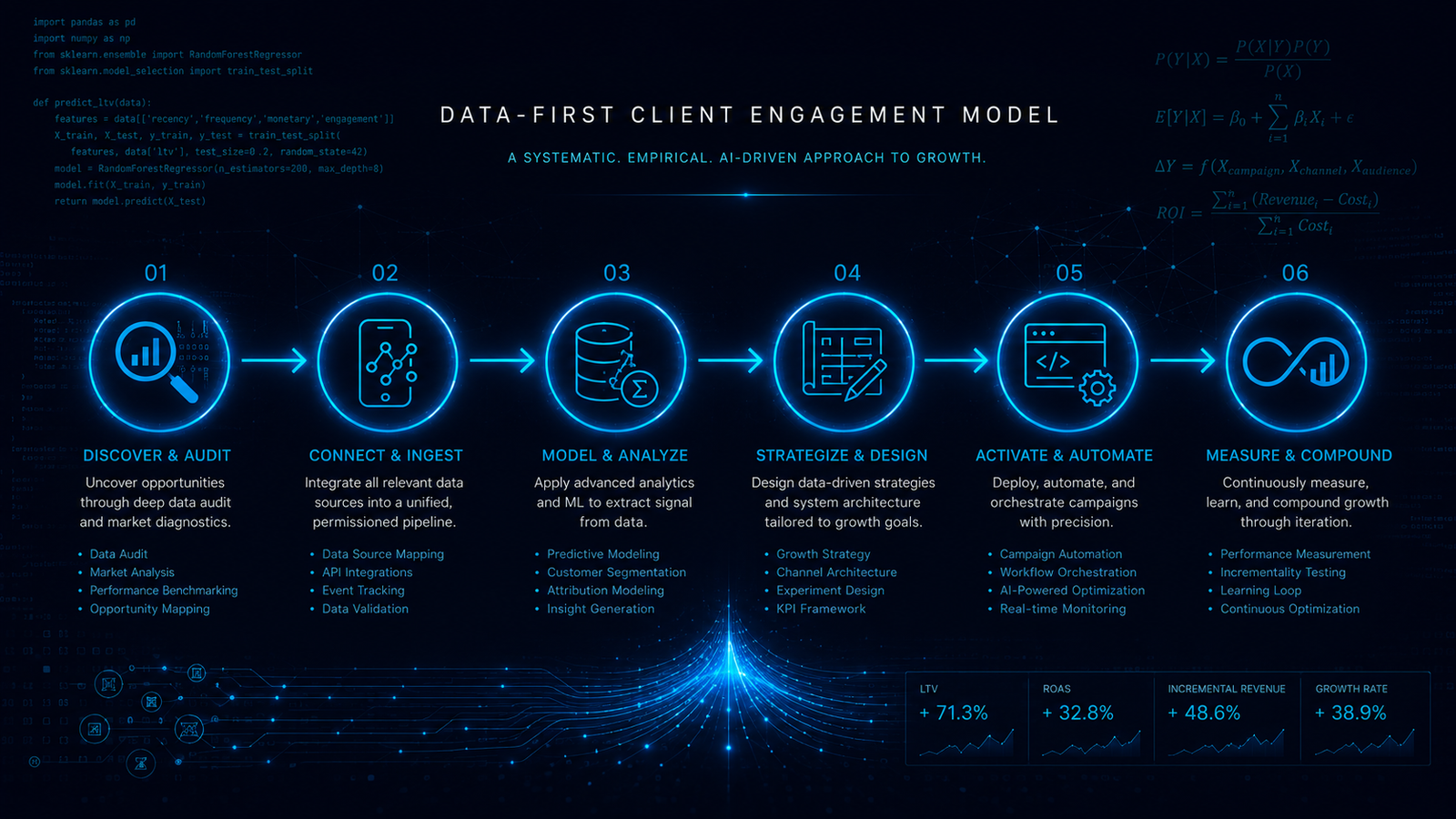
Every step is built on the same principle that drives the Cognitive Marketing Engine — diagnose empirically before prescribing strategically, and never execute without mathematical validation.
Client qualification: not every business is the right fit
This practice works with clients who understand that intelligence-led marketing requires data access, strategic patience and genuine commitment — not just a budget and an expectation of overnight results. Saying this plainly up front saves both sides months.
Ideal clients
- High-scale ecommerce brands with measurable transaction data
- Venture-backed or growth-stage B2B SaaS companies
- Enterprise lead generation businesses in Tier 1 markets
- International businesses in the UK, USA, UAE and beyond requiring full attribution accountability
- Pakistani businesses serious about data-driven growth rather than vanity metrics
Immediately disqualified
- Businesses wanting overnight results without strategic investment
- Clients unwilling to provide raw data access — BigQuery, Search Console API, transaction logs
- Businesses looking for execution only, with zero strategic input
- Anyone expecting cookie-cutter packages and vanity metric reports
First contact and initial qualification
Every inquiry receives a personal response — not an automated sequence — within 24 to 48 hours. Contact comes through the form on this website, direct email or WhatsApp.
A brief written intake follows, covering business type, current marketing situation, primary problem, data infrastructure available and approximate monthly marketing investment.
This intake is not bureaucracy. It is the first data point. How a client answers these questions says more about fit than any discovery call. If the intake signals a genuine fit, we move to Step 2.
The data architecture discovery call
This is not a creative brainstorm. It is a diagnostic session. The call is structured around one objective: understanding the current state of the client’s data infrastructure and identifying the gaps costing them money right now.
What is covered
- Current analytics setup — GA4, BigQuery, raw data access
- Ad platform data — Google Ads API logs, Meta Graph API history
- Transaction data infrastructure — Shopify, SQL databases, CRM exports
- The current attribution model in use, and why it is likely wrong
- Surface-level performance anomalies, and what the raw data might reveal underneath
No creative ideas are discussed in this call. No campaign suggestions are made. No pricing is discussed. The only output is a clear understanding of whether the data architecture audit can be run, and what it will require.
The data architecture audit
Timeline: 14 to 21 business days
This is the foundational diagnostic — Loop 1 of the Cognitive Marketing Engine applied to the client’s actual data. No strategy is built without it.
What the client must provide
- Complete raw access to Google Analytics BigQuery exports
- Historical transaction database logs (SQL or Shopify APIs)
- Google Search Console API credentials
- Historical ad spend platform log files — Google Ads, Meta and any other active channels
What happens during the audit
- Raw data extraction from all provided sources, bypassing processed dashboards entirely
- Unsupervised ML pipelines (Isolation Forests) to identify statistical anomalies invisible to standard tools
- SBERT semantic embedding analysis detecting search intent vector drift in organic content
- Bot-fraud and invalid traffic detection, identifying budget bleeding before any optimisation decision
- Attribution distortion analysis, mapping where platform-reported numbers diverge from true incremental lift
What the first 30 days actually look like
Placeholder — no video yet. Delete this box and drop in the Elementor Video widget when the recording is ready, or hide this whole section from Advanced → Responsive until then.
Causal strategy and portfolio architecture delivery
Timeline: 7 to 10 business days after audit completion
Based entirely on the Empirical Diagnostic Report, a full strategic blueprint is built using Loop 2 methodology.
What this includes
- Bayesian Media Mix Modeling output — mathematically optimal budget distribution across all active channels, privacy-safe and independent of platform attribution
- Markowitz Efficient Frontier ad portfolio — risk-adjusted allocation that maximises ROI while protecting against channel concentration risk
- Content vector realignment plan for organic channels where semantic drift has been identified
- Audience segmentation model built on behavioural data signals, not demographic assumptions
- Predictive lead scoring framework — an XGBoost propensity model configured for the client’s specific conversion patterns
Delivery format: a structured strategy document plus a 90-minute walkthrough call, ensuring the client understands not just what the strategy recommends but why the data supports every recommendation. Client sign-off is required before execution begins.
Programmatic execution deployment
Begins after strategy approval
Execution is not done manually. Custom Python pipelines are deployed, connected directly to the Google Ads API and Meta Graph API, with automated guardrails that respond to real-time data signals.
What this means for the client
- No waiting for someone to log in and manually adjust bids
- Automated responses to inventory levels, sentiment velocity shifts and real-time conversion signals
- Programmatic creative rotation based on predicted fatigue, not reactive replacement after performance drops
- Continuous data ingestion from all active channels into the central optimisation engine
The client’s role during execution is active collaboration, not passive waiting. Clients provide timely access to updated data sources, flag business changes that affect campaign context, and participate in monthly strategy reviews. This is not a set-and-forget engagement — intelligence-led marketing requires intelligence from both sides.
Reporting, optimisation and continuous ML retraining
The monthly cycle is where the compounding actually happens.
The monthly cycle
- Reporting built around true incremental lift — not platform-reported ROAS or last-click attribution. Every report connects activity to revenue, pipeline value, acquisition cost and lifetime value trajectories
- Optimisation running programmatically in real time, with major strategic reviews monthly as new data signals and market changes arrive
- ML model retraining every 30 days on fresh transaction and behavioural data, addressing concept drift so predictions stay accurate as the market evolves
- Review calls monthly, covering model performance, market shifts, upcoming adjustments and client business updates that affect the optimisation architecture
No vanity metrics. No green arrows next to numbers that do not move the business.
Where AI agents fit into this process
Agents are why a six-step process with a 14-to-21-day audit does not require a large team. Two architectures do the work — autonomous agents where the correct action cannot be defined in advance, and workflow agents built on n8n, Make.com or Zapier where it can. Two capability layers support both: MCP gives them governed access to real data, and skills package the method so every run meets the same standard.
| Step | Handled by agents | Stays human |
|---|---|---|
| Step 1 — First contact | Workflow agent routes and logs the intake; MCP writes it to the CRM | Reading the answers and judging fit |
| Step 2 — Discovery call | Workflow agent pulls a pre-call data inventory from connected accounts | The call itself, and what the gaps mean |
| Step 3 — The audit | Autonomous agents run anomaly detection, drift analysis and fraud screening at scale | Deciding which anomalies actually matter |
| Step 4 — Strategy | Autonomous agents produce allocation and scoring model outputs; skills keep the method identical every run | The strategic recommendation, and the trade-offs behind it |
| Step 5 — Execution | Workflow agents fire guardrails, bid shifts, alerts and escalations through the platform APIs | Approving reallocation above the agreed threshold |
| Step 6 — Optimisation | Autonomous retraining on a 30-day cycle; skills run the same evaluation checks each time | Interpreting what changed in the market, and why |
The boundary, stated plainly
- No agent decides what your real problem is. Diagnosis sets the direction of everything downstream; an agent optimises within a frame it cannot question.
- No agent approves spend reallocation above the agreed threshold. A model can recommend it. A person signs it off.
- No agent operates where the outcome cannot be measured. Without a reliable feedback signal, an agent confidently optimises toward the wrong thing.
- No agent writes claims about your brand. Generated at scale, these become a legal and reputational liability faster than they become a saving.
How these architectures apply channel by channel sits in the AI agents section, and the underlying stack is listed under tools & tech.
Engagement structure
The commercial terms are stated openly rather than kept for a proposal call.
Minimum commitment: 6 months
Custom pricing
No guarantees on results
The one thing that makes this process different
Every agency will tell you their process is thorough. Most of them mean they have a good onboarding form and a well-designed proposal template.
This process is different because it starts with raw data rather than assumptions, and every subsequent decision is mathematically validated against that data.
The audit takes 14 to 21 days because real data takes time to process correctly. The strategy takes another week because mathematical modelling cannot be rushed. The execution is automated because manual human intervention at scale introduces error.
This is not slow. This is the difference between a strategy built on evidence and one built on a 30-minute call and a pre-made slide deck.
Questions about working together
How long before we see results?
The first month is diagnostic and the second is strategic, so meaningful performance movement typically begins in month three. That is why the minimum commitment is six months. Anyone promising results inside 30 days is either running tactics that were never diagnosed, or reporting metrics that do not move the business.
Why is raw data access required before anything starts?
Because processed dashboards show what already happened, not why. Anomaly detection, semantic drift analysis, fraud screening and true incremental lift all require event-level data — BigQuery exports, Search Console API, transaction logs, ad platform logs. Without that access the audit cannot run, and without the audit no strategy is defensible.
What if I only want execution, not strategy?
Then this is not the right engagement, and that will be said directly at the intake stage rather than after an invoice. Execution deployed on an undiagnosed account scales whatever error is already there. There are capable execution-only providers; this practice is not one of them.
Is this different from hiring an AI digital marketing expert in Pakistan on a monthly retainer?
The commercial shape is similar — a monthly engagement with a minimum term. What differs is the order of work: the first three to four weeks produce a diagnostic report rather than campaign activity, and no strategy is presented until the data supports it. Local clients are priced in PKR with the same scope documentation as international engagements.
Who owns the accounts, models and data?
The client. Ad accounts, Search Console, tag manager and analytics stay in the client’s name throughout and afterwards. Nothing is held hostage if the engagement ends.
What is expected from the client each month?
Timely access to updated data sources, early notice of business changes that affect campaign context — stock issues, pricing changes, launches — and participation in the monthly strategy review. The models are only as current as the information they are given.

Usman Saeed
AI-Driven Digital Marketing Intelligence Consultant & Growth Engineer in Pakistan. Usman Saeed specializes in engineering resilient digital growth architectures — helping enterprise brands eliminate tracking data drops, secure conversion signals, and maximize profitability through E-commerce Engineering, server-side Signal Engineering, and Predictive Intelligence. With 12+ years of experience and advanced data science expertise, marketing guesswork is replaced with mathematical precision — automated systems that bridge execution with business intelligence, ensuring your investment delivers measurable scale.
Where to go next
Ready to begin?
Every inquiry gets a personal response within 24 to 48 hours. If your data cannot support the modelling, you will be told that directly — before anything is invoiced.