
Paid Media Management SaaS vs Cognitive Intelligence
Managing hundreds of ad groups, thousands of keywords and dozens of audiences across platforms while maintaining optimisation discipline is operationally impossible without automation. Optmyzr, WordStream, Madgicx, Revealbot, AdEspresso and Adalysis provide that infrastructure, and the operational value is real.
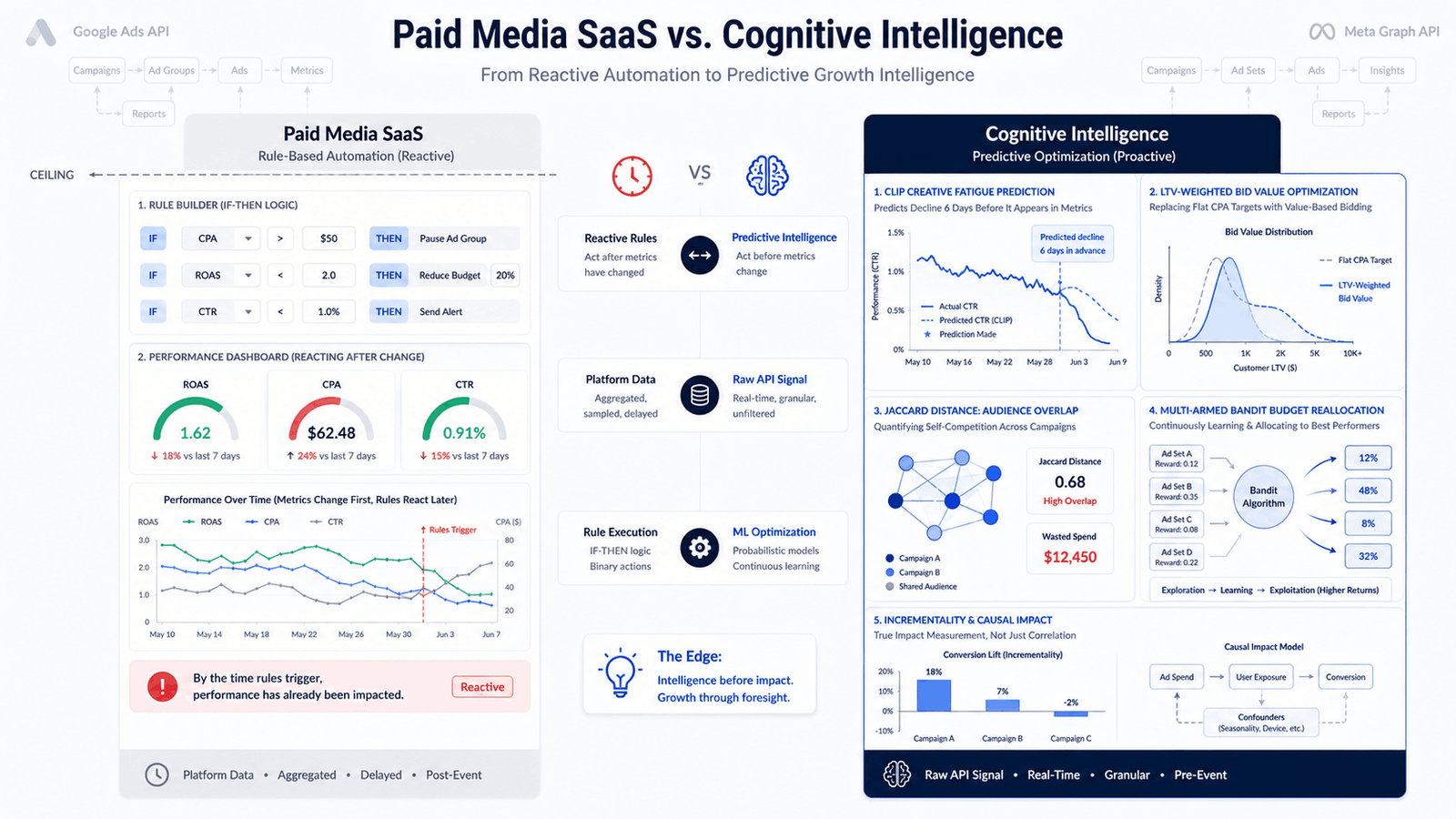
So is the ceiling. Rules execute predefined instructions written by humans from historical intuition and industry benchmarks. They respond to observed metrics — not to the causes behind them, not to the predicted trajectory, and not to the signals that precede dashboard-visible change.
What are paid media management tools?
Campaign management, optimisation and reporting platforms built to reduce the manual effort of operating paid search and paid social at scale. Core capabilities are automated rule execution, bulk editing, performance alerting, A/B testing management and reporting.
The more sophisticated platforms add ML-influenced recommendations layered on top of platform-native Smart Bidding. The simpler ones focus on workflow efficiency without analytical sophistication beyond the native interface.
What they are: campaign management and automation tools that reduce manual effort. What they are not: raw data intelligence systems, causal inference platforms, or predictive optimisation engines operating independently of platform-reported metrics.
Five tiers of paid media tooling
This category has quietly split into five distinct groups. Most comparisons cover tier 1 and miss that the platforms themselves have absorbed much of what tier 1 used to sell.
PPC management and automation
- Optmyzr
- Adalysis
- Revealbot
- WordStream
- AdEspresso
- Shape
- Opteo
Rule engines, bulk editing and alerting beyond native platform capability. The operational backbone for most agencies.
Enterprise ad management
- Skai (Kenshoo)
- Marin Software
- Smartly.io
- Adobe Advertising Cloud
- MediaOcean
Cross-channel buying at enterprise scale with proprietary bidding layers. Smartly.io in particular does genuine creative automation at volume — routinely absent from SMB-focused comparisons.
Creative-led paid social
- Madgicx
- Motion
- Foreplay
- AdRoll
- Pencil
Built around creative testing and analysis rather than bid management. Motion is the closest commercial tool to creative-level performance analytics, and is missing from most comparisons in this space.
Feed and shopping management
- Channable
- DataFeedWatch
- Feedonomics
- Productsup
- Shoptimised
For ecommerce, feed quality frequently drives more Shopping performance than bid management does — and this tier is almost never included in paid media tool comparisons.
Native platform automation — free
- Google Ads Scripts (free)
- Google Ads automated rules (free)
- Meta automated rules (free)
- Google Ads API (free)
- Google Ads Editor (free)
Google Ads Scripts does a large share of what tier 1 charges for, in JavaScript, for free. Worth knowing before subscribing — especially for single-account advertisers.
Honest analysis of the leading platforms
Each assessment covers genuine strengths and where the architecture stops.
Optmyzr
What it doesAdvanced paid search management with rule-based automation, ML-assisted recommendations, Quality Score tooling and bid management for Google and Microsoft Ads.
Who uses itPPC agencies and in-house teams managing large, complex search accounts.
Genuine strengthsRule engine supports genuinely more complex conditional logic than native automated rules. Quality Score workflows are structured and useful. Strong reporting customisation for agency client work. Reasonable one-click optimisations for standard tasks.
Where the ceiling isOperates on platform-reported data — the same data in the native interface. Its ML recommendations inherit the same attribution limits, bot contamination and reporting biases. It cannot reach log-level API data to identify which signals genuinely drive conversion versus which are coincidentally correlated.
Madgicx
What it doesAI-powered Meta and Google optimisation combining autonomous creative testing, audience management and budget allocation driven by ML performance predictions.
Who uses itDTC brands and performance agencies running significant Meta and Google budgets.
Genuine strengthsCreative testing workflows are more systematic than manual approaches. Autonomous budget reallocation across campaigns. Audience insights connecting creative performance to segment characteristics. Solid ecommerce reporting.
Where the ceiling isIts “AI” runs on platform-reported metrics — the same ROAS, CPA and CTR visible natively. It cannot detect creative fatigue before metrics move (needs CLIP-based vision analysis), model true incremental lift (needs synthetic controls), or restore iOS-degraded signal (needs Bayesian CAPI matching). Sophisticated rule-based automation informed by platform ML — not independent modelling.
Revealbot
What it doesAutomated rules and reporting for Meta and Google with a flexible rule builder supporting complex conditional logic across accounts.
Who uses itPerformance agencies and teams needing custom automation across multiple accounts.
Genuine strengthsThe most flexible rule builder in the tier — conditional logic across multiple metrics simultaneously. Cross-account rule templates keep automation strategy consistent. Slack integration for real-time alerts. Reasonable creative testing workflows.
Where the ceiling isRules execute on conditions; they do not model why conditions occur or predict when they will. A rule pausing an ad at ROAS 2.0 fires after the decline, after the budget was spent, after the chance to preemptively reallocate has passed.
WordStream
What it doesAdvertising management with workflow tools, performance grading, keyword research and recommendations across Google, Microsoft and Facebook Ads.
Who uses itSMBs and small agencies needing structure without dedicated PPC expertise.
Genuine strengthsGenuinely accessible for non-specialists — the structured weekly workflow lowers the expertise barrier for standard accounts. Performance grading gives external benchmark context. Reasonable keyword and negative keyword management.
Where the ceiling isBuilt for operational simplicity: recommendations apply standard best practice rather than account-specific modelling. For accounts with non-standard funnels or specific business logic, generic advice systematically misses the opportunities that need account-specific analysis. Meta capability is notably weaker than Google.
AdEspresso
What it doesMeta Ads management and optimisation with simplified campaign creation, A/B testing at scale and automated rules.
Who uses itSMBs and teams running Meta Ads without deep platform expertise.
Genuine strengthsSimplified creation workflow genuinely reduces Ads Manager complexity. Systematic A/B testing across multiple variables. Accessible reporting for basic monitoring.
Where the ceiling isIts A/B testing applies fixed budget allocation across all variants for the full test duration — including variants that are statistically losing from early data. Multi-armed bandit testing with Thompson sampling reallocates toward winners as evidence accumulates, wasting far less budget on losing variants.
Adalysis
What it doesGoogle Ads management focused on systematic ad copy testing, Quality Score monitoring and account structure auditing.
Who uses itGoogle Ads specialists and agencies managing large search accounts.
Genuine strengthsSystematic ad testing framework enables consistent, statistically informed copy experimentation at scale. Quality Score monitoring workflows. Account structure auditing catches standard structural issues reliably.
Where the ceiling isTesting uses standard significance testing rather than bandit methodology, so test budget is allocated less efficiently. And its bid layer runs on platform-reported conversions — it cannot feed LTV-weighted values into Smart Bidding through the Conversion Import API, which is what teaches the algorithm to optimise for long-term value.
Also assessed: Skai, Marin Software, Smartly.io, Adobe Advertising Cloud, MediaOcean, Shape, Opteo, Motion, Foreplay, Pencil, AdRoll, Channable, DataFeedWatch, Feedonomics and Productsup. Smartly.io and Motion go furthest on creative — and still analyse performance after delivery rather than predicting fatigue from creative features beforehand.
Why a rule fires after the money is already spent
Placeholder — no video yet. Delete this box and drop in the Elementor Video widget when the recording is ready, or hide this whole section from Advanced → Responsive until then.
Rule-based automation cannot predict
Every tool in this category implements if-then logic triggering actions when predefined conditions are met. Rules respond to metrics after those metrics have already changed.
A rule pausing a campaign at CPA above $50 activates after CPA has already exceeded $50 — after the excess spend occurred.
A rule increasing budget at ROAS above 5.0 activates after ROAS has already reached 5.0, potentially after the performance peak has passed.
Automation makes reaction faster. It does not make it earlier.
Predicts the performance trajectory — which campaigns are approaching a CPA breach before it occurs, which creatives are approaching fatigue before decline, which reallocation opportunities exist based on forecast curves rather than observed history.
The action happens while it can still change the outcome.
Platform-reported data carries systematic bias
Every tool optimises on platform-reported metrics drawn from the native interface or API. Those metrics carry biases that propagate directly into every optimisation decision built on them.
Attribution bias — platform models overcredit some touchpoints, so optimisation favours the most aggressively attributed channel rather than the most incremental one.
Bot contamination — invalid traffic inflates CTR and corrupts conversion data, so algorithms favour the placements generating the most fraud.
iOS signal loss — incomplete conversion information produces suboptimal delivery decisions the dashboard reports as successful.
Extracts raw API log-level impression, click and conversion data, bypassing platform aggregations entirely.
Independent ML modelling then identifies the actual performance signals underneath the reported metrics — including the fraud and attribution distortion the dashboard presents as performance.
No LTV integration into bidding
Every tool optimises bids on immediate conversion metrics — cost per purchase, cost per lead, ROAS on immediate transaction value. None integrate predicted lifetime value into bidding strategy.
A customer acquired at $45 CPA generating $850 LTV over 24 months is far more valuable than one acquired at $18 CPA generating $120 LTV.
Optimising for immediate conversion cost systematically under-bids for the first and over-bids for the second — and reports the result as efficiency.
Integrates BG/NBD and Gamma-Gamma predicted LTV directly into Smart Bidding via the Conversion Import API.
The platform’s own algorithm then optimises toward long-term customer value rather than immediate transaction cost — using Google’s delivery power pointed at the right target.
Creative fatigue detected too late
Every tool monitors creative metrics — CTR, conversion rate, frequency — and alerts on threshold breach. By then the creative has been fatiguing for days or weeks.
Budget wasted on declining performance. CPM inflation from audience fatigue. Conversion data degradation feeding back into Smart Bidding.
All of it occurring in the window between actual fatigue onset and threshold-triggered alert — and compounding across every campaign simultaneously.
Applies CLIP and ResNet computer vision analysis to extract feature-level representations of creative assets.
Fatigue is predicted from visual feature characteristics and historical decay patterns — before any metric deterioration is visible in a dashboard.
No causal incrementality validation
These tools optimise for the metrics you define — ROAS, CPA, conversion volume. None validate whether those conversions are genuinely incremental.
Without causal validation, optimisation may direct significant budget toward branded search, retargeting and bottom-of-funnel campaigns that predominantly capture organic demand rather than generating it.
Those campaigns look outstanding by ROAS. They are the most efficient way to pay for revenue you were going to receive anyway.
Applies synthetic control methodology and CausalML — designing and executing holdout experiments that measure true incremental lift.
The output identifies which campaign types and audience segments generate genuine new demand versus which intercept existing demand.
Audience overlap creates self-competition
These tools manage individual campaigns and ad sets. They do not model the competitive relationship between ad sets in the same account targeting overlapping audiences.
When multiple ad sets target overlapping audiences, they enter the same auction against each other — driving up their own CPMs and fragmenting their own delivery.
Cost inflates without reach increasing. Most tools have no mechanism for detecting this, let alone quantifying what it costs.
Applies Jaccard distance vector analysis, modelling the mathematical overlap between all active audience definitions simultaneously.
The output quantifies the CPM inflation attributable to self-competition and prescribes the specific consolidation decisions that reduce it most efficiently.
Paid media SaaS vs Cognitive Intelligence
Automation makes execution faster. Intelligence makes the decision earlier and better informed.
| Dimension | Paid media SaaS | Cognitive Intelligence |
|---|---|---|
| Optimisation logic | ×Rule-based automation | ✓ML-powered predictive optimisation |
| Timing | ×Responds to observed metrics | ✓Predicts performance trajectory |
| Data source | ×Platform-reported metrics | ✓Raw API log-level data |
| Bidding target | ×Immediate conversion cost | ✓BG/NBD LTV-weighted values |
| Creative fatigue | ×Detected after decline | ✓CLIP feature-level prediction |
| Incrementality | ×Not validated | ✓Synthetic controls and CausalML |
| Audience overlap | ×Not modelled | ✓Jaccard distance self-competition |
| Testing method | ×Fixed-allocation A/B testing | ✓Multi-armed bandit, Thompson sampling |
| Bot and fraud | ×Accepted in the data | ✓Isolation Forest filtering |
| Attribution bias | ×Accepted as accurate | ✓Identified and corrected |
| Deployment | ×Platform rule engine | ✓Custom Python API pipelines |
| Alerting | ×Threshold breach | ✓Predictive anomaly detection |
| Commercial model | ×$49–$5,000+ subscription | ✓Custom engagement investment |
When paid media SaaS is the right choice, and when it is not
Below a certain spend level, rule automation is not just adequate — it is the correct investment.
Paid media SaaS is genuinely the right choice when
- Operational efficiency is the primary need — reducing manual management time through rules and bulk editing
- Account structure is conventional, where standard automation rules apply reliably
- Budget is modest enough that the optimisation delta does not justify custom ML infrastructure
- The team lacks paid media expertise, and structured workflows improve on unguided management
- Google Ads Scripts already covers it — worth checking before subscribing, especially for single accounts
Cognitive Intelligence becomes necessary when
- Monthly spend exceeds $20,000, where the optimisation gap produces meaningful budget efficiency
- Platform attribution is producing misleading signals — bot contamination, iOS degradation, attribution bias
- LTV varies widely across segments, so LTV-weighted bidding would materially shift acquisition strategy
- Creative declines faster than management cycles can respond
- Incrementality proof is required for a CFO or board
- Audience self-competition is suspected — overlapping ad sets inflating CPMs without adding reach
Where AI agents fit in paid media
This category has an unusually direct relationship with the agent question, because every tool on this page already is a workflow agent — a rule engine firing defined sequences on triggers, in a purpose-built interface.
That is why the distinction matters so much here. Buying a better rule engine does not add prediction. Autonomous agents supply what no rule can — fatigue prediction, LTV-weighted values, overlap modelling. MCP gives either governed access to the ad APIs and warehouse; skills keep every run to the same standard.
| Task | Architecture that fits | Why |
|---|---|---|
| Predicting creative fatigue | Autonomous — CLIP feature analysis models decay before metrics move | A rule watches CTR, which is the symptom appearing days late |
| Setting bid values from LTV | Autonomous — predicted LTV pushed into Smart Bidding via Conversion Import | A rule uses the conversion value the platform recorded, which is the problem |
| Detecting audience self-competition | Autonomous — Jaccard overlap modelled across all live ad sets | A rule cannot compute overlap it was never told to look for |
| Pausing on a CPA breach | Workflow — threshold crossed, campaign paused, owner notified | Ideal for a rule — this is exactly what tier 1 does well |
| Bulk applying negatives | Workflow with MCP — search term report pulled, negatives pushed via API | Ideal for a rule; the classification of what to negate can come from a model |
| Launching a new creative | Workflow with human approval — staged, reviewed, then published | The upload is mechanical; approving brand-facing creative is not |
What stays with a person
- Approving spend reallocation above the agreed threshold. A model recommends. A person signs it off.
- Creative and claims going live under your brand. Generated at volume this becomes a compliance liability faster than a saving.
- Deciding what the campaign is actually for. An agent optimises the objective it is given; whether that objective serves the business is a judgement.
- Acting on a counterintuitive incrementality result. When the holdout says your best-reported campaign is not incremental, that needs validation before budgets move.
The full breakdown sits in the AI agents section.
Questions about paid media tools
Do I still need Optmyzr or Revealbot if I work this way?
Usually yes, and most engagements keep them. They remain the right tool for bulk editing, cross-account rule consistency and alerting — genuine operational work that custom modelling does not replace. What changes is what informs the rules: thresholds derived from models rather than from benchmarks and intuition.
Can Google Ads Scripts replace a paid media SaaS subscription?
For a single account, frequently yes. Scripts runs JavaScript directly against your account on a schedule and can do a large share of what tier 1 charges for — custom alerts, bulk changes, reporting, anomaly checks. Where paid tools genuinely earn their cost is multi-account management, shared rule templates and a UI a team can operate without a developer.
Our ROAS looks strong. Why would we need incrementality testing?
Because strong ROAS is exactly what demand capture looks like. Branded search and retargeting report excellent returns while largely intercepting customers who would have converted anyway. The only way to distinguish that from genuine demand generation is measuring what happens when the spend is removed — which no optimisation platform performs.
How does LTV-weighted bidding actually work in Google Ads?
Predicted lifetime value is calculated externally — BG/NBD for purchase probability, Gamma-Gamma for monetary value — then written back as the conversion value through the Conversion Import API. Smart Bidding then optimises toward that value instead of immediate order value. You are not replacing Google’s algorithm; you are pointing it at a better target.
Is creative fatigue prediction genuinely possible before metrics move?
To a useful degree, yes. CLIP and ResNet extract feature-level representations of a creative — composition, colour, subject, text density — and those features have measurable historical decay patterns within an account. It is a probability estimate rather than a certainty, but it arrives days before CTR deterioration is visible, which is where the value is.
Does this apply to Pakistani accounts with smaller budgets?
The $20,000 monthly figure is guidance, not a gate — the real question is whether the optimisation gap exceeds the cost of closing it. Below that, native automation plus Google Ads Scripts is usually the honest recommendation, and it gets given directly. Bot fraud filtering is the one exception that frequently pays for itself at lower spend in this region.

Usman Saeed
AI-Driven Digital Marketing Intelligence Consultant & Growth Engineer in Pakistan. Usman Saeed specializes in engineering resilient digital growth architectures — helping enterprise brands eliminate tracking data drops, secure conversion signals, and maximize profitability through E-commerce Engineering, server-side Signal Engineering, and Predictive Intelligence. With 12+ years of experience and advanced data science expertise, marketing guesswork is replaced with mathematical precision — automated systems that bridge execution with business intelligence, ensuring your investment delivers measurable scale.
Where to go next
Paid media intelligence starts with raw API data, not dashboard metrics
The audit examines log-level data, attribution distortion and where budget is funding demand you already had. If rule automation genuinely fits your spend level, you will be told that directly.