
Real Estate Marketing Intelligence: Lead Quality Over Lead Volume
Real estate digital marketing has an economics problem that most practitioners treat as a targeting problem. The issue is not reaching enough people — agencies, developers, portals and brokers typically generate significant lead volume. The issue is that the overwhelming majority of those leads have no genuine near-term intent.
The cost is not just wasted sales time. It is the opportunity cost of the high-intent leads buried in the same CRM, not receiving the follow-up speed their intent warrants. Intelligence does not solve this by generating more leads. It solves it by distinguishing, at individual lead level, who will actually transact.
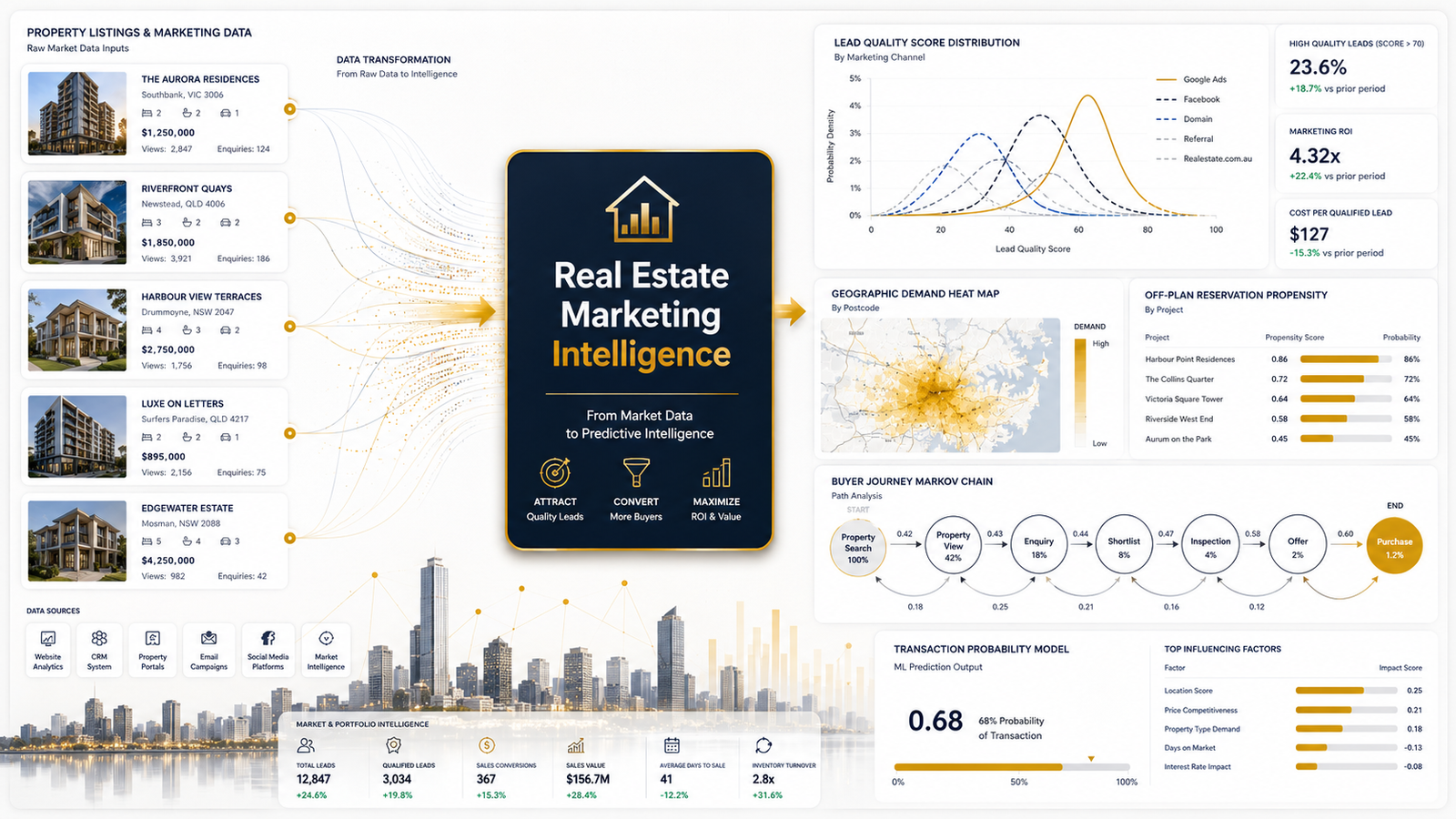
Why lead volume is the wrong metric
Four structural realities shape real estate marketing economics, and standard practice accounts for none of them.
- Intent is rare and unevenly distributed — Typically 3 to 12% of generated contacts have genuine near-term purchase or rental intent. The rest are browsers, researchers, speculators and passive observers whose details fill the CRM while sales teams spend time on conversations that will never close.
- Sales cycles outrun attribution windows — Purchase decisions average 3 to 18 months from first digital touchpoint to transaction. Platform default windows — 7-day click on Meta, 30-day on Google — capture a small fraction of the touchpoints that actually contributed.
- Transaction values make precision extraordinarily valuable — With individual commissions running into thousands, a modest improvement in lead prioritisation produces returns that would be marginal in almost any other vertical.
- Demand is geographic and seasonal at the same time — Budget is usually allocated by historical sales volume and agent territory rather than forecast demand, concentrating spend where demand is already saturated while emerging zones go under-funded.
Markets served
Buyer behaviour, portal dominance and regulatory context differ sharply by market, and each changes what the modelling has to account for.
- Tier 1 English-speaking — United States, United Kingdom, Canada, Australia, Ireland. Residential agencies, commercial firms, luxury developers, PropTech companies and mortgage brokers in high-value markets where transaction values make lead quality optimisation extraordinarily high-return.
- Gulf & Middle East — United Arab Emirates, Saudi Arabia, Kuwait, Qatar, Bahrain. Among the world’s most active investment markets, with significant international buyer segments, off-plan development sales and luxury marketing requiring culturally adapted frameworks.
- European markets — Germany, Netherlands, Portugal, Spain. Businesses navigating GDPR compliance in property data handling while competing for both domestic and international buyer audiences.
- Asia-Pacific — Singapore, Malaysia, Hong Kong, Australia. High-value urban markets with significant cross-border investment flows and multilingual buyer audiences requiring sophisticated segmentation.
Seven real estate problems this practice solves
Real problems observed across 12+ years of real estate engagements, from small agencies to major developers.
- Lead volume without lead quality — Significant contact volumes from Meta Lead Ads, Google Search and portal advertising, with sales teams working every lead with equal effort — wasting time on low-intent contacts while high-intent buyers receive identical follow-up to browsers who registered curiosity.
- Attribution across multi-month sales cycles — Standard attribution dramatically underestimates the contribution of brand awareness, content marketing and early-funnel touchpoints that started the buyer journey months before the visible conversion event.
- Geographic demand forecasting failure — Budgets allocated across postcodes, neighbourhoods and city zones by historical volume rather than forecast demand — concentrating spend in saturated areas while emerging zones receive insufficient investment before competition intensifies.
- Off-plan sales cycle complexity — Buyers commit six or seven figures based on renders, floor plans and location analysis. The signals predicting genuine intent differ fundamentally from resale, and the multi-year timeline from launch to completion creates attribution challenges standard tools cannot model.
- Portal dependency without independent attribution — Heavy reliance on Rightmove and Zoopla in the UK, Realtor.com and Zillow in the USA, Bayut and Property Finder in the UAE, alongside parallel paid media. Attribution across portal spend, paid media and organic is rarely modelled, making allocation effectively arbitrary.
- Luxury audience precision — The addressable market for a £5M London property or a $10M Dubai villa is measured in thousands, not millions. Demographic and interest targeting generates enormous wasted reach against audiences mathematically incapable of transacting at the target price point.
- Seasonal demand mismanagement — Spring and autumn peaks in Western markets, Ramadan and post-summer patterns in the Gulf, school-calendar cycles for family property. Budgets distributed evenly across the year under-invest during high-intent seasons and waste spend during low-intent periods.
Why lead scoring changes real estate economics
Placeholder — no video yet. Delete this box and drop in the Elementor Video widget when the recording is ready, or hide this whole section from Advanced → Responsive until then.
The Cognitive Marketing Engine applied to real estate
The four-loop framework powering this practice, applied with real estate-specific diagnostic logic, data sources and optimisation targets.
Real estate diagnostics
Real estate causal strategy
Real estate programmatic execution
Real estate continuous optimisation
AI agents in real estate: speed where it matters, judgement where it counts
Marketing AI agents come in two architectures. Workflow agents — n8n, Make.com, Zapier — run a sequence defined in advance when a trigger fires. Autonomous agents decide their own next step from live data, which requires a model underneath. Two capability layers serve both: MCP for governed access to the CRM, portals, analytics and ad platforms, and skills for packaged, repeatable expertise.
Real estate is unusually well suited to this split, because response speed and lead prioritisation are two different problems that most agencies solve with the same tool.
| Decision | Architecture that fits | Why |
|---|---|---|
| Lead prioritisation | Autonomous — the model scores each lead on behavioural signals and routes by predicted intent | A rule can route by source or budget field; it cannot rank genuine intent |
| Geographic budget shifts | Autonomous — demand forecasts drive allocation across submarkets | A rule follows last year’s split, which is the problem being solved |
| Off-plan reservation timing | Autonomous — engagement sequence modelling identifies peak intent moments | A rule fires on a fixed delay and usually misses the moment |
| Instant lead response | Workflow — enquiry received, acknowledgement and routing fire within seconds | Ideal for a rule, and speed alone materially improves contact rates |
| Viewing reminders and follow-up | Workflow — appointment booked, sequence fires on a defined schedule | Ideal for a rule; who gets priority comes from the model |
| Portal enquiry consolidation | Workflow with MCP — enquiries pulled from portals into the CRM with source preserved | Ideal for a rule; the attribution modelling happens afterwards |
What is deliberately not automated
- Property valuation advice and pricing guidance. These carry professional and in many markets regulatory weight; a model can inform them, a qualified person gives them.
- Disqualifying a lead entirely. Low scores change priority and routing, never access — a model that is wrong about one buyer costs a full transaction.
- Spend reallocation above the agreed threshold. A model can recommend it. A person signs it off.
- Property claims and listing descriptions. Generated at scale these create misrepresentation exposure faster than they create efficiency.
The full channel-by-channel breakdown sits in the AI agents section.
Real estate marketing intelligence solutions
The solution suite across six intelligence categories, mapped specifically to real estate vertical dynamics.
Predictive intelligence for real estate
- Real estate lead scoring — XGBoost + gradient boosting on behavioural signals. Individual lead conversion probability from listing engagement, saved listings, virtual tour completions, floor plan downloads, mortgage calculator use and enquiry patterns — prioritising sales attention toward high-intent leads while routing the rest to automated nurture.
- Real estate CLV prediction — BG/NBD + referral network modelling. Buyer, seller and landlord lifetime value accounting not just for commission but repeat transactions, portfolio relationships and referral value.
- Property demand forecasting — Temporal Fusion Transformer + geographic signals. Submarket-level demand forecasting from search volume trends, price appreciation, demographic shifts, planning approvals and infrastructure development — enabling proactive allocation toward emerging zones.
- Off-plan reservation propensity — Deep learning on engagement sequences. Which engagement patterns — render downloads, payment plan views, location analysis, developer track record research — most strongly predict reservation intent, enabling precisely timed outreach.
- Real estate churn prediction — LSTM on client behavioural data. Client disengagement prediction for property management, rental and advisory relationships, identifying switching risk before the decision is made.
- Real estate segmentation — DBSCAN + behavioural interest clustering. First-time buyer versus investor versus upsizer versus relocator segments derived from behavioural evidence rather than stated preferences that self-selection bias corrupts.
Organic growth intelligence for real estate
- Real estate SEO intelligence — SBERT + property search intent classification. Search intent vector drift detection across property guides, neighbourhood analysis and investment content, where Google’s understanding of buyer intent shifts as market conditions change.
- Real estate content intelligence — UMAP + HDBSCAN topic clustering. Topical saturation mapping across content libraries, identifying over-saturated topics and genuine demand gaps in target geographic markets and property categories.
- Authority leakage mapping — Graph theory + eigenvector centrality. Internal link optimisation for sites with large listing footprints, ensuring category pages and editorial receive appropriate equity rather than dilution across thousands of listing pages.
- Real estate AEO optimisation — Transformer-based answer engine optimisation. Structuring content to be selected as the authoritative answer in AI-generated property responses, as buyers increasingly research markets through AI before contacting agents.
Paid search intelligence for real estate
- Real estate Google Ads intelligence — Intent-based bidding + lead quality integration. Bids adjusted by predicted lead quality rather than raw conversion volume, preventing Smart Bidding from optimising toward high-volume, low-quality sources.
- Real estate PPC portfolio — Markowitz optimisation for property campaigns. Cross-campaign allocation across residential, commercial, luxury and rental, with geographic bid adjustment based on predicted demand curves per submarket.
- Real estate pCLV bidding — Client LTV + transaction value in Smart Bidding. Teaching the algorithm to optimise for long-term client value and average commission rather than cost per raw enquiry.
- Real estate bot fraud filtering — Isolation Forests on form submission patterns. Detecting fraudulent form submissions that inflate lead counts with zero genuine intent, and removing them from the conversion signals Smart Bidding optimises against.
Media buying intelligence for real estate
- Real estate paid social intelligence — Behavioural targeting + first-party audiences. Meta, Instagram and TikTok advertising built on actual property engagement signals rather than platform interest approximations.
- Real estate creative intelligence — CLIP + property visual performance analysis. Which photography styles, virtual tour formats, neighbourhood video and lifestyle imagery generate the highest engagement and lead quality among target segments.
- Attribution latency modelling — Time-to-transaction hazard functions. Attribution window extension across 3 to 18 month buyer journeys that fall entirely outside platform defaults.
- Luxury audience intelligence — Programmatic DSP custom audience modelling. Precision audience building using DSP targeting, behavioural wealth signal modelling and geographic concentration analysis, avoiding wasted reach on audiences incapable of transacting at the target price point.
Content marketing intelligence for real estate
- Real estate content attribution — Markov chain + Shapley value. Fractional attribution across multi-touchpoint journeys, showing which neighbourhood guides, market reports and investment analysis genuinely drive enquiry and transaction activity.
- Content decay detection — LDA + temporal semantic drift. Identifying neighbourhood guides, market reports and investment content that have drifted from current market conditions and buyer intent, before rankings reflect it.
- Micro-engagement dropout modelling — Survival analysis on listing behavioural data. Where potential buyers disengage from property information at specific structural points, enabling precise optimisation for enquiry conversion.
Omnichannel data intelligence for real estate
- Real estate attribution intelligence — Shapley value + Markov chain. Platform-agnostic attribution across portal spend, paid media, organic, social and direct — replacing arbitrary platform models with defensible fractional credit.
- Privacy-safe budget allocation — Bayesian Marketing Mix Modeling. Portal versus paid versus organic optimisation on aggregated time-series data, without relying on individual-level tracking that is increasingly restricted.
- Real estate incremental lift — Synthetic controls + matched geographic testing. Genuine marketing-caused enquiry and transaction activity versus market-driven demand that would have found the agency regardless.
- Cross-device intelligence — DBSCAN entity resolution + journey mapping. Connecting mobile property search, desktop floor plan analysis and tablet virtual tours from the same buyer into coherent journey profiles.
Real estate technology stack
The platform and tool infrastructure applied to these engagements. Selected per engagement, never applied as a checklist.
- CRM & lead management — Salesforce, HubSpot, Zoho CRM, REsimpli, Follow Up Boss, Propertybase, Buildout, custom real estate CRM integrations
- Portals & listing platforms — Rightmove API, Zoopla API, OnTheMarket, Realtor.com, Zillow, Trulia, Bayut, Property Finder, Lamudi, Zameen.com integration
- Analytics & attribution — Google Analytics 4, Google BigQuery, Looker Studio, custom real estate attribution dashboards
- Paid media — Google Ads real estate vertical, Meta Ads under property advertising rules, LinkedIn Ads for commercial property, TikTok property ads, YouTube property tours, programmatic DSP via The Trade Desk and DV360
- Virtual tour & listing technology — Matterport, EyeSpy360, virtual staging platforms, 3D floor plan tool APIs for engagement tracking
- Data & ML infrastructure — Python, XGBoost, PyTorch, Scikit-learn, Prophet, Google BigQuery, dbt, and geographic modelling libraries including GeoPandas and PostGIS
Ideal client profile
This engagement model is built for a specific kind of property business. Saying so plainly saves both sides months.
- Agencies and brokerages generating 200+ leads per month, where lead quality optimisation and sales team efficiency have direct, measurable revenue impact
- Property developers running off-plan or new development sales, where reservation modelling, demand forecasting and long-cycle attribution are business-critical
- Luxury real estate businesses where precision targeting, high transaction values and mathematically small addressable markets make standard advertising inefficient
- PropTech companies requiring intelligence across complex multi-stakeholder sales cycles
- International property businesses operating across Tier 1 markets under several simultaneous regulatory frameworks
The honest answers to real estate client questions
We generate a lot of leads already. Why do we need lead scoring?
Lead volume is not a success metric; lead quality is. In a CRM of 500 contacts where 8% have genuine near-term intent, what determines outcomes is whether that 8% receives the follow-up speed and quality their intent warrants. Lead scoring does not generate more leads — it ensures the right leads get the right attention at the right moment, which is where real estate conversion is actually won or lost.
Our paid media shows good cost-per-lead. Is attribution modelling still relevant?
Cost-per-lead measures the cost of acquiring contact information, not of producing genuine intent. A £15 Meta lead and a £45 Google Search lead can have dramatically different downstream conversion rates, making the apparently expensive lead the cheaper one per transaction. Attribution across the full journey, combined with quality scoring, produces cost-per-qualified-lead and cost-per-transaction — the only meaningful measures.
The market is seasonal and location-specific. Can a model account for that?
That is precisely what the geographic and seasonal demand models are built for. Temporal Fusion Transformer models incorporate seasonal decomposition, geographic cluster analysis and market-specific external signals, producing forecasts substantially more precise than the last-year-same-period extrapolation most businesses plan with.
Can you guarantee more property sales from this engagement?
No transaction volume guarantee is made. What is guaranteed is rigorous identification of the specific problems limiting current performance — lead quality distribution, attribution gaps, geographic budget misallocation, or off-plan engagement signal mismatch — with statistical evidence of magnitude before any intervention.
Can AI agents handle our lead follow-up automatically?
The instant acknowledgement and routing, yes — a workflow agent doing that within seconds materially improves contact rates. Deciding which leads deserve priority needs an autonomous agent with a scoring model behind it. Valuation advice, pricing guidance and listing claims stay with a person; those carry professional weight, not just performance weight.
Do you work with Pakistani property businesses as well as international ones?
Yes. Zameen.com integration sits in the stack for exactly that reason, and Gulf markets with large Pakistani investor segments are explicitly served. The qualifier is data volume rather than geography: lead scoring needs enough closed and disqualified outcomes in the CRM to train against, and where that history does not exist yet, that gets said directly.

Usman Saeed
AI-Driven Digital Marketing Intelligence Consultant & Growth Engineer in Pakistan. Usman Saeed specializes in engineering resilient digital growth architectures — helping enterprise brands eliminate tracking data drops, secure conversion signals, and maximize profitability through E-commerce Engineering, server-side Signal Engineering, and Predictive Intelligence. With 12+ years of experience and advanced data science expertise, marketing guesswork is replaced with mathematical precision — automated systems that bridge execution with business intelligence, ensuring your investment delivers measurable scale.
Where to go next
Ecommerce intelligence
The real estate engagement starts with your CRM, not your portal dashboard
The first conversation covers lead data, closed-transaction history and attribution gaps. If your CRM cannot support the modelling yet, you will be told that directly.