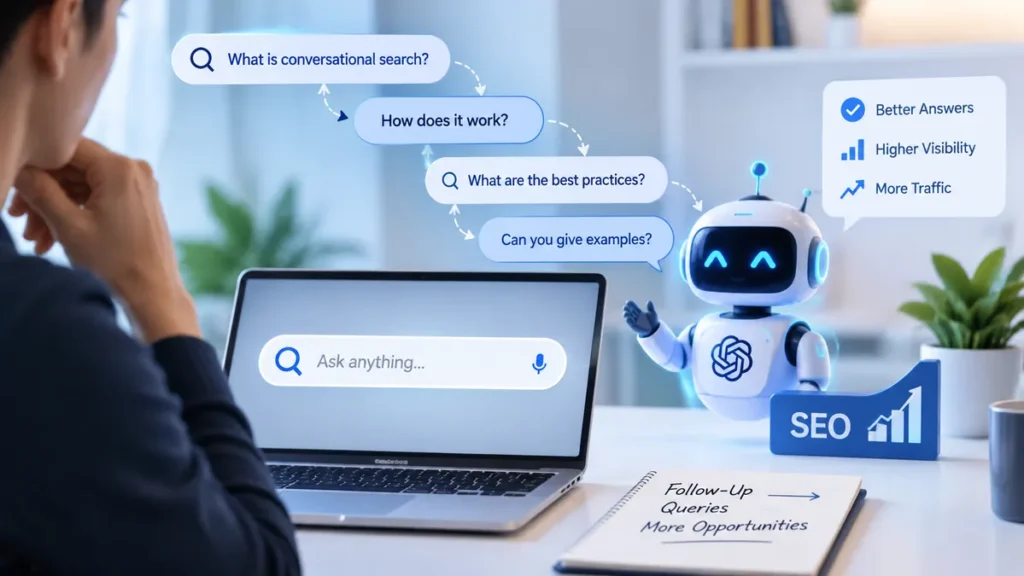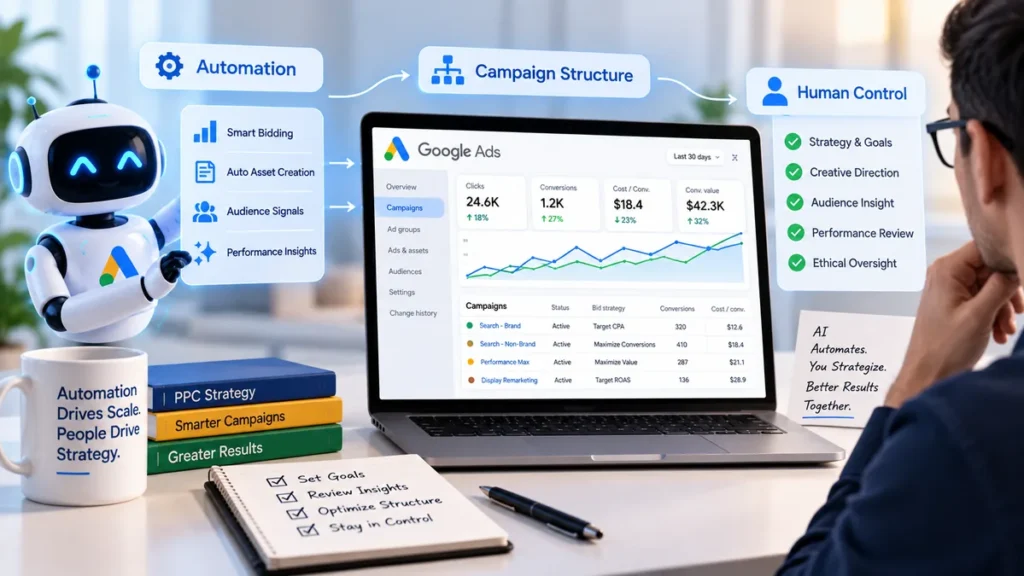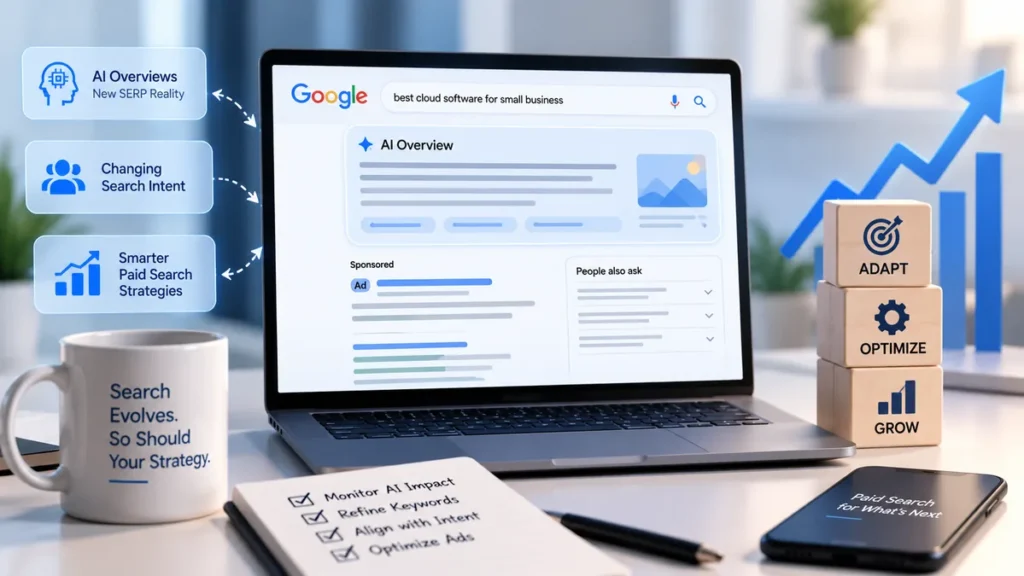
AI Overviews are changing how people discover, evaluate, and select information before they click a traditional search result. That shift creates a practical challenge for advertisers: how should paid search adapt to AI Overviews when the search journey itself is becoming more answer-driven?
The answer is not to treat every search query the same way.
A modern paid search strategy for AI Overviews should separate queries according to commercial intent, informational intent, and the role that search plays in creating demand. Some queries deserve aggressive paid-search defense. Some require coordination between SEO and PPC. Others may justify moving budget upstream into demand generation.
This means how AI Overviews affect paid search depends heavily on what the user is trying to accomplish.
A high-commercial-intent query such as a supplier shortlist, quote request, or product-specific search is fundamentally different from an informational query where an AI-generated answer may satisfy the user before a click happens.
The strategic framework is simple:
- Fight for high-value commercial searches.
- Influence informational and consideration-stage searches.
- Generate Demand when search volume is no longer capturing the full opportunity.
How Do AI Overviews Affect Paid Search?
The biggest change is not simply that AI Overviews can answer questions. The bigger change is that the search results page increasingly becomes part of the answer itself.
That changes the relationship between impressions, clicks, visibility, and conversions.
The AI Overviews impact on Google Ads should therefore be evaluated at the query and intent level rather than through aggregate account metrics alone.
For example, a decline in informational clicks does not automatically mean that the underlying market demand has disappeared. Users may still be researching a problem, but some of that research may now happen directly inside an AI-generated search answer.
This creates several important questions:
- Are users still searching for the commercial category?
- Is the brand appearing in AI-generated answers?
- Is the query commercially valuable enough to defend?
- Is paid advertising duplicating organic visibility?
- Would the same budget create more value earlier in the customer journey?
These questions form the foundation of AI-era PPC optimization.
How Should Advertisers Classify Search Queries in the AI Search Era?
The first step in how to classify search intent for PPC is to stop treating all search terms as equally valuable.
A practical framework divides queries into three strategic groups.
| Search behavior | Strategic role | Recommended response |
|---|---|---|
| High commercial intent | Conversion capture | Fight |
| Informational / consideration | Answer influence | Influence |
| Early-stage / weak immediate intent | Future demand | Generate Demand |
This framework makes search intent based bidding more useful than a simple bid-up/bid-down approach.
1. Fight: Capture Existing Commercial Demand
The Fight category contains high commercial intent search queries where the user is already close to taking a commercial action.
Examples include searches containing:
- buy
- quote
- supplier
- distributor
- pricing
- near me
- vendor comparison
- product-specific commercial terms
These searches represent bottom of funnel paid search activity.
When the economics work, the objective is not simply to obtain visibility. The objective is to defend access to demand that already exists.
2. Influence: Participate in the Answer
Informational and consideration searches require a different approach.
These informational search queries and AI Overviews can produce zero-click search behavior, where the user receives enough information from the search experience without visiting a website.
Instead of automatically increasing bids, advertisers should ask whether their brand is already visible through organic results and AI-generated answers.
This is where organic and paid search overlap becomes strategically important.
3. Generate Demand: Create Future Search Demand
Some users are not ready to buy.
If informational search traffic is becoming less efficient because users receive answers without clicking, increasing CPC is not necessarily the correct response.
The alternative is to invest in channels that create awareness before the next commercial search.
This is the role of AI search and demand generation.
When Should a PPC Campaign Fight for Top Position?
When should a PPC campaign fight for top position?
A campaign should consider defending top visibility when the query represents strong commercial intent and the resulting traffic produces qualified business outcomes.
For example, suppose a B2B buyer searches for a specific supplier category and is actively requesting quotations. Losing that impression may mean losing access to an existing commercial opportunity.
The decision should therefore consider:
- Search intent.
- Conversion quality.
- Revenue or pipeline value.
- Customer lifetime value.
- Incremental conversion probability.
- Competitive pressure.
- Cost of acquiring the customer.
This is more sophisticated than simply maximizing impression share.
A commercial keyword bidding strategy should focus on the economic value of the next qualified click rather than the vanity value of being visible everywhere.
How Can Advertisers Decide Which Commercial Keywords to Fight For?
The answer is to connect search-term analysis with actual business value.
A keyword may generate conversions while producing poor-quality customers. Another keyword may generate fewer conversions but substantially higher customer value.
That is why Google Ads customer lifetime value should influence bidding decisions where customer value varies significantly.
For example:
A search query should be considered strategically valuable when its downstream customer value justifies the cost of defending visibility.
This is where customer lifetime value bidding becomes important.
Instead of asking only, “Which keyword has the lowest CPA?”, advertisers can ask:
- Which queries generate high-value customers?
- Which queries generate qualified pipeline?
- Which queries produce repeat purchases?
- Which queries generate customers with higher retention?
- Which queries produce incremental revenue?
This approach improves paid search conversion quality rather than simply maximizing conversion volume.
How Do AI Overviews Affect Google Ads?
How do AI Overviews affect Google Ads?
AI Overviews can change the amount and type of traffic available from informational searches, but the impact will differ by query category.
Commercial searches and informational searches should therefore be analyzed separately.
For commercial queries, advertisers may still need strong paid visibility because the user is actively evaluating suppliers, products, services, or vendors.
For informational searches, the user may be satisfied by an AI-generated search answer before visiting a website.
The correct response is therefore not “increase every bid.”
It is to understand the changing role of the search result.
What Should Advertisers Do With Informational Queries?
What should advertisers do with informational queries?
They should first determine whether paid advertising is adding incremental value.
If an informational query already produces strong organic visibility and the brand is repeatedly referenced in AI-generated results, additional paid spend may duplicate visibility rather than create incremental demand.
However, if the brand is absent from the organic and AI answer layer, the opportunity may be different.
This is where how to improve brand visibility in AI search results becomes an important strategic question.
The objective is no longer only to win the click.
The objective is to become part of the information environment that shapes the buyer’s decision.
How Can Advertisers Influence AI Search Answers?
How can advertisers influence AI search answers?
Paid advertising does not mean directly controlling an AI-generated answer. Instead, businesses can improve the quality, clarity, authority, and availability of information that search and answer systems can retrieve.
This is closely connected to how brands can become visible in AI-generated search answers.
Content should provide:
- Clear definitions.
- Direct answers.
- Explicit entities and relationships.
- Evidence and supporting details.
- Structured comparisons.
- Specific product or service information.
- Strong contextual relevance.
The goal is to build content that can be understood and retrieved as a useful answer.
That supports how to build content that influences AI search answers without assuming that an advertiser can directly command what an AI system says.
How Can SEO and PPC Work Together for AI Search?
How can SEO and PPC work together for AI search?
SEO and PPC should increasingly be treated as complementary visibility systems rather than isolated channels.
SEO can establish organic authority and answer visibility.
PPC can capture high-value commercial demand and fill visibility gaps.
The combined approach can be represented as:
SEO visibility → AI answer visibility → consideration → paid commercial capture → conversion
This is why how SEO and PPC should work together matters more as search results become increasingly answer-driven.
For example, if a brand already owns an informational topic organically and is cited within AI-generated answers, paid search may be better deployed against commercial queries where the incremental value is clearer.
What Does It Mean to Influence an AI Search Answer?
Influence means improving the probability that a brand, product, source, or concept is represented accurately when an AI system constructs an answer.
This connects directly with how AI citations influence customer consideration.
If a prospective customer encounters a company repeatedly during research, that company may become part of the buyer’s consideration set before a commercial search ever occurs.
Therefore, how to optimize content for AI-generated search answers is not simply an SEO exercise.
It is also a demand-creation and brand-visibility exercise.
The content should be:
- Specific.
- Self-contained.
- Semantically clear.
- Factually supported.
- Structured around real questions.
- Easy to extract into meaningful passages.
Should Advertisers Increase CPC When AI Overviews Reduce Clicks?
Should advertisers increase CPC when AI Overviews reduce clicks?
Not automatically.
A reduction in informational clicks does not prove that increasing CPC will restore the lost value.
If users are receiving answers without clicking, the fundamental behavior has changed. Buying the same click more aggressively may simply increase acquisition costs.
Advertisers should instead compare:
Search demand → visibility → click → qualified conversion → customer value
rather than:
Search demand → click → CPC
This is one reason how to reduce wasted paid search spend should become a central PPC management objective.
When Should PPC Budget Move Into Demand Generation?
When should PPC budget move into demand generation?
Budget should be considered for upstream demand generation when search is capturing less immediate demand but the underlying market opportunity remains important.
This is particularly relevant for B2B companies with long sales cycles.
A buyer may first encounter a category through:
- YouTube.
- Social video.
- Industry content.
- Educational content.
- Thought leadership.
- Product demonstrations.
- Brand campaigns.
Later, that buyer may perform a commercial Google search.
That means how to use demand generation with paid search is not about abandoning search. It is about creating demand that search can capture later.
How Does Demand Generation Complement Paid Search?
How does demand generation complement paid search?
Paid search is often strongest when demand already exists.
Demand generation works earlier.
The two can therefore operate as a connected system:
- Demand generation creates awareness.
- Content builds consideration.
- Search captures active intent.
- Paid search defends high-value commercial queries.
- CRM and analytics measure downstream value.
- Budget is reallocated according to incremental return.
This is the foundation of AI search and demand generation.
It also explains the difference between paid search and demand generation: paid search frequently captures existing intent, while demand generation can create or accelerate future intent.
How Can YouTube Generate Demand Before Search?
How can YouTube generate demand before search?
YouTube can be used to introduce a problem, category, product, or solution before the user begins actively searching for suppliers.
A practical YouTube demand generation strategy can include:
- Educational videos.
- Problem-awareness content.
- Product demonstrations.
- Expert commentary.
- Customer education.
- Category comparisons.
- Short-form video campaigns.
This supports how to create demand when AI search reduces clicks.
The objective is not to force an immediate conversion from every viewer. It is to influence future demand and make the eventual commercial search more valuable.
How Should B2B Companies Adapt PPC to AI Search?
How should B2B companies adapt PPC to AI search?
B2B organizations should pay particular attention to the relationship between informational research and later commercial intent.
A B2B buyer can spend weeks or months researching:
- Vendors.
- Technology categories.
- Implementation requirements.
- Pricing models.
- Integration requirements.
- Security.
- ROI.
- Procurement considerations.
This makes how the AI search changes the B2B customer journey an important strategic consideration.
A useful B2B demand generation strategy combines early-stage education with strong commercial search capture.
Instead of treating every informational query as a conversion opportunity, businesses can use informational content to establish authority while reserving aggressive paid-search investment for high-value commercial moments.
What Is the Difference Between Search Demand and Generated Demand?
Existing search demand occurs when users already know enough about a problem, category, brand, product, or service to search for it.
Generated demand occurs when marketing creates awareness or consideration before the user actively searches.
The distinction matters because how AI search changes commercial search behavior may affect how much existing demand is captured through clicks.
If search becomes more answer-oriented, marketers may need to build stronger connections between brand exposure and later commercial intent.
That is why how conversational search affects paid search strategy is becoming relevant to PPC planning.
How Should Search Intent Determine PPC Budget?
How should search intent determine PPC budget?
Budget allocation should reflect both intent and economic value.
A simple framework is:
| Intent | Search behavior | Budget approach |
|---|---|---|
| Transactional | Ready to buy/contact | Defend |
| Commercial investigation | Comparing solutions | Selectively defend |
| Informational | Researching a problem | Influence |
| Awareness | Learning about category | Generate demand |
This is the practical application of how to optimize paid search by search intent.
It also provides a framework for how to allocate PPC budget after AI Overviews.
Instead of moving budget solely because CPC or CTR changed, marketers can reallocate based on what each query contributes to the customer journey.
How Should Businesses Audit AI Overview Visibility?
How should businesses audit AI Overview visibility?
An AI search visibility audit should examine the search terms that matter commercially and determine what appears when those queries trigger AI-generated results.
A useful audit can measure:
- Which important queries trigger AI Overviews.
- Whether the brand appears organically.
- Whether the brand is cited in AI-generated answers.
- Which competitors are referenced.
- Whether paid ads are present.
- Whether organic and paid visibility overlap.
- Whether the query produces commercial or informational intent.
- Whether downstream conversions justify paid visibility.
This makes how businesses can measure visibility in generative search a measurable marketing question rather than a vague AI-search concept.
It also addresses how businesses can audit AI Overview visibility in a repeatable way.
How Should Advertisers Measure AI Search Visibility?
How should advertisers measure AI search visibility?
Measurement should go beyond traditional rankings.
A modern measurement framework can track:
- Brand mentions.
- Brand citations in AI search.
- Query-level AI Overview presence.
- Competitor citations.
- Organic visibility.
- Paid visibility.
- Click-through behavior.
- Assisted conversions.
- Qualified leads.
- Customer value.
This is particularly useful for understanding how to measure brand influence in AI-generated answers.
The objective is not to create a single vanity metric. It is to understand whether the brand is becoming more visible and influential during the research process.
How Does Customer Lifetime Value Affect Google Ads Bidding?
How does customer lifetime value affect Google Ads bidding?
Customer lifetime value changes the definition of a valuable conversion.
A lead that produces a $100 customer and a lead that produces a $10,000 customer should not necessarily receive the same economic treatment simply because both are recorded as one conversion.
That is where Google Ads bidding strategy should connect with customer economics.
The website’s Paid Search Intelligence approach focuses on using deeper Google Ads data, customer-value signals, and portfolio-level analysis rather than relying only on the standard reporting interface.
This can support how to combine AI search visibility with PPC campaigns because search visibility, paid traffic, and downstream customer value can be analyzed together.
How Can Paid Search Intelligence Improve Budget Allocation?
How can paid search intelligence improve budget allocation?
Paid search intelligence can connect campaign performance with search-term behavior, customer value, diminishing returns, and conversion quality.
This is particularly relevant to PPC budget reallocation.
Instead of asking:
“Which campaign had the highest ROAS last month?”
the better analytical questions are:
- Where is the next dollar of spend likely to produce value?
- Which queries are becoming less efficient?
- Which campaigns are capturing incremental demand?
- Which conversions have the highest customer value?
- Where is informational traffic losing click volume?
- Where should demand-generation investment increase?
This is where paid search budget allocation becomes an analytical problem rather than a manual bidding preference.
What Is the Role of Google Ads Intelligence in AI-Era PPC?
What is the role of Google Ads Intelligence in AI-era PPC?
Google Ads intelligence should help advertisers understand what the platform is optimizing, what business value those signals represent, and where budget can be reallocated.
This includes:
- Search-term analysis.
- Conversion-quality analysis.
- Customer-value modeling.
- Campaign portfolio analysis.
- Performance Max analysis.
- Invalid-traffic analysis.
- Budget allocation.
- Incrementality analysis.
The objective of Google Ads search term analysis is not simply to identify expensive keywords. It is to understand the economic role of each search term.
That is the broader purpose of paid search intelligence.
What Is the Role of Performance Max Budget Allocation?
Performance Max budget allocation deserves separate attention because campaign-level reporting may not explain the complete mix of placements and intent being purchased.
Advertisers should therefore consider:
- Where Performance Max is spending.
- Which signals produce qualified customers.
- How its incremental value compares with Search.
- Whether budget is being shifted away from high-intent opportunities.
- Whether customer-value signals are correctly represented.
The goal is not automatically to reduce or increase Performance Max. The goal is to understand its role inside the overall portfolio.
How Can Businesses Reduce Wasted Paid Search Spend?
How can businesses reduce wasted paid search spend?
The most effective approach is to identify waste at the search-term, conversion, placement, and customer-value levels.
Common areas include:
- Irrelevant search queries.
- Low-quality leads.
- Non-incremental conversions.
- Poor-value customers.
- Invalid traffic.
- Overlapping campaigns.
- Poor budget allocation.
- Excessive spend on informational searches.
This is why incremental paid search value is often more informative than platform-reported conversion volume alone.
A campaign can appear efficient while contributing little incremental business value.
What Is an AI-Era Paid Search Strategy?
What is an AI-era paid search strategy?
An AI-era paid search strategy treats search as part of a larger customer journey rather than as an isolated click-acquisition system.
The strategy has three connected layers:
Fight
Defend valuable commercial intent where a qualified customer is already searching.
Influence
Build organic, editorial, and informational visibility that helps shape consideration and AI-generated answers.
Generate Demand
Use video, social, YouTube, and other demand-generation channels to create awareness before the commercial search happens.
This framework helps answer how AI-generated answers change Google Ads strategy without assuming that every search query requires the same response.
What Are the Biggest Paid Search Mistakes in the AI Overview Era?
The most common strategic mistakes include:
- Increasing CPC automatically when informational clicks fall.
- Treating every keyword as equally valuable.
- Ignoring customer lifetime value.
- Measuring only platform-reported conversions.
- Ignoring AI Overview visibility.
- Failing to distinguish commercial and informational intent.
- Treating SEO and PPC as completely separate systems.
- Continuing to fund informational clicks without evaluating incremental value.
- Ignoring demand generation.
- Failing to perform regular search-term and AI-visibility audits.
These mistakes can lead to how AI search answers affect paid search advertising becoming a cost problem rather than an opportunity for better allocation.
How Should PPC Teams Reallocate Budget?
PPC teams should review budget according to the Fight, Influence, and Generate Demand framework.
A practical review process is:
Step 1: Classify search terms by intent.
Step 2: Identify AI Overview triggers.
Step 3: Check whether the brand receives organic or AI citations.
Step 4: Identify commercial queries where paid visibility remains economically valuable.
Step 5: Identify informational queries where paid visibility may be duplicative.
Step 6: Identify areas where demand generation could create future search demand.
Step 7: Reallocate budget using conversion quality and customer value.
This creates a more disciplined paid search strategy in the AI search era.
How Often Should Businesses Audit AI Search Visibility?
AI search behavior is changing quickly enough that visibility should not be treated as a one-time technical audit.
Businesses should establish a recurring process for:
- Query monitoring.
- AI Overview trigger analysis.
- Brand citation checks.
- Competitor visibility.
- Search-term classification.
- Paid/organic overlap.
- Conversion-quality analysis.
- Budget reallocation.
The appropriate frequency depends on the size and volatility of the account, but the important principle is continuity.
How Can Businesses Build a More Resilient Paid Search System?
A resilient system connects search intelligence, customer intelligence, content, and demand generation.
The architecture can be summarized as:
Search data → Intent classification → AI visibility → Commercial value → Budget decision → Customer outcome
This creates a feedback loop.
When informational clicks decline, the business does not panic.
It asks why.
If AI-generated answers are satisfying informational needs, the response may be stronger answer visibility.
If high-intent commercial demand remains valuable, the response may be stronger paid defense.
If demand is moving upstream, the response may be increased investment in video and awareness.
That is how how to optimize Google Ads for AI search becomes a strategic problem rather than a simple bid-management task.
How Do Fight, Influence, and Generate Demand Work Together?
The three strategies are not competing campaigns.
They represent different stages of the same customer journey.
| Strategy | Primary objective | Typical environment |
|---|---|---|
| Fight | Capture existing high-value intent | Commercial search |
| Influence | Shape consideration | Informational and research |
| Generate Demand | Create future intent | Video, social, awareness |
A business may use all three simultaneously.
For example:
- YouTube creates awareness.
- Educational content answers research questions.
- AI-search visibility establishes authority.
- Commercial PPC captures the buyer when intent becomes explicit.
- Customer-value modeling determines which conversions deserve greater investment.
This integrated approach supports how AI search changes the B2B customer journey and helps connect early-stage visibility with later-stage revenue.
What Is the Future of Paid Search After AI Overviews?
The future of paid search is unlikely to be defined only by who can achieve the lowest CPC or highest click-through rate.
The more important questions will increasingly be:
- Which searches represent genuine commercial intent?
- Which answers are being consumed without a click?
- Which brands are visible inside AI-generated research?
- Which paid clicks produce qualified customers?
- Which channels create future search demand?
- Which budget allocation produces incremental business value?
That is why how AI search changes commercial search behavior matters so much.
Search is not disappearing. The role of the search result is changing.
Advertisers that understand that distinction can separate three different objectives instead of forcing every query into the same PPC playbook.
Practical AI Search and Paid Search Audit Checklist
Use this checklist when reviewing an account:
Search Intent
- Are queries classified by commercial, consideration, and informational intent?
- Are consideration stage search queries separated from high-intent searches?
- Are informational search queries and AI Overviews being evaluated separately?
- Are high commercial intent search queries receiving appropriate attention?
AI Visibility
- Which searches trigger AI Overviews?
- Is the brand present?
- Are competitors cited?
- Is there AI Overview search visibility?
- Is the brand receiving brand citations in AI search?
Paid Search
- Which queries should Fight?
- Which queries should Influence?
- Which queries should Generate Demand?
- Is the commercial keyword bidding strategy aligned with actual customer value?
- Is the Google Ads bidding strategy based on meaningful business signals?
Budget
- Is PPC budget reallocation happening based on current search behavior?
- Is Performance Max budget allocation producing incremental value?
- Is paid search budget allocation aligned with intent?
- Is demand generation receiving enough investment?
Customer Value
- Is Google Ads customer lifetime value being measured?
- Is customer lifetime value bidding being used where appropriate?
- Is paid search conversion quality being evaluated beyond raw conversion count?
- Is incremental paid search value understood?
Topic Cluster: Where This Article Fits
This article sits within the broader Paid Search Strategy in the AI Search Era topic cluster.
Related supporting topics include:
- AI Overviews and Google Ads
- AI Overviews and PPC Click-Through Rates
- High Commercial Intent PPC Strategy
- Informational Search and AI Overviews
- Search Intent Based Budget Allocation
- AI Search Visibility for Advertisers
- AI Search and SEO/PPC Integration
- Paid Search and Demand Generation
- YouTube Demand Generation for B2B
- Zero-Click Search and Paid Media
- Google Ads Customer Lifetime Value Bidding
- Paid Search Conversion Quality
- Performance Max Budget Allocation
- Google Ads Search Term Intelligence
- AI Search Visibility Audits
- Paid Search Intelligence
- Google Ads Intelligence
- AI-Era PPC Optimization
Frequently Asked Questions
How should paid search adapt to AI Overviews?
How should paid search adapt to AI Overviews? By separating high-commercial-intent searches that should be defended from informational searches that may be better served through organic visibility, AI-search influence, and demand generation.
How do AI Overviews affect paid search?
How do AI Overviews affect paid search? They can change how users interact with informational search results, making it more important to distinguish between clicks that create incremental value and searches where users receive sufficient information without clicking.
How do AI Overviews affect Google Ads?
How do AI Overviews affect Google Ads? Their effect varies by query intent. Commercial searches may remain valuable for direct-response advertising, while informational searches may require greater emphasis on content, organic visibility, and AI-answer influence.
Should advertisers increase CPC when AI Overviews reduce clicks?
Should advertisers increase CPC when AI Overviews reduce clicks? Not automatically. Advertisers should first determine whether the lost clicks represented valuable incremental demand and whether another channel can create greater economic value.
When should a PPC campaign fight for top position?
When should a PPC campaign fight for top position? When the search has strong commercial intent and the expected customer or pipeline value justifies the cost of defending paid visibility.
How can advertisers influence AI search answers?
How can advertisers influence AI search answers? By creating clear, authoritative, structured, and semantically relevant information that helps answer systems understand the brand, product, service, and topic relationships.
How should businesses respond to zero-click searches?
How should businesses respond to zero-click searches? They should measure whether visibility and consideration are still being created even when clicks decline, and then adjust the mix between paid search, organic content, AI-search visibility, and demand generation.
When should PPC budget move into demand generation?
When should PPC budget move into demand generation? When existing search demand becomes less efficient to capture directly and the business has an opportunity to create awareness and future commercial intent upstream.
How can SEO and PPC work together for AI search?
How can SEO and PPC work together for AI search? SEO can establish informational and AI-search visibility while PPC captures valuable commercial intent and fills strategically important visibility gaps.
How can businesses audit AI Overview visibility?
How can businesses audit AI Overview visibility? By monitoring commercially relevant queries, AI Overview triggers, brand citations, competitor citations, organic visibility, paid visibility, and resulting customer outcomes.
How should search intent determine PPC budget?
How should search intent determine PPC budget? High-commercial-intent queries can justify stronger paid defense, while informational queries may require a combination of organic influence and demand-generation investment.
How does customer lifetime value affect Google Ads bidding?
How does customer lifetime value affect Google Ads bidding? It allows advertisers to distinguish between conversions that have similar immediate metrics but substantially different long-term economic value.
How can YouTube generate demand before search?
How can YouTube generate demand before search? YouTube can introduce problems, categories, products, and solutions to prospective customers before they begin searching for a commercial solution.
How should B2B companies adapt PPC to AI search?
How should B2B companies adapt PPC to AI search? B2B companies should connect early-stage educational visibility and demand generation with strong paid capture of high-value commercial searches.
What is the difference between paid search and demand generation?
What is the difference between paid search and demand generation? Paid search generally captures existing intent, while demand generation works earlier in the journey to create awareness and future intent.
How can businesses reduce wasted paid search spend?
How can businesses reduce wasted paid search spend? By analyzing search terms, conversion quality, customer value, invalid traffic, campaign overlap, and the incremental contribution of each area of spend.
How should advertisers measure AI search visibility?
How should advertisers measure AI search visibility? They should track brand mentions, citations, AI Overview presence, competitor visibility, organic exposure, paid exposure, and downstream business outcomes.
How can AI search change commercial search behavior?
How can AI search change commercial search behavior? It can move parts of the research process into answer interfaces, potentially changing when users click, which sources they encounter, and how brands enter the consideration set.
Final Takeaway
The central question is no longer simply whether AI Overviews reduce clicks.
The more useful question is:
What role should each search query play in the new customer journey?
Some queries should be Fought because they represent valuable commercial intent.
Some should be Influenced through strong organic content, AI-search visibility, and coordinated SEO/PPC strategy.
Others should trigger a shift toward Demand Generation, particularly when the customer journey starts long before the commercial search.
This creates a practical operating model for modern PPC:
Fight where demand is valuable. Influence where answers shape consideration. Generate Demand where search is no longer the first step.
That is the foundation of a more resilient paid search strategy for the AI-search era.