
CRM & Marketing Automation SaaS vs Cognitive Intelligence
HubSpot, Salesforce, Marketo, ActiveCampaign, Klaviyo and Pardot are genuinely essential. They organise contact data, automate repetitive communication, track pipeline progression and let teams operate at scale without manual coordination.
They are operational infrastructure, not intelligence systems. The limitation is not their operational capability — it is their analytical architecture: rule-based logic and historical triggers rather than predictive models and causal inference.
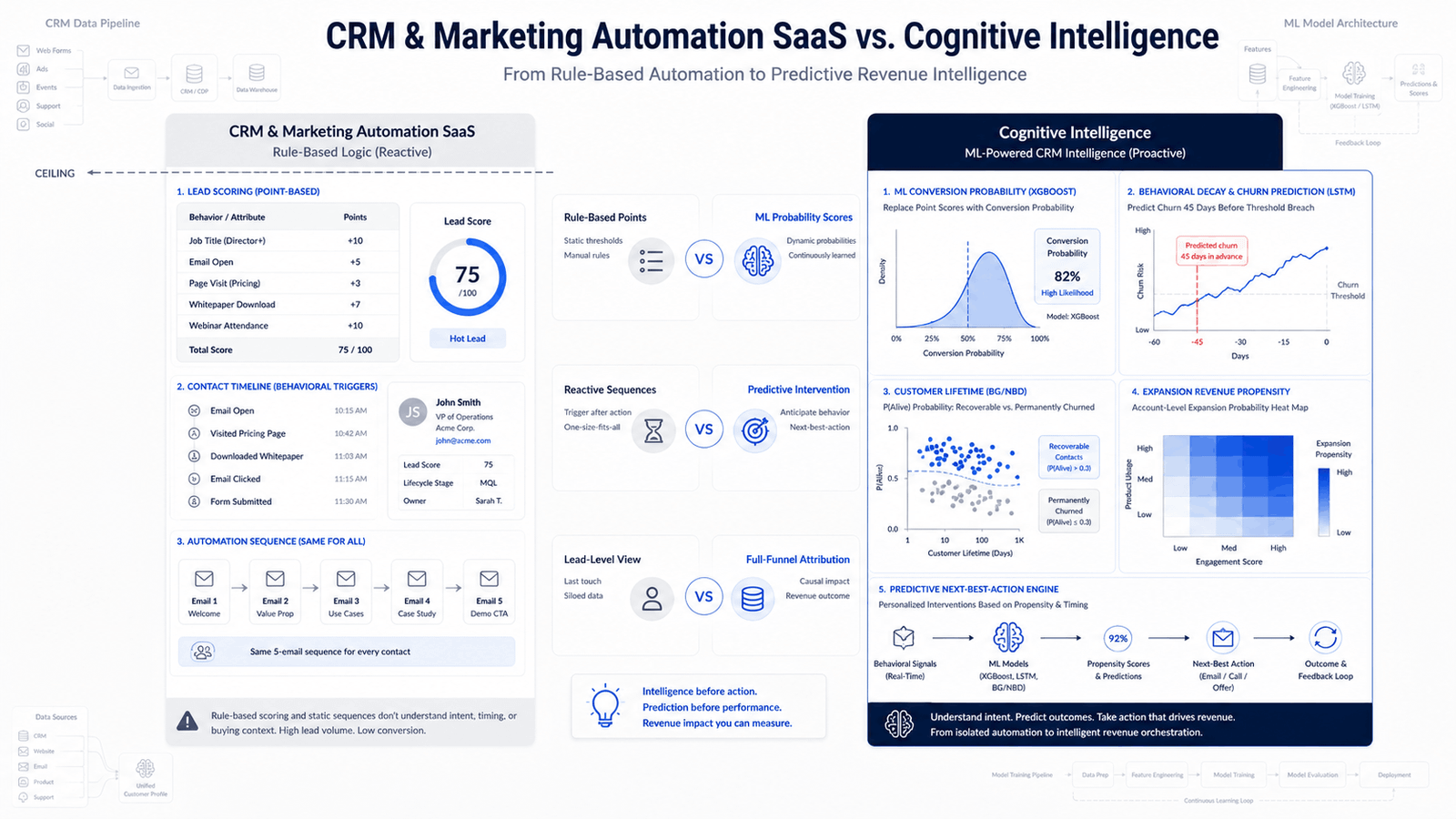
What are CRM and marketing automation tools?
CRM platforms are contact database and pipeline management systems — organising customer data, tracking interaction history, managing deal stages. Marketing automation layers communication on top: behavioural email sequences, nurturing workflows, scoring rules, multi-channel orchestration.
The distinction has largely blurred. Most modern platforms provide both. And both are constrained by the same architecture: rule-based logic applied to historical behavioural data, with lead scoring built on manually defined point systems rather than trained models.
What they are: contact management, pipeline and communication automation. What they are not: predictive modelling platforms, churn intelligence systems, or causal attribution frameworks.
Five tiers of CRM and automation software
Most comparisons cover one tier. Businesses evaluating this category are usually choosing across several — and the analytical ceiling is identical in all five.
Unified CRM + automation suites
- HubSpot
- Salesforce
- Zoho CRM
- Microsoft Dynamics 365
- Freshsales
- Pipedrive
- Monday.com CRM
CRM, marketing and sales in one platform. Reduces data fragmentation, which is real value — and concentrates every prediction inside one vendor’s data model.
Enterprise B2B marketing automation
- Adobe Marketo Engage
- Pardot
- Oracle Eloqua
- Adobe Campaign
- Acoustic
Deep nurturing, ABM and revenue reporting for complex B2B demand generation. Scoring remains a manually configured point system in all of them.
Ecommerce lifecycle platforms
- Klaviyo
- Omnisend
- Attentive
- Postscript
- Drip
- Yotpo
Purpose-built for DTC email and SMS on ecommerce behavioural data. Klaviyo is the only one shipping genuine predictive features — and they are still confined to its own data model.
SMB and mid-market automation
- ActiveCampaign
- Brevo
- Mailchimp
- Customer.io
- MailerLite
- GetResponse
Sophisticated automation at accessible pricing. Scoring is point-based throughout, and sequences execute uniformly regardless of predicted response.
Product-led and mobile engagement
- Braze
- Iterable
- Intercom
- MoEngage
- CleverTap
- OneSignal
Built for in-product and mobile lifecycle messaging. MoEngage and CleverTap are particularly strong in South Asian and Gulf markets and are frequently missing from Western comparisons.
Honest analysis of the leading platforms
Each assessment covers genuine strengths and where the architecture stops. None of these are criticisms of engineering quality — they are the structural consequence of building one platform for thousands of businesses.
HubSpot
What it doesUnified inbound CRM, marketing automation, CMS and sales enablement, with visual workflow building and point-based lead scoring.
Who uses itSMB to mid-market B2B teams using inbound content as a primary acquisition channel.
Genuine strengthsGenuine platform integration reduces the silos separate best-in-class tools create. Workflow builder is usable by non-technical marketers. Strong content and SEO tooling.
Where the ceiling isNative scoring is a point system reflecting what your team assumes predicts quality. Enterprise-tier Predictive Lead Scoring is a real improvement, but its accuracy is bounded by HubSpot’s own feature set — not raw exports, product usage or third-party intent.
Salesforce
What it doesThe most comprehensive enterprise CRM, with Marketing Cloud for journeys and Einstein AI for predictive scoring and forecasting.
Who uses itEnterprise sales organisations, financial services, healthcare and large B2B.
Genuine strengthsUnmatched depth for complex sales process management. AppExchange and API infrastructure integrate with virtually any enterprise system. Einstein provides genuine ML within the Salesforce data model.
Where the ceiling isEinstein trains on data inside Salesforce. Where the strongest predictors live elsewhere — product usage logs, support sentiment, session sequences, intent data — accuracy is bounded by access, not algorithm. And it predicts without prescribing: no causal layer.
Adobe Marketo Engage
What it doesEnterprise B2B marketing automation covering lead management, ABM, revenue attribution and advanced nurturing.
Who uses itEnterprise B2B demand generation teams in technology, financial services and manufacturing.
Genuine strengthsAmong the deepest nurturing and ABM capability available. Strong Salesforce integration. Advanced segmentation for complex B2B audiences. Revenue Cycle Analytics for funnel reporting.
Where the ceiling isDemographic and behavioural scoring are both manually configured rules — team assumptions, not data-driven discovery. Behavioural tracking is limited to Marketo-tracked touchpoints, missing product and support signals that often predict B2B conversion better than marketing engagement.
ActiveCampaign
What it doesCustomer experience automation combining email, automation, CRM and sales automation with sophisticated behavioural triggering.
Who uses itSMB and mid-market ecommerce, course creators, SaaS and professional services.
Genuine strengthsMore automation capability per dollar than most alternatives at the price point. Wide range of behavioural triggers. Site tracking extends data beyond email engagement.
Where the ceiling isPoint-based scoring, and sequences execute predefined paths that do not adapt to predicted future behaviour. A contact entering re-engagement at 60 days inactive receives the same sequence whether their reactivation probability is 4% or 60% — the platform cannot calculate either.
Klaviyo
What it doesThe dominant ecommerce email and SMS platform, with Predictive Analytics covering predicted CLV, churn risk and next order date.
Who uses itDTC ecommerce and Shopify brands, from SMB to multi-million-subscriber lists.
Genuine strengthsEcommerce data integration depth generic email platforms cannot match. Genuine ML-based prediction inside its data model. Strong segmentation and coordinated email plus SMS.
Where the ceiling isPredictions train on purchase behaviour within Klaviyo — not raw Shopify API sequences, session behaviour or external signals. CLV uses aggregated patterns rather than individual P(Alive) and Gamma-Gamma modelling. And churn risk is not an uplift model: it cannot separate customers who will respond to intervention from those who will churn regardless.
Pardot
What it doesSalesforce’s B2B marketing automation, combining activity scoring with profile grading for sales prioritisation.
Who uses itB2B organisations already standardised on Salesforce CRM.
Genuine strengthsNative bi-directional Salesforce sync without integration work. Combined scoring plus grading gives both engagement and fit signals. Engagement Studio for visual nurture design.
Where the ceiling isScoring and grading are both rule-based configurations. Tracking is limited to Pardot-observed touchpoints — so scores can direct sales toward highly engaged contacts with low conversion probability, while under-prioritising quieter contacts with stronger buying signals elsewhere.
Also assessed but not detailed above: Zoho CRM, Microsoft Dynamics 365, Oracle Eloqua, Brevo, Mailchimp, Customer.io, Braze, Iterable, Intercom, Omnisend, Attentive, Postscript, MoEngage and CleverTap. All share the same six limitations below — the differences between them are operational, not analytical.
Why rule-based lead scoring stops working
Placeholder — no video yet. Delete this box and drop in the Elementor Video widget when the recording is ready, or hide this whole section from Advanced → Responsive until then.
Rule-based scoring, not learned prediction
Every platform’s native lead scoring is a point system. You assign values to attributes and actions based on what you believe predicts quality.
Assumption-based, not evidence-based. The model reflects what the team believes predicts conversion, and those beliefs are frequently wrong.
Linear and non-interactive. Point systems add scores without modelling interaction effects. Every “VP Marketing” gets the same points regardless of behavioural context.
XGBoost gradient boosting trained on your historical conversion data discovers which signal combinations actually predict conversion in your business.
Interaction effects are modelled automatically — which is precisely what a point system cannot replicate at any level of configuration effort.
No churn early warning
These platforms track engagement. They do not build predictive models on it to generate individual churn probability with enough lead time to act.
The standard approach is reactive: flag contacts inactive for 60, 90 or 180 days.
By the time that threshold fires, the disengagement pattern has been visible in the data for weeks. The window for low-friction intervention has already closed.
LSTM deep learning on behavioural engagement sequences detects activity decay patterns 30 to 60 days before a standard inactivity threshold would trigger.
Intervention happens when it still has a realistic probability of changing the outcome.
No P(Alive) modelling for lapsed contacts
Lapsed re-engagement runs on recency — time since last engagement decides who enters the workflow.
Recency cannot distinguish a contact in a longer-than-usual gap from one who has permanently disengaged.
Sending to permanently churned contacts wastes send volume, damages deliverability through unsubscribes and complaints, and distorts engagement metrics — with no compensating value.
BG/NBD P(Alive) probability modelling calculates the mathematical likelihood that each lapsed contact is still genuinely recoverable.
Only positive-probability contacts enter re-engagement. Deliverability is protected as a direct consequence.
No expansion revenue intelligence
CRMs track contract value, renewal dates, usage and support history. They do not model which accounts are approaching natural expansion.
Expansion identification is reactive — customers request upgrades when they hit plan limits.
The revenue sitting in accounts approaching a trigger point, but not yet at the friction point that prompts a request, is systematically missed.
XGBoost expansion propensity modelling identifies which accounts carry the behavioural and firmographic signals predicting near-term expansion.
Outreach happens before the friction point — and before a competitor spots the same signal.
Automation sequences execute uniformly
A trigger condition routes every contact into the same workflow. Same emails, same timing, same channel.
Every contact entering a trigger receives an identical sequence regardless of predicted conversion probability, historical engagement patterns, firmographics or channel preference.
The workflow is personalised in its merge fields, not in its logic.
Sequence content, timing and channel are routed by individual ML-predicted response patterns — different variants for different predicted behaviours.
Personalisation moves from the copy into the decision about which sequence a contact should receive at all.
Attribution stops at the lead
These platforms measure which campaigns generated contacts. Most do not track contribution through pipeline progression to closed revenue.
Leads are treated as equivalent. They are not — some sources produce contacts that close at higher rates, at higher contract values, with shorter cycles.
Budget decisions get made on lead volume and lead cost rather than pipeline quality and revenue contribution.
Markov chain and Shapley value attribution connects touchpoints through pipeline stages to closed revenue.
The output is revenue per dollar invested by activity — which regularly reorders the channel ranking that lead-cost reporting produced.
CRM automation vs Cognitive Intelligence
Every row is architectural. The platform is not underbuilt — it is built for a different job.
| Dimension | CRM & automation SaaS | Cognitive Intelligence |
|---|---|---|
| Lead scoring | ×Rule-based point systems | ✓ML-powered conversion probability |
| Scoring basis | ×Team assumptions | ✓Evidence discovered in your data |
| Interaction effects | ×Not modelled — scores simply add | ✓Gradient boosting models them automatically |
| Churn detection | ×Reactive inactivity thresholds | ✓LSTM, 30–60 day advance warning |
| Lapsed contacts | ×Recency-based segmentation | ✓BG/NBD P(Alive) probability |
| Expansion revenue | ×Reactive to upgrade requests | ✓XGBoost propensity modelling |
| Automation logic | ×Uniform sequence per trigger | ✓ML-routed sequence variants |
| Intervention targeting | ×Everyone above a threshold | ✓CausalML uplift — the persuadable only |
| Attribution depth | ×Stops at lead creation | ✓Full-funnel to closed revenue |
| Data scope | ×Platform-tracked signals only | ✓Multi-source, including product and intent |
| Model maintenance | ×Static scoring rules | ✓Monthly retraining cycle |
| Commercial model | ×$29–$4,000+ monthly subscription | ✓Custom engagement investment |
When your CRM is enough, and when it is not
Most businesses should keep their CRM. The question is whether it should also be doing the predicting.
Your CRM and automation stack is sufficient when
- Contact management and pipeline organisation is the primary requirement
- Standard behavioural sequences and nurturing workflows meet the need without individual-level prediction
- Team size and budget make custom modelling disproportionate to the improvement available
- HubSpot Predictive or Einstein AI on Enterprise tier already produces scores that match observed conversion
- Lead volume is low enough that sales can work every contact properly regardless of scoring
Cognitive Intelligence becomes necessary when
- Lead quality varies widely and sales effort is being spread evenly across it
- Churn is outrunning reactive intervention — you find out after the decision was made
- Lapsed re-engagement is consuming send volume and damaging deliverability
- Expansion revenue is only identified when a customer asks for it
- Budget decisions need full-funnel revenue attribution, not lead-cost reporting
- Native ML scoring is producing scores that do not match observed conversion — a signal the platform’s feature set is insufficient
Where AI agents fit in a CRM workflow
Your CRM already runs rules. That is what an automation workflow is — a workflow agent, in a nicer interface. Workflow agents on n8n, Make.com or Zapier extend the same logic across systems the CRM does not reach. Autonomous agents supply what no rule can: the score, the uplift decision, the retraining. MCP gives either governed access to the CRM and warehouse; skills keep every run to the same standard.
| Task | Architecture that fits | Why |
|---|---|---|
| Scoring every contact nightly | Autonomous — the model rescores on fresh behavioural data | A rule can schedule the run; it cannot produce the score |
| Deciding who enters re-engagement | Autonomous — P(Alive) and uplift decide who is worth contacting | A rule uses days-since-open, which is exactly the deliverability problem |
| Choosing the sequence variant | Autonomous — predicted response pattern routes the contact | A rule sends the same sequence to everyone in the trigger |
| Writing scores back to the CRM | Workflow with MCP — scores pushed to HubSpot or Salesforce on schedule | Ideal for a rule; no modelling in the transport |
| Alerting an owner to a churn spike | Workflow — threshold crossed, task created, notification sent | Ideal for a rule; the threshold comes from the model |
| Enriching a new lead on creation | Workflow with MCP — enrichment fetched and written in seconds | Ideal for a rule; speed matters more than intelligence here |
What stays with a person
- Defining what a qualified lead means. Get the target variable wrong and the model is accurate about the wrong outcome.
- Deciding the offer. The model identifies who is persuadable; what you offer them is commercial judgement.
- Suppressing a contact permanently. Low scores change priority and routing — never access. One wrongly-dropped account can outweigh the efficiency gain.
- Anything sent under your brand name. Generated at volume, outbound copy damages sender reputation faster than it produces pipeline.
The full breakdown sits in the AI agents section.
Questions about CRM and marketing automation
Do I need to replace my CRM to work this way?
No, and in almost every engagement the CRM stays exactly where it is. HubSpot, Salesforce and Klaviyo remain the operational system of record — contact management, sequences, pipeline. What changes is what feeds their scoring and segmentation: model outputs written back into the CRM rather than point rules configured inside it.
HubSpot and Salesforce already have predictive scoring. Is that not enough?
Often it is, and that is said plainly on this page. Both train genuine ML on your historical data, and for many businesses the accuracy is adequate. The constraint is feature scope: they can only learn from signals inside their own data model. Where your strongest predictors are product usage, support sentiment, session sequences or third-party intent, the ceiling is access rather than algorithm — and the symptom is scores that do not match observed conversion.
What is P(Alive) and why does it matter for email?
It is the probability that a lapsed contact is still genuinely reachable rather than permanently gone, calculated from their individual purchase or engagement rhythm. It matters because recency-based re-engagement mails everyone past a date threshold — including people who will never open again. Those sends generate complaints and unsubscribes, which degrade deliverability for the contacts who would have converted.
Why is uplift modelling different from churn scoring?
A churn score tells you who is likely to leave. An uplift model tells you who will change behaviour because you intervened. Those are different groups. Some at-risk customers will churn regardless, some were never really at risk, and a small number actually disengage faster when contacted. Retention budget spent on a churn score alone funds all four groups equally.
Can AI agents run this on top of my existing CRM?
Yes — that is the usual shape. Workflow agents handle enrichment, score write-back and alerting through MCP connections to the CRM. Autonomous agents produce the scores and uplift decisions. Your team keeps working inside HubSpot or Salesforce; the intelligence layer simply populates fields that used to hold rule-based points.
Does this apply to businesses in Pakistan and the Gulf?
Yes, and two platforms usually missing from Western comparisons matter here — MoEngage and CleverTap are widely used across South Asia and the Gulf for mobile lifecycle messaging. The analytical ceiling is identical. The qualifier is data volume: scoring models need enough closed and disqualified outcomes in the CRM to train against.

Usman Saeed
AI-Driven Digital Marketing Intelligence Consultant & Growth Engineer in Pakistan. Usman Saeed specializes in engineering resilient digital growth architectures — helping enterprise brands eliminate tracking data drops, secure conversion signals, and maximize profitability through E-commerce Engineering, server-side Signal Engineering, and Predictive Intelligence. With 12+ years of experience and advanced data science expertise, marketing guesswork is replaced with mathematical precision — automated systems that bridge execution with business intelligence, ensuring your investment delivers measurable scale.
Where to go next
Your CRM knows what happened. The question is what happens next
The audit examines your actual contact history and scoring accuracy. If your native predictive scoring is already sufficient, you will be told that directly.