
Research Interests: The Five-Domain Roadmap in AI-Driven Marketing Science
The three papers currently under peer review are not the destination — they are the first formal outputs of a much larger research programme that has been forming since the decision to pursue MS Data Science (AI focus) in 2025.
This page documents the complete research direction: every active and planned area of investigation, how each connects to the Cognitive Marketing Engine, and — critically — which directions are being built into actual SaaS products rather than only published as papers. This is not a wish list. It is the roadmap.
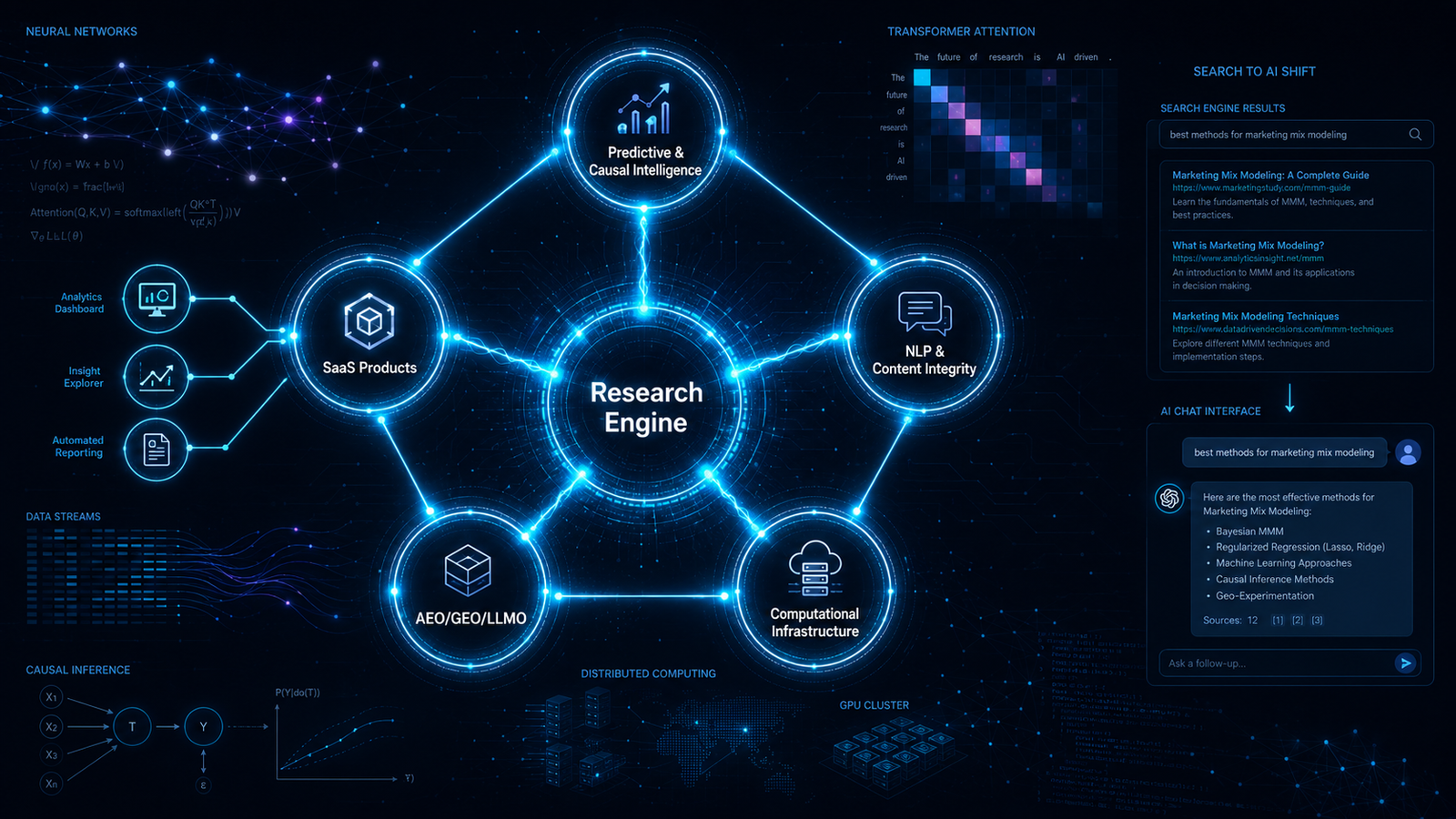
The unifying thread
Every research interest below answers some version of the same question:
Where is marketing still relying on guesswork, and what mathematical or computational approach can replace that guesswork with evidence?
Six domains have emerged as the areas where this question is most urgent and most underexplored.
Extending the foundation laid by the first three papers
The first three papers established a foundation in lead scoring, sequential behaviour modelling and multi-touch attribution. The next questions extend each in directions current literature has not fully addressed.
Cross-platform propensity transfer learning
Can a propensity model trained on one client’s historical data, in one industry, be partially transferred to a new client in a related industry — reducing the cold-start problem that makes early-stage ML modelling difficult for smaller businesses? This addresses a practical limitation of Loops 1 and 4: smaller clients often lack enough historical data for robust training. Transfer learning could make computational marketing accessible to businesses currently too small for it.
Causal attribution under privacy constraints
As cookie-based and device-level tracking degrades — iOS privacy changes, browser restrictions, regulatory pressure — how can causal attribution models like those in Paper 3 be adapted to work reliably on aggregated, privacy-safe data only? This is directly relevant to Loop 2: media mix modelling is inherently more privacy-resilient than device-level attribution, but optimal MMM configuration for small and mid-size businesses is underdeveloped.
Multi-industry customer lifetime value benchmarking
Paper 2 applied deep learning to ecommerce CLV prediction. A natural extension: how do CLV models need to adapt across industries — subscription SaaS versus DTC ecommerce versus B2B services — where purchase frequency, contract structures and churn dynamics differ fundamentally?
Where marketing content meets responsible AI
As AI-generated marketing content becomes ubiquitous, a new class of problems is emerging — problems traditional marketing tools were never designed to catch.
Pre-publication content integrity detection
Marketing copy increasingly uses psychological persuasion techniques, some legitimate and some crossing into manipulative dark patterns — false urgency, hidden costs, manipulated defaults. As AI makes it trivial to generate persuasive copy at volume, can transformer models such as BERT automatically flag content that may violate platform policies or constitute dark patterns before publication? This has direct commercial application: a checker that scans ad copy, landing pages and email for policy-violation risk before it goes live, preventing suspensions and reputational damage.
Brand voice consistency at scale
For businesses producing large content volumes across multiple platforms, can NLP models detect brand voice drift — content that technically follows guidelines but has gradually shifted in tone, vocabulary or framing away from the established voice?
Semantic content decay detection at scale
Building on the LDA-based decay detection already used in Loop 1: how can this be automated to continuously monitor an entire content library of hundreds or thousands of pages, flagging content whose semantic alignment with current search intent has decayed before rankings drop?
The five-year research roadmap in a few minutes
Placeholder — no video yet. Delete this box and drop in the Elementor Video widget when the recording is ready, or hide this whole section from Advanced → Responsive until then.
Marketing in the AI search era
This is one of the most urgent and underexplored research areas in digital marketing, and one with almost no rigorous academic literature yet. Users increasingly get answers directly from AI systems rather than clicking through to websites, which creates three interconnected new disciplines.
The three disciplines
AEO (Answer Engine Optimisation) — optimising content to be selected as the direct answer in AI-generated responses. GEO (Generative Engine Optimisation) — optimising for how generative systems synthesise and cite information across multiple sources. LLMO (Large Language Model Optimisation) — understanding how models represent, weight and retrieve information about brands and topics.
Citation pattern analysis
When AI systems answer questions and cite sources, what structural, semantic and authority signals correlate with being cited rather than merely being indexed? This differs fundamentally from traditional ranking factor research, because the ranking happens inside a model’s reasoning process rather than a conventional algorithm.
Semantic authority mapping for LLMO
Traditional SEO authority is measured through backlinks and domain metrics. What does authority mean to a language model — and can content be structured to increase the likelihood that it is retrieved and accurately represented when answering related queries?
AEO content structuring using transformer analysis
Using the same SBERT and transformer techniques already applied in Loop 1 for search intent drift, can content be analysed and restructured specifically to increase retrievability and citation probability in AI-generated answers, while remaining genuinely good for human readers?
Making the framework itself a subject of research
The Cognitive Marketing Engine is not a finished product. It is a living framework that improves as research progresses, and several open questions about its own architecture are active interests.
Optimal retraining frequency under concept drift
Loop 4 currently uses monthly retraining as a standard cycle. But is monthly optimal for every model type and every industry? Research into drift detection metrics that could trigger adaptive retraining schedules — more frequent for fast-moving sectors like fashion and flash-sale ecommerce, less frequent for B2B and real estate — would make Loop 4 both more efficient and more accurate.
Multi-objective portfolio optimisation beyond Markowitz
Loop 2 currently applies the Markowitz Efficient Frontier, a model designed for financial portfolios with a single risk-return trade-off. Marketing budget allocation usually has several competing objectives at once — revenue, brand awareness, acquisition cost and lifetime value. Research into multi-objective optimisation that balances these mathematically is an active interest.
Explainability in causal marketing models
As CausalML and Bayesian models become more central to client strategy, how can their outputs be explained to non-technical stakeholders in a way that builds genuine understanding rather than trust based on “the model said so”? This connects directly to the core value of data over opinion: clients need to understand why, not just what.
Where research becomes a product
This domain differs from the others: it is where research is deliberately designed for commercialisation. The mission has always included building micro SaaS products that make advanced marketing intelligence accessible to businesses that cannot afford enterprise data science teams. Every product in the pipeline derives directly from a research question above.
Product 1 — Google Ads waste spend detector
Product 2 — Content integrity checker
Product 3 — AEO/GEO content audit tool
The pattern
- Research question, with academic rigour
- Validated on real client data
- Packaged as a self-service tool
- Accessible beyond the direct client base
This is the mechanism by which the mission — making advanced marketing intelligence affordable globally — actually gets executed. Not by scaling a consulting practice indefinitely, which has natural limits, but by productising the research itself.
Agent evaluation and reliability in marketing
Marketing AI agents come in two architectures. Workflow agents — n8n, Make.com, Zapier — execute a sequence defined in advance. Autonomous agents decide their own next step from live data. Two capability layers serve both: MCP for governed access to real tools and data, and skills for packaged, repeatable expertise.
The industry is deploying autonomous agents into live ad accounts far faster than it is establishing how to tell whether they are working. That gap is the research question.
Open questions being explored
- Evaluation under delayed feedback. An agent reallocating budget may not see the true outcome for weeks. How is an agent scored when the reward signal arrives long after the decision?
- Objective misspecification detection. An agent optimising a proxy metric can damage the real business goal while its own dashboard improves. Can that divergence be detected automatically?
- Safe autonomy thresholds. At what decision size, and under what confidence, should an agent act versus recommend? This is currently set by judgement rather than evidence.
- Reproducibility across runs. Skills promise a consistent standard every run. Measuring whether that actually holds, on live marketing data, is an open methodological problem.
This domain is deliberately listed with open questions rather than answers, because that is its honest current state. How the two architectures apply channel by channel today sits in the AI agents section.
How this connects to the long-term vision
Every domain above feeds into the same picture.
PhD track, 2027 onwards
A globally validated practice
Micro SaaS to technology company
The honest summary
Most research interests pages are aspirational — a list of topics someone finds interesting, disconnected from anything they are actually doing.
This page describes work already in progress: three papers under review, active coursework directly informing client strategy, and SaaS concepts already mapped to specific research domains. The research interests are not separate from the practice. They are the next five to ten years of it, already planned.
Questions about this roadmap
What is AEO, GEO and LLMO, and why do they matter now?
They describe optimising for AI answer engines rather than traditional search results. AEO targets being chosen as the direct answer, GEO targets how generative systems synthesise and cite across sources, and LLMO concerns how models represent a brand or topic internally. They matter now because users are already getting answers without clicking through, and almost no rigorous frameworks exist for it yet.
Is this roadmap funded or speculative?
It is a research direction, not a funded programme, and it is described that way deliberately. The three papers are real and under review. The SaaS products are at target, research and concept stage respectively — each labelled with its actual stage rather than presented as shipped.
Why include AI agent reliability as a research domain?
Because the industry is deploying autonomous agents into live ad accounts faster than it is establishing how to know whether they work. Delayed feedback, objective misspecification and safe autonomy thresholds are all genuinely open problems. Listing them as questions rather than claiming solutions is the honest position.
How does this research reach clients before it is published?
Through the framework. Methods are applied to client accounts once they are validated on real data, which is usually well before a paper completes peer review. The client benefit is the model; the paper is the independent check on whether the method holds up.
Does an AI digital marketing expert in Pakistan have any advantage in this research?
One specific advantage: access to first-party data across 100+ engagements in 12+ industries and four markets, which most data science researchers never get. The constraint is the opposite — fewer institutional resources than a large research group. The roadmap is scoped accordingly, toward questions where real client data matters more than compute budget.

Usman Saeed
AI-Driven Digital Marketing Intelligence Consultant & Growth Engineer in Pakistan. Usman Saeed specializes in engineering resilient digital growth architectures — helping enterprise brands eliminate tracking data drops, secure conversion signals, and maximize profitability through E-commerce Engineering, server-side Signal Engineering, and Predictive Intelligence. With 12+ years of experience and advanced data science expertise, marketing guesswork is replaced with mathematical precision — automated systems that bridge execution with business intelligence, ensuring your investment delivers measurable scale.
Where to go next
Want to be part of what gets built?
The first conversation is about data gaps and pipelines, not roadmaps. If your data cannot support the modelling, you will be told that directly.