
Research: AI-Driven Marketing Science Backed by Peer Review
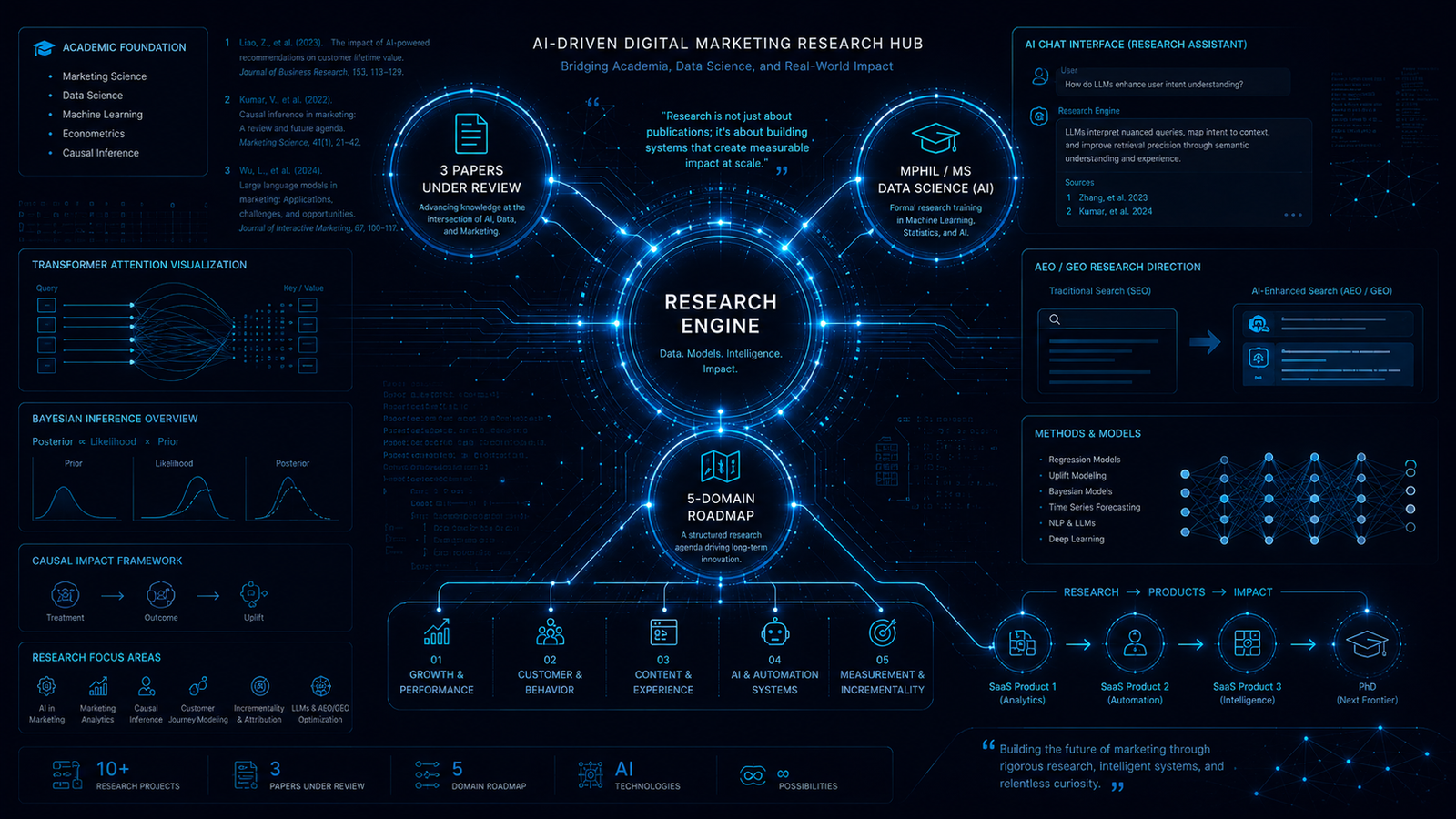
Three international research papers currently under peer review. An active MS Data Science (AI focus) journey building directly on a Master’s in Computer Science. A six-domain research roadmap already shaping the SaaS products planned for 2027 and beyond.
This is not academic work happening separately from client work. Every research question originates from real patterns observed across 12+ years and 100+ client engagements, and every finding feeds back into the Cognitive Marketing Engine applied in active strategies.
Data over opinion, tested rigorously
A practitioner can claim a strategy works based on a handful of client results and call it expertise. A researcher has to prove it — with methodology, statistical validation, and peer review from people whose job is to find flaws in the argument.
This practice operates at the intersection of both.
- 12+ years of practice generates the questions
- Graduate research provides rigorous methodology
- Peer review validates the answers
- Client engagements apply them, and generate new questions
This loop — practice to research to validation to practice — is what makes the strategic recommendations here mathematically defensible, not just experientially confident.
Three papers under peer review
Each originated from a real client pattern and directly informs specific loops of the Cognitive Marketing Engine.
AI-driven lead scoring
Deep learning for ecommerce
Multi-touch attribution
MS Data Science (AI focus), on the thesis track
From a Master of Computer Science (2015–2017) that quietly laid the technical foundation, to the 2025 decision to return to graduate study. That page documents why the programme was necessary, what it actually involves, and how every concept learned in coursework reaches client engagements within weeks.
It includes the direct mapping from coursework — Advanced NLP, Advanced Machine Learning, Algorithm Analysis, and Data Tools & Techniques — to specific components of the Cognitive Marketing Engine, and the path toward PhD applications in 2027.
The research practice, explained in a few minutes
Placeholder — no video yet. Delete this box and drop in the Elementor Video widget when the recording is ready, or hide this whole section from Advanced → Responsive until then.
The six-domain roadmap for the next five to ten years
Every domain answers the same question: where is marketing still relying on guesswork, and what computational approach can replace it with evidence?
Predictive & causal intelligence
NLP & content integrity
AEO / GEO / LLMO
CME extensions
SaaS product research
Agent evaluation and reliability
What research has to do with AI agents
Marketing AI agents come in two architectures. Workflow agents — built on n8n, Make.com or Zapier — run a sequence defined in advance when a trigger fires. They are genuinely useful and require no research background. Autonomous agents decide their own next step from live data, which means someone has to build the model, choose the objective and design an evaluation proving it works.
That model layer is what the three papers are. Without research of this kind, an “AI agent” is a rule with better branding.
Autonomous agents
Workflow agents
MCP — Model Context Protocol
Skills — packaged expertise
Agent evaluation is itself an open research domain here, and how these architectures apply channel by channel sits in the AI agents section.
How this research shapes client work
This is the connection most consulting practices cannot make, because most consultants are not doing original research in the first place.
| Loop | What runs in it | Research foundation |
|---|---|---|
| Loop 1 — empirical diagnostics | SBERT semantic embedding tracking and Isolation Forest anomaly detection | Advanced NLP and Advanced ML coursework; extended in Domains 01 and 02 |
| Loop 2 — causal strategy | Bayesian Media Mix Modeling and Markov chain multi-touch attribution | Direct output of Paper 03; extensions in Domains 01 and 04 |
| Loop 3 — programmatic execution | Custom Python pipelines and API deployment | Algorithm Analysis and Data Tools & Techniques coursework |
| Loop 4 — continuous optimisation | XGBoost propensity modelling and BG/NBD lifetime value tracking | Direct output of Papers 01 and 02; adaptive retraining research in Domain 04 |
The framework is not static because the research is not static. As the degree progresses and new papers move through peer review, the Cognitive Marketing Engine evolves with them.
Why this matters
There are thousands of digital marketing consultants who will say they use AI or are data-driven. For most, that means a chat assistant for content ideas and a dashboard with “AI-powered” in its marketing copy. Here it means five specific things.
- Original research currently under international peer review
- Active graduate coursework in the mathematical foundations of the models being used
- A traceable line from academic research to client-facing strategy
- A long-term trajectory toward PhD-level expertise in this exact intersection
- SaaS products already being designed from validated research findings
This is a different category of expertise — and it is documented, verifiable and continuously growing.
Questions about this research practice
What research has Usman Saeed actually published?
Three papers are under peer review for 2026 — AI-driven lead scoring, deep learning on sequential ecommerce behaviour, and AI-driven multi-touch attribution. Under review means independent reviewers are examining the methodology; none are published yet, and that is stated plainly rather than implied otherwise.
How is research different from just being experienced?
Experience produces confident conclusions from a limited sample. Research tests whether those conclusions survive scrutiny — with stated methodology, statistical validation and reviewers whose job is to find the flaw. Both are useful; only one of them is checkable by someone other than the person making the claim.
Does the research delay client work?
No, because it runs on client data rather than textbook datasets. Methods reach live accounts once validated, typically well before a paper completes review. The table on this page maps each loop of the framework to the research behind it.
Do AI agents replace the need for this research?
They depend on it. Workflow agents need no research at all — anyone can build a trigger-based sequence in n8n or Zapier. Autonomous agents need a model, an objective and an evaluation, and that is exactly what these papers provide. Agent evaluation is itself listed as an open research domain here.
Why does an AI digital marketing expert in Pakistan do academic research at all?
Because the questions came from the work. Twelve years across 100+ engagements surfaced problems that off-the-shelf tools do not solve well, and answering them properly requires methodology rather than intuition. The unusual advantage here is access to first-party data across 12+ industries and four markets, which most researchers never get.

Usman Saeed
AI-Driven Digital Marketing Intelligence Consultant & Growth Engineer in Pakistan. Usman Saeed specializes in engineering resilient digital growth architectures — helping enterprise brands eliminate tracking data drops, secure conversion signals, and maximize profitability through E-commerce Engineering, server-side Signal Engineering, and Predictive Intelligence. With 12+ years of experience and advanced data science expertise, marketing guesswork is replaced with mathematical precision — automated systems that bridge execution with business intelligence, ensuring your investment delivers measurable scale.
Three pages, one continuous body of work
Research papers
Academic journey
Research interests
Ready to see how this applies to your business?
The first conversation is about data gaps and pipelines, not credentials. If your data cannot support the modelling, you will be told that directly.