
My Approach: The Cognitive Marketing Engine and Computational Strategy
After 12+ years working with 100+ clients across Pakistan, the UK, USA and UAE, one pattern became impossible to ignore: the marketing industry is extraordinarily good at looking busy. Keyword calendars, creative briefs, campaign launches, monthly PDFs full of green arrows — and underneath all of it, expensive, systematic, preventable guesswork.
So I built a different approach. Not a different service list. Not a different pricing model. A fundamentally different way of thinking about what marketing is and what it takes to do correctly.
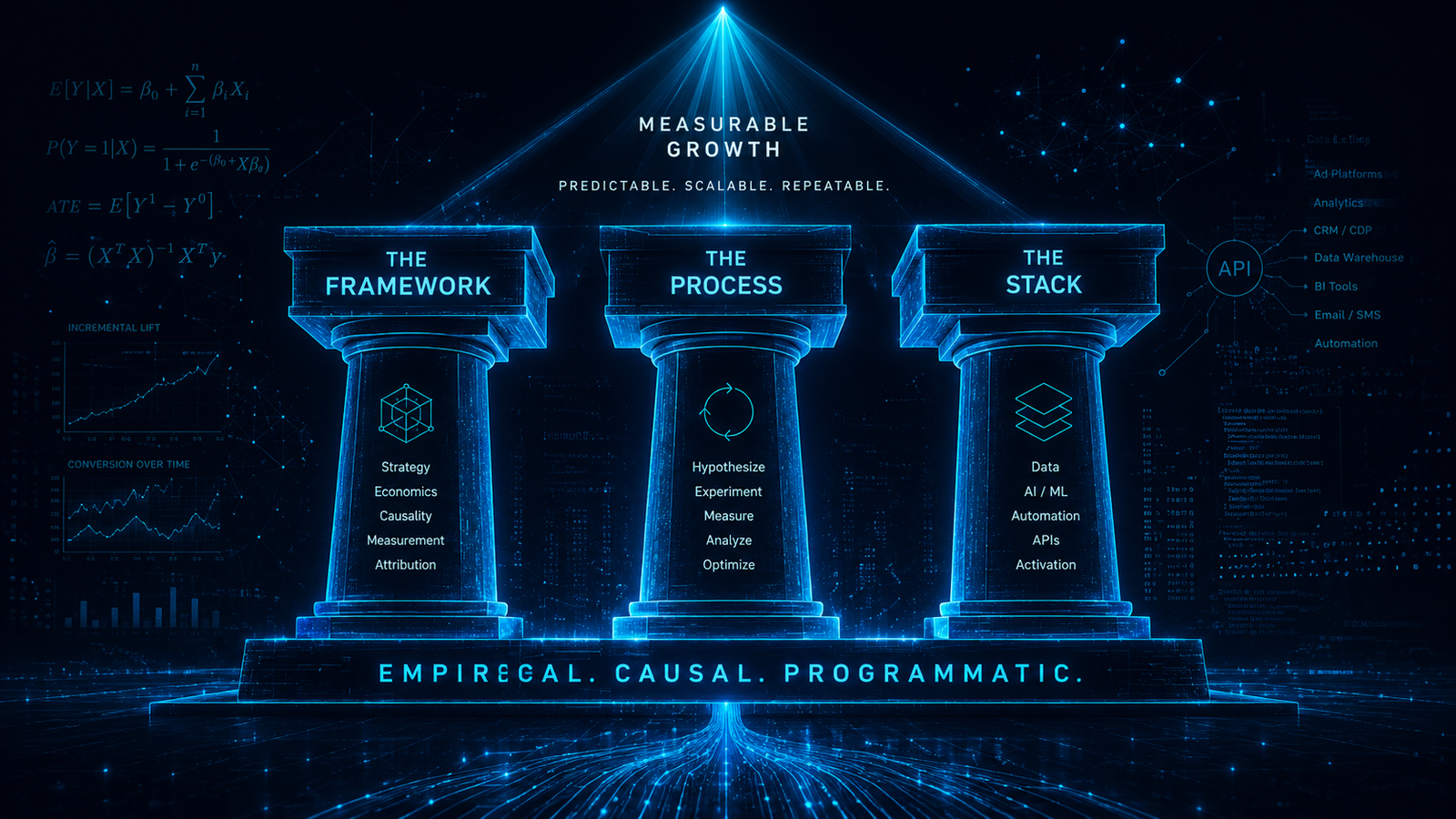
Three things most practitioners have in isolation
This practice combines all three simultaneously. That combination — practitioner experience, academic research and computational implementation in one place — is what the rest of the approach rests on.
12+ years of real client data
Active international research
Computational implementation
The core philosophy
Every marketing decision made without empirical diagnostics is a decision made on incomplete information. Every campaign launched without causal validation is a campaign that cannot be accurately measured. Every optimisation made without model retraining is an optimisation that decays silently over time.
The approach rests on one non-negotiable sequence:
- Diagnose empirically
- Strategise causally
- Execute programmatically
- Optimise continuously
In that order. Always. Without exception.
Data never sleeps. And neither does budget bleeding when the root cause goes unmeasured.
The Cognitive Marketing Engine
A four-loop computational marketing framework that powers every engagement, bridging 12+ years of marketing practice with full-stack data science implementation. Each loop produces the input the next one requires, which is why the order never changes.
Loop 1 — Empirical anomaly and drift identification
Loop 2 — Causal strategy and portfolio architecture
Loop 3 — Programmatic API and algorithmic execution
Loop 4 — Continuous ML optimisation and drift monitoring
How working together actually works
This is not a standard agency onboarding. Every step is structured around the same empirical principle that drives the engine — data first, strategy second, execution third. Minimum engagement is six months, because intelligence-led marketing compounds over time.
- First contact and qualification. Personal response within 24–48 hours, then a written intake covering data infrastructure, primary problem and business context. Not every business is the right fit, and qualification happens before any commitment.
- Data architecture discovery call. A diagnostic session, not a creative brainstorm. GA4 setup, BigQuery access, ad platform API logs, transaction infrastructure and attribution gaps. No campaign ideas, no pricing.
- Data architecture audit — 14 to 21 business days. Raw extraction from all provided sources, then Isolation Forests, SBERT analysis, bot-fraud detection and attribution distortion mapping. Output: a full Empirical Diagnostic Report.
- Causal strategy delivery — 7 to 10 business days after the audit. Bayesian MMM allocation, Markowitz portfolio optimisation, content vector realignment and XGBoost propensity modelling, delivered with a 90-minute walkthrough. Client sign-off required before execution.
- Programmatic execution deployment. Custom Python pipelines with direct API connections to every active platform, and automated guardrails responding to real-time signals. No manual button-pushing at scale.
- Reporting, optimisation and continuous retraining. Monthly incremental lift reporting rather than vanity metrics, real-time programmatic optimisation, a 30-day model retraining cycle and monthly strategy reviews.
The approach, explained in a few minutes
Placeholder — no video yet. Delete this box and drop in the Elementor Video widget when the recording is ready, or hide this whole section from Advanced → Responsive until then.
The 360° tools and tech infrastructure
The technology behind this practice spans every dimension of computational marketing — media buying, machine learning, deep learning, data engineering, CMS, ecommerce, CRM, creative production and industry-specific vertical stacks. Tools are selected per engagement, never applied as a checklist.
Media buying infrastructure
Machine and deep learning
Analytics and data engineering
CMS, ecommerce and CRM
Industry-specific stacks
AI agents: how the engine runs without a team behind it
An AI agent is software that pursues a goal across multiple steps rather than performing a single action. This is the layer that makes a four-loop framework and a six-step process operable by one practitioner rather than a department.
Two architectures do the work, and two capability layers give either one its reach. The architectures are a choice per task; the capability layers are used by both.
Autonomous agents
Workflow (trigger-based) agents
MCP — Model Context Protocol
Skills — packaged expertise
The boundary, stated plainly
- No agent decides what your real problem is. Diagnosis sets the direction of everything downstream; an agent optimises within a frame it cannot question.
- No agent approves spend reallocation above the agreed threshold. A model can recommend it. A person signs it off.
- No agent operates where the outcome cannot be measured. Without a reliable feedback signal, an agent confidently optimises toward the wrong thing.
- No agent writes claims about your brand. Generated at scale, these become a legal and reputational liability faster than they become a saving.
What this approach has produced
Four outcomes from live engagements. They are shown because they are real, not because they are promised — every account starts from a different data position, and no honest practitioner guarantees a specific number in advance.
150 → 1,000 daily organic clicks
City-level rankings in Pakistan
Manual to programmatic execution
Volume to quality-scored pipeline
What this approach is not
Being clear about the fit up front saves both sides months of the wrong engagement.
Not a quick fix
Not a passive retainer
Not for every business
Not standard consulting
The four pages that complete this picture
The Cognitive Marketing Engine
The engagement process
The 360° tools & tech stack
AI agents
Most practitioners optimise for deliverables. This practice optimises for outcomes.
Blogs published, ads launched, reports sent, invoices paid — those are deliverables. Real data, rigorous analysis and intelligent execution are what produce outcomes.
Questions about this approach
What is the Cognitive Marketing Engine in simple terms?
A fixed four-step method: diagnose the account empirically from raw data, build strategy using causal and econometric modelling, execute through code rather than dashboards, then retrain the models continuously so performance does not decay. The order never changes, because each step produces what the next one needs.
How is this different from a typical digital marketing agency?
An agency usually starts at execution — campaigns launched, content published, reports sent. This approach spends the first three to four weeks producing a diagnostic report before any strategy exists. It also runs as a single-practitioner practice, so the person who designs the strategy is the person who implements and reports on it.
Do I need to understand data science to work this way?
No. The modelling happens on this side and the output arrives as decisions in plain business language, with the reasoning shown. What is required is access to your own data and a willingness to hear what it says, including when it contradicts a current assumption.
Where do AI agents fit into the approach?
They are the operating layer. Autonomous agents handle work where the correct action cannot be defined in advance — diagnosis, allocation, retraining. Workflow agents built on n8n, Make.com or Zapier handle guardrails and alerts where it can. MCP gives either architecture access to real data, and skills package the method. Diagnosis, threshold approvals and brand claims stay with a person.
Is this approach only for large international businesses?
No, but it does require enough data volume for modelling to be statistically meaningful. That includes Pakistani businesses serious about data-driven growth, not only Tier 1 market enterprises. Where the data cannot support the modelling, simpler methods give better returns — and that gets said directly rather than sold around.
What does an AI digital marketing expert in Pakistan actually do differently here?
The difference is where the work starts. Most engagements begin with channel activity; this one begins with raw event-level data from BigQuery, Search Console and platform logs. Everything after that — budget allocation, content decisions, bid logic — is derived from what that data shows rather than from platform dashboards or industry benchmarks.

Usman Saeed
AI-Driven Digital Marketing Intelligence Consultant & Growth Engineer in Pakistan. Usman Saeed specializes in engineering resilient digital growth architectures — helping enterprise brands eliminate tracking data drops, secure conversion signals, and maximize profitability through E-commerce Engineering, server-side Signal Engineering, and Predictive Intelligence. With 12+ years of experience and advanced data science expertise, marketing guesswork is replaced with mathematical precision — automated systems that bridge execution with business intelligence, ensuring your investment delivers measurable scale.
Start with the data, not the pitch deck
Every inquiry gets a personal response within 24 to 48 hours. If your data cannot support the modelling, you will be told that directly — before anything is invoiced.