
Meta Ads LTV Prediction Service for Shopify and E-Commerce Brands
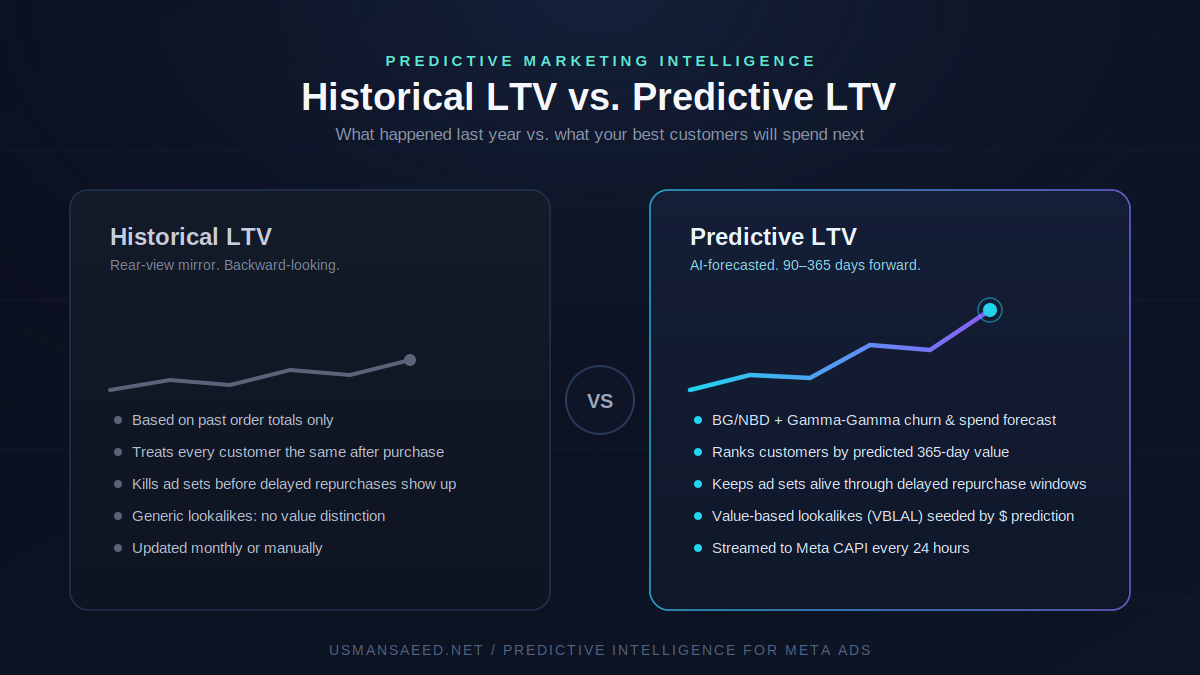
A Meta Ads LTV prediction service replaces the order value your pixel sends with a modelled forecast of what each customer will be worth over the next 90 to 365 days, then streams that score into the Meta Conversions API so the auction bids on future value instead of the cheapest available checkout. This page explains the models, the pipeline, the proof framework, and where the honest limits sit.
Where Meta Ads Quietly Leaks Spend After iOS 14
Rising cost per acquisition on Meta is usually a data problem showing up inside an ad account, not a media buying problem. When every purchase is reported to Meta as a single event carrying one order value, the auction has no way to tell a discount hunter apart from a customer who will reorder for two years. It optimises for whoever converts most cheaply, because that is the only instruction it was given. Three specific failure modes follow from that.
1. The delayed attribution blindspot
2. Value-based lookalike collapse
3. Budget saturation
New creative, fresh hooks and higher budgets all operate on top of the same instruction: find conversions fast. They can improve the margins of a campaign, but they cannot change what the auction is optimising toward. Until the value signal itself changes, a bigger budget buys the same customer profile in larger volume — which is why value-based lookalike audience automation sits upstream of creative strategy, not alongside it.
How the Predictive LTV Engine Works
The engine is an e-commerce LTV data pipeline in four stages: ingest transaction history, model each customer’s future value, hash the identifiers, and stream the scores to Meta server-side on a fixed refresh cycle. Nothing about it is exotic — the difficulty is in the modelling choices and in keeping the pipeline alive once it is running.
Continuous data ingestion
Predictive cohort modelling
One-way hashing
Server-side streaming to CAPI
The fragile part is stage four. A dropped webhook, an expired token or a rate limit does not just cost you a report — it quietly freezes the audience Meta is actively bidding against, and the account keeps spending as if nothing changed. Monitoring that stream is most of the ongoing work.
Why BG/NBD and Gamma-Gamma Fit E-Commerce
E-commerce purchasing is irregular, discretionary and non-contractual — customers never announce that they have left. That is exactly the problem the Buy-Till-You-Die family of models was designed for, which is why BG/NBD and Gamma-Gamma models are the default starting point for Shopify LTV rather than the subscription survival curves used in SaaS.
Models two things at once for every customer: how often they buy while still active, and the probability they have already silently churned without ever cancelling anything. In non-subscription retail that second number is the one nobody tracks, because there is no cancellation event to count.
Models expected transaction value per customer independently of how often they buy, then combines with the BG/NBD output into a single forecast value per profile. Because it borrows statistical strength across similar cohorts, it still produces a usable estimate for customers with only one or two orders on record.
Worth being straight about: these models are not proprietary. They are published academic work, and they are implemented in open-source libraries you can read and run yourself. What is not open source is the fitting, the validation, the segment thresholds and the pipeline that keeps the output flowing into an ad account without breaking. That is the actual work.
How the First 14 Days Prove It — Or Do Not
The model is tested against your own account with a parallel split, not against a case study. Two campaigns run at once with everything held constant except the audience seed, so any difference in average order value or revenue is attributable to targeting rather than to creative, seasonality or timing. If the split shows no difference, that is a real result and it gets reported as one.
Your existing Meta campaigns running current broad targeting or pixel-based purchase lookalikes. Optimising against what customers did spend.
A parallel campaign seeded with the modelled high-LTV segment as a value-based lookalike. Optimising against what comparable customers are forecast to spend.
Held constant: identical creative, identical copy, split budget, same placements, same schedule. This side-by-side is also the clearest practical demonstration of predictive LTV vs historical LTV — one campaign is looking backwards, the other forwards, and the account settles the argument.
Segment-matched creative
Once the segments hold up, ad copy is split to match them: premium bundle messaging stops being served to clearance-driven shoppers and vice versa. The mechanism is simple — fewer irrelevant impressions per user means frequency builds more slowly against the people who were never going to buy at that price point.
An interactive calculator for modelling your own CAC, average order value and repeat rate against a predictive segmentation curve is planned for this page. It does not exist yet, and this box is here so nobody is promised a tool they cannot click. Until it ships, the same maths is run manually inside the discovery audit.
Meta Now Has Native pLTV — And It Still Needs Your Model
Meta made predicted lifetime value optimisation generally available to advertisers during 2026, sitting alongside standard value optimisation inside Advantage+ campaigns. This is genuinely significant, and it does not remove the need for a predictive LTV pipeline — it makes one mandatory. Meta’s pLTV layer optimises against a forecast value it cannot produce itself; that number has to be supplied by the advertiser through the Conversions API.
- Delivery and auction ranking against a value signal
- A pLTV optimisation layer inside Advantage+, no custom bidding required
- Enormous reach and a learning system that improves with volume
- Reported median ROAS improvement in its own testing
- The forecast itself — Meta cannot see your repeat-purchase curve
- Enough value-carrying purchase events each week for the layer to stabilise
- Clean, current, hashed first-party identifiers with real value variance
- Bounded, sane predictions — a confident wrong number is worse than none
The failure mode to take seriously: a noisy model does not produce neutral results. It produces efficient delivery towards the wrong people, at speed, with the platform’s full confidence behind it. This is also why the argument has shifted — the differentiator is no longer whether you can push a value into Meta, it is whether the number you are pushing is defensible. Thresholds and eligibility rules for this feature change; confirm the current requirements in Meta’s documentation before rebuilding an account around it.
The Tools That Partly Do This
There is a real and growing category here, and most of it is credible. The distinction worth understanding is not good versus bad software — it is which layer a tool operates at: reporting a predicted value, activating one into ad platforms, or giving you the models to build your own.
| Layer | What it gives you | Where the ceiling is | Custom model |
|---|---|---|---|
| Tier 1 — activation platforms Voyantis, AdZeta, Angler AI, Black Crow AI, Retina AI | Predicted value modelled and pushed into Meta, Google and TikTok as platform-native signals. Genuinely closes the reporting-to-activation gap. | Enterprise pricing, mostly unpublished. The model is theirs, not yours, and its assumptions are not fully inspectable. Migration means losing the model. | ✗ Vendor-owned |
| Tier 2 — analytics and retention suites Triple Whale, Lifetimely, Klaviyo, Polar, Peel | Cohort analysis, predicted CLV, churn risk and profit tracking. Several now sync segments out to Meta and Klaviyo, so the old “dashboard only” criticism no longer holds across the board. | Segment syncing is not the same as a continuously refreshed per-customer value stream into CAPI, and the underlying model is a general one applied to your data. | ✗ Generalised |
| Tier 3 — open-source and warehouse PyMC-Marketing, CLVTools, BigQuery ML | The actual BG/NBD, Pareto/NBD and Gamma-Gamma implementations, free, inspectable and yours. The models themselves are not the expensive part of this problem. | Nothing is built for you. Fitting, validation, hashing, CAPI transport, monitoring and the decision of where segment cut-offs sit are all still engineering work. | ✓ Fully yours |
| This service | Tier 3 models, fitted and validated on your data, operated as a monitored Tier 1 pipeline into Meta CAPI — with the model, the assumptions and the code visible to you. | Needs enough order history to fit stable cohorts, and needs someone to keep owning the media decisions. It is a data layer, not a replacement for a media buyer. | ✓ Fully yours |
One category note, because it comes up: Adapty is often listed alongside these and does not belong here — it is a mobile in-app subscription platform with LTV prediction for iOS and Android apps, not for Shopify storefronts. Ryze AI and Hyper AI are autonomous ad-management agent platforms rather than LTV modelling tools; they are covered in the agents section below.
Who This Is Built For
This suits Shopify and e-commerce brands with meaningful order history and active Meta spend that have run into a specific wall. It is a poor fit for new stores, for businesses with negligible repeat purchase, and for anyone wanting a dashboard rather than a change in how the account bids.
- CAC rising while conversion rate holds steady — a signal that the auction is finding the wrong profile, not that the funnel broke
- ROAS flattening or falling as budget scales — the saturation pattern described above
- An LTV number you can see but cannot act on — the ratio lives in a spreadsheet and never reaches the ad account
- Post-iOS 14 signal gaps — still leaning on browser pixels without a reliable server-side Conversions API stream
- Agencies and in-house teams wanting a data layer — this strengthens the signal your media buyer acts on, it does not replace them
- EU and UK advertisers — where reduced platform-side personalisation makes first-party value signal materially more important
If your team already understands predictive LTV vs historical LTV but has no engineering capacity to fit the models, hash and stream through CAPI and keep it running, that gap is the entire scope of this service.
What Actually Changes in the Numbers
The target is the blended CAC to LTV ratio. Most brands recalculate it monthly from historical data, while the decisions it should govern — bids, budgets, audiences — are made daily inside the auction. Replacing a backward-looking figure with a continuously refreshed forecast moves three things.
1. The CAC ceiling stops being one number
2. The scaling curve bends later
3. Creative tests get readable
None of this requires replacing your tech stack, your agency or your media buyer. It requires better data entering the system you already run — and an honest reading of what comes back out. No result is guaranteed here; the split test exists precisely so the account, not the pitch, decides whether it worked.
Where AI Agents Fit Into an LTV Pipeline
An AI agent is not another SaaS subscription. A SaaS tool is someone else’s generic model; an AI agent is your own model, run autonomously. Cognitive Intelligence decides what to build — agents are how it keeps running. Two architectures apply to an LTV pipeline, and they are chosen by one test: can the correct next action be written down in advance?
Built on ML and data science. The agent decides its own next step from live data — re-fitting models when a cohort drifts, flagging when predicted and realised value diverge, adjusting segment thresholds as the repeat curve moves. Used where the right action cannot be specified ahead of time.
n8n, Make.com, Zapier. An event fires a defined sequence: nightly refresh runs, hashed batch posts to CAPI, failed webhook raises an alert, token nearing expiry triggers rotation. Used where the correct action is known in advance — which covers most of the pipeline's daily operation.
Model Context Protocol lets an agent query BigQuery, Search Console, the Meta Marketing API and your CRM directly, instead of working from output somebody pasted in. Context, not architecture. Platforms like Ryze AI and Hyper AI are built around exactly this pattern for ad-account operations.
So that every run meets the same standard: the same validation checks on a model fit, the same hashing rules, the same reporting format. Skills are what stop an autonomous system from being differently wrong each week.
What Stays With a Person
This is the part most vendors skip, so it is worth stating plainly. These are not automation gaps waiting to close — they are judgement calls that should not be delegated to a system that cannot be held responsible for them.
- Deciding the model is wrong. An agent will keep serving predictions long after the underlying business has changed. Noticing that the model no longer describes reality is a human read.
- Setting what counts as a good customer. Highest forecast value is not always the right target — margin, returns rate and support cost belong in that decision, and they are business choices.
- Owning the privacy position. Which identifiers get collected, on what legal basis, with what consent. Hashing is a safeguard, not a decision, and no agent should be making that call.
- Killing the project. If the split test shows nothing, someone has to say so and stop spending on it. No autonomous system is incentivised to reach that conclusion about itself.
Channel-level agent work — media buying agents, PPC agents, content marketing agents — is being documented separately. The AI agents hub is the current starting point.
Frequently Asked Questions
Meta launched its own predicted LTV optimisation. Do I still need this?
Yes, and more than before. Meta’s pLTV layer optimises against a predicted value that it cannot generate on its own — the platform has no visibility into your repeat-purchase curve, your margins or your returns rate. You supply the forecast through the Conversions API; Meta supplies distribution. The native feature raises the value of having a defensible model, because a poor forecast now gets acted on faster and with more budget behind it.
What is the actual difference between predictive LTV and historical LTV?
Historical LTV reports what a customer has already spent. Predictive LTV forecasts what that customer, and customers who resemble them, are statistically likely to spend over the next 90 to 365 days, including their probability of churning first. Historical LTV can only change your targeting after a customer has proven their value; predictive LTV changes it beforehand, which is the only point at which the auction can act on it.
Can my agency or media buyer take this dataset with them?
The scores that reach Meta are one-way hashes held inside Audience Manager, and Meta provides no route to export them back into plain text. More practically, the models, the fitting code and the pipeline live in your infrastructure, and predictive scores lose accuracy quickly as behaviour shifts — a stale export has limited value to anyone. The protection is ownership of the pipeline, not secrecy about the method.
How long before anything shows up in the ad account?
Modelling and pipeline setup typically takes about a week of working time, depending on data access. After that, Meta’s delivery system needs a learning period on the new signal before results are readable at all — reading a split test before the learning phase completes produces noise, not evidence. No specific outcome or timeline is promised; the parallel test is what tells you whether it worked.
Is this compliant with GDPR and CCPA?
Server-side transfer and one-way hashing support a compliant setup, but they do not create compliance on their own. Hashed identifiers are still personal data under GDPR, and lawful processing depends on your consent mechanism and legal basis — which are yours to own, not something a pipeline can supply. The engineering side is built to fit whatever position your legal advisers set, and the audit covers what is actually being collected and on what basis.
What kind of match rate should I expect when sending audiences to Meta?
Match rate depends almost entirely on how complete your hashed identifier set is — email alone matches less well than email plus phone plus name and location fields, and guest checkout data is usually the weak point. Rather than quoting a benchmark figure, the audit measures your current match rate against your own customer file, because that number varies far more between stores than most vendors admit.
Do I need a minimum store size or order volume?
Buy-Till-You-Die models need enough transaction history to build statistically stable cohorts, and Meta’s value-based layers need enough weekly value-carrying purchases to learn from. Both point the same way: this suits established stores rather than new ones. Rather than applying a hard cutoff, readiness is assessed against your actual order history during the audit — including the case where the honest answer is not yet.
Does this work for Google Ads and TikTok too?
The same modelling layer extends to both. On Google the activation route is Enhanced Conversions and Offline Conversion Tracking with target ROAS bidding rather than Meta’s value optimisation; TikTok has its own value-based equivalent. The models do not change — the transport and bidding surface does.

AI-Driven Digital Marketing Intelligence Consultant & Growth Engineer in Pakistan. Usman Saeed specializes in engineering resilient digital growth architectures — helping enterprise brands eliminate tracking data drops, secure conversion signals, and maximize profitability through E-commerce Engineering, server-side Signal Engineering, and Predictive Intelligence. With 12+ years of experience and advanced data science expertise, marketing guesswork is replaced with mathematical precision — automated systems that bridge execution with business intelligence, ensuring your investment delivers measurable scale.
Where to Go Next
Customer LTV prediction
LTV for Google Ads
LTV for TikTok Ads
Signal Engineering
Find Out What Your Customer File Is Actually Worth
A discovery audit reads your transaction history and reports what a predictive model can and cannot tell you about your customer base — including the case where your data is not ready for it yet.