
Tools & Tech Stack: The 360° Computational Marketing Infrastructure
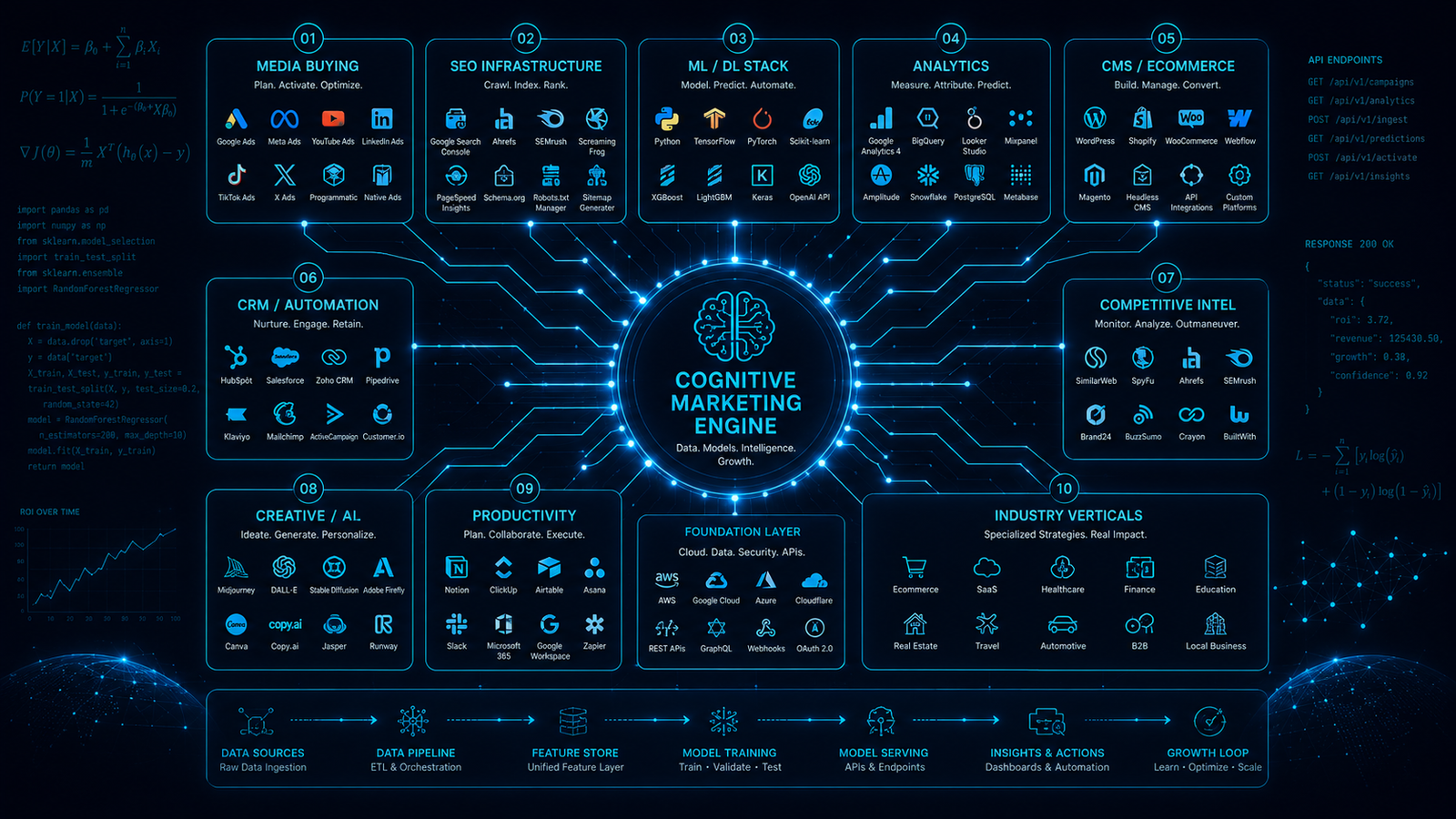
This is the full technology architecture behind the Cognitive Marketing Engine — media buying platforms, machine learning and deep learning algorithms, analytics pipelines, CMS and ecommerce infrastructure, and the agent layer that runs on top of it, organised by function.
No tool is here because it is popular. Each one is selected per engagement because it solves a specific problem that other tools cannot.
Paid media buying platforms
Full-spectrum programmatic and direct media buying across every major platform.
Search and intent-based platforms
- Google Ads — Search, Display, Shopping, Performance Max, YouTube Ads, Demand Gen. Google Ads API for programmatic bid management, automated rule deployment and raw log extraction beyond dashboard limits
- Microsoft Ads (Bing) — Search, Audience Network, Shopping. Microsoft Ads API for cross-platform budget modelling and audience overlap analysis
- Apple Search Ads — iOS app and mobile-first client acquisition in Tier 1 markets
Social and behavioural platforms
- Meta Ads — Facebook, Instagram, Reels, Messenger, Audience Network. Meta Graph API for raw creative performance data and audience signal extraction
- TikTok Ads — In-Feed, TopView, Branded Hashtag, Search Ads, Shopping. Marketing API for audience behaviour extraction and creative fatigue modelling
- Snapchat Ads — Snap Ads, Story Ads, Dynamic Ads, AR Lens, Spotlight. Marketing API for segmentation and dynamic catalog integration
- Pinterest Ads — Promoted Pins, Shopping Ads, Idea Ads, Collections. Shopping API for visual commerce in home, fashion and beauty
- LinkedIn Ads — Sponsored Content, Message Ads, Lead Gen Forms. Marketing API for B2B targeting, ABM and intent signal extraction
- X (Twitter) Ads — Promoted posts, trend takeovers, follower campaigns. Ads API for real-time sentiment velocity tracking tied to bid adjustments
- YouTube Ads — Skippable and non-skippable in-stream, Bumper, Masthead, Shopping. Data API for organic-paid integration and audience overlap
- Quora Ads — B2B and high-intent research-phase audience targeting
- Reddit Ads — Community-based targeting in technology, gaming, finance and niche verticals
- Amazon Ads — Sponsored Products, Sponsored Brands, DSP, Video. Advertising API for intent-based targeting and product-level ROAS modelling
- Taboola and Outbrain — Native content distribution and top-of-funnel retargeting in international markets
Programmatic and DSP platforms
- Google Display & Video 360 — Programmatic display, video and connected TV buying
- The Trade Desk — Cross-channel programmatic buying with first-party data integration
- MediaMath — Enterprise DSP for international campaign automation
- AdRoll — Retargeting and prospecting across web, social and email simultaneously
Search engine optimisation infrastructure
Raw data extraction, semantic analysis and technical architecture — not SaaS tool dependency.
Raw data sources (primary)
- Google Search Console API — Raw query-level data extraction, bypassing the processed interface
- Google BigQuery — GA4 raw event-level exports, session reconstruction and funnel modelling at SQL level
- Server log files — Apache and Nginx crawl log analysis for true bot detection and Googlebot behaviour mapping
- Bing Webmaster Tools API — Cross-engine ranking signal extraction
Technical SEO infrastructure
- Screaming Frog SEO Spider — Full-site crawl, log file analysis, custom extraction
- Sitebulb — Visual crawl architecture mapping and Core Web Vitals analysis
- DeepCrawl / Lumar — Enterprise-scale crawl monitoring and JavaScript rendering analysis
- OnCrawl — Crawl and log file integration for enterprise SEO data warehousing
Keyword and SERP intelligence
- Ahrefs API — Backlink graph data extraction — used for raw link data, not content scoring
- Semrush API — Competitor visibility data and SERP feature tracking
- Moz API — Domain authority signals for link portfolio modelling
- SerpAPI — Real-time SERP data extraction for semantic vector analysis
- DataForSEO API — Bulk SERP data, keyword metrics and rank tracking at scale
Semantic and NLP analysis
- Sentence-BERT (SBERT) — Semantic embedding generation for search intent vector mapping
- LDA (Latent Dirichlet Allocation) — Topic modelling for content decay detection across large libraries
- spaCy — Named entity recognition and dependency parsing for content semantic analysis
- Hugging Face Transformers — BERT, RoBERTa and DeBERTa for search intent classification
- Google Natural Language API — Entity and sentiment analysis for content alignment scoring
Machine learning and deep learning stack
The algorithmic engine powering predictive, prescriptive and causal marketing intelligence.
Core ML frameworks
- Scikit-learn — Classification, regression, clustering and anomaly detection pipelines
- XGBoost — Gradient boosting for propensity modelling, lead scoring and RTO classification
- LightGBM — High-performance gradient boosting for large-scale behavioural datasets
- CatBoost — Categorical feature handling for ecommerce product and audience modelling
Deep learning frameworks
- TensorFlow / Keras — Neural network architecture for sequential user behaviour modelling
- PyTorch — Custom deep learning models for creative performance prediction and NLP tasks
- FastAI — Transfer learning for computer vision and NLP marketing tasks
Transformer and large language model applications
- BERT — Search intent classification, content quality scoring, dark pattern detection in marketing copy
- RoBERTa — Sentiment analysis and brand voice consistency checking
- DeBERTa — Disentangled attention for nuanced marketing content classification
- GPT-4 API — Automated content brief generation, creative variant testing, competitive copy analysis
- Sentence-BERT (SBERT) — Semantic similarity scoring for SERP intent alignment
- CLIP — Cross-modal creative performance prediction for visual ad assets
- Whisper (OpenAI) — Audio transcription for video content analysis and YouTube optimisation
Computer vision models
- ResNet — Feature extraction for Meta creative fatigue prediction
- CLIP — Image-text alignment scoring for creative-audience fit analysis
- YOLOv8 — Object detection for creative element analysis and brand safety verification
- EfficientNet — Lightweight image classification for large-scale creative library analysis
Anomaly detection and unsupervised learning
- Isolation Forest — Statistical anomaly detection in ad spend, traffic patterns and conversion funnels
- DBSCAN — Density-based clustering for audience segmentation without predefined cluster counts
- Autoencoders — Reconstruction-error anomaly detection for sophisticated bot traffic identification
- One-Class SVM — Novelty detection for unusual campaign performance patterns
Causal inference and econometric models
- CausalML (Uber) — Uplift modelling and treatment effect estimation for true incremental lift
- DoWhy — Causal graph construction and structural equation modelling for attribution
- EconML (Microsoft) — Heterogeneous treatment effects for personalised campaign optimisation
- Synthetic control methods — Counterfactual estimation without holdout groups
- Difference-in-differences — Quasi-experimental design for channel-level true incrementality
Probabilistic and Bayesian models
- PyMC — Bayesian Media Mix Modeling, prior specification and posterior inference
- Stan (via PyStan) — Probabilistic programming for complex marketing econometric models
- Bayesian structural time series — CausalImpact analysis of campaign interventions
- BG/NBD model — Buy-till-you-die probabilistic model for customer dropout prediction
- Gamma-Gamma model — Monetary value modelling for customer lifetime value calculation
- Pareto/NBD — Enterprise-scale CLV modelling for subscription and repeat-purchase businesses
Forecasting and time series
- Prophet (Meta) — Time series forecasting for demand planning and budget seasonality
- NeuralProphet — Deep-learning-enhanced forecasting for non-linear performance trends
- LSTM — Sequential user behaviour modelling for ecommerce conversion prediction
- Temporal Fusion Transformer — Multivariate time series forecasting for campaign performance
- ARIMA / SARIMA — Classical time series for baseline modelling and anomaly benchmarking
Reinforcement learning and portfolio optimisation
- Multi-armed bandits — Thompson Sampling and UCB for real-time creative and bid optimisation
- Deep Q-Network (DQN) — Sequential decision-making for automated budget reallocation
- Proximal Policy Optimization — Continuous action space optimisation for programmatic bidding
- Markowitz mean-variance — Risk-adjusted budget allocation across advertising channels
- Black-Litterman model — Incorporating subjective views into optimal budget portfolios
- Convex optimisation (CVXPY) — Constrained budget optimisation with business rule integration
Analytics, data engineering and attribution
The data pipeline and measurement architecture behind every decision.
Web analytics and tracking
- Google Analytics 4 — Event-based tracking with BigQuery integration
- Google BigQuery — Raw event-level data warehousing and SQL-based funnel analysis
- Google Tag Manager — Tag architecture, custom event tracking, server-side tagging
- Server-side GTM — First-party data collection bypassing browser tracking limitations
- Mixpanel — Product analytics and user behaviour flow analysis for SaaS clients
- Amplitude — Behavioural cohort analysis and retention modelling for app and SaaS products
- Heap — Automatic event capture for retroactive behavioural analysis
Attribution and measurement
- Google Attribution 360 — Data-driven attribution with BigQuery integration
- Northbeam — ML-powered multi-touch attribution for ecommerce
- Triple Whale — Ecommerce-specific attribution with pixel and API integration
- Rockerbox — Cross-channel attribution with server-side event integration
- AppsFlyer — Mobile attribution and deep linking for app-based campaigns
- Branch — Mobile measurement and universal linking for cross-device attribution
- Markov chain attribution (custom) — Graph-based multi-touch attribution built in Python
Data warehousing and engineering
- Google BigQuery — Primary data warehouse for all raw marketing data
- Amazon Redshift — Enterprise client data warehousing for US-market engagements
- Snowflake — Cross-cloud data sharing for multi-platform client data integration
- dbt — Data transformation and modelling layer on top of warehouses
- Apache Airflow — Workflow orchestration for automated data pipeline scheduling
- Fivetran / Stitch — Automated connectors for CRM, ad platform and ecommerce data ingestion
Visualisation, reporting and the Python data stack
- Looker Studio — Client-facing dashboards with BigQuery and GA4 integration
- Tableau — Advanced data visualisation for enterprise client reporting
- Power BI — Microsoft ecosystem client reporting and executive dashboards
- Metabase — Open-source BI for internal data exploration and model monitoring
- Pandas / NumPy — Data manipulation and numerical computing for all ML pipelines
- Matplotlib / Seaborn — Statistical visualisation for diagnostic reports
- Plotly / Dash — Interactive visualisation for client-facing analytical dashboards
- Jupyter / Google Colab — Exploratory analysis and cloud-based model development
How the stack fits together
Placeholder — no video yet. Delete this box and drop in the Elementor Video widget when the recording is ready, or hide this whole section from Advanced → Responsive until then.
CMS, ecommerce and website infrastructure
Full-spectrum website, ecommerce and content management stack.
Content management systems
- WordPress — Primary CMS for content-heavy websites, blogs and service businesses
- Elementor — Page builder for WordPress with custom CSS and dynamic content
- Webflow — No-code CMS with clean semantic HTML output for SEO-optimised builds
- Ghost — Headless CMS for content-first publishing and newsletter integration
- Contentful — Headless CMS for enterprise multi-channel content delivery
- Sanity.io — Structured content platform for complex multi-region architectures
- Strapi — Open-source headless CMS for API-first website development
- Drupal — Enterprise CMS for government and large institutional clients
- Joomla — CMS for mid-market service businesses in international markets
Ecommerce platforms
- Shopify — Primary ecommerce platform for DTC and international ecommerce clients
- Shopify Plus — Enterprise Shopify for high-volume ecommerce brands
- Shopify API / GraphQL — Raw order, customer and product data extraction for ML pipelines
- WooCommerce — WordPress-native ecommerce for content-heavy ecommerce brands
- Magento / Adobe Commerce — Enterprise ecommerce for large catalog and multi-store clients
- BigCommerce — Scalable alternative for mid-market international brands
- PrestaShop — Ecommerce for European and Middle Eastern market clients
- OpenCart — Lightweight ecommerce for budget-conscious market segments
- Custom headless ecommerce — Next.js or Gatsby frontend with Shopify or CommerceJS backend
Ecommerce-specific tools and integrations
- Klaviyo — Email and SMS automation with Shopify behavioural data integration
- Omnisend — Multi-channel ecommerce marketing automation
- Yotpo — Reviews, loyalty and SMS for ecommerce social proof infrastructure
- Gorgias — Ecommerce customer support with Shopify integration
- ReCharge — Subscription management for DTC ecommerce brands
- Bold Commerce — Subscription, upsell and checkout optimisation for Shopify
- LoyaltyLion — Loyalty program infrastructure with behavioural data integration
- Postscript — SMS marketing with Shopify purchase behaviour segmentation
- Attentive — AI-powered SMS and email for ecommerce personalisation
- Privy — Conversion optimisation popups and email capture for ecommerce
CRM, marketing automation and lead management
Full-funnel lead and customer relationship infrastructure.
CRM platforms
- HubSpot CRM — Inbound marketing, lead scoring and pipeline management; API used for ML-enhanced lead scoring integration
- Salesforce — Enterprise CRM for B2B and large enterprise client engagements
- Salesforce Marketing Cloud — Enterprise marketing automation and journey building
- Zoho CRM — Mid-market CRM with multichannel lead tracking
- Pipedrive — Sales pipeline CRM for B2B lead generation clients
- Monday.com CRM — Project-integrated CRM for agency and service businesses
Marketing automation
- ActiveCampaign — Behaviour-based email automation with CRM integration
- Mailchimp — Email marketing for small to mid-market clients
- Klaviyo — Ecommerce-specific email and SMS automation
- Brevo (Sendinblue) — Multi-channel marketing automation for international markets
- Drip — Ecommerce CRM and email automation
- Pardot — B2B marketing automation within the Salesforce ecosystem
- Marketo — Enterprise B2B demand generation and lead nurturing
Conversion rate optimisation
- Hotjar — Heatmaps, session recordings and user behaviour analysis
- Microsoft Clarity — Behavioural analytics with ML anomaly flagging
- VWO — A/B and multivariate testing platform
- Optimizely — Enterprise experimentation platform for statistical significance testing
- Unbounce — Landing page builder with AI-powered traffic splitting
- Instapage — Conversion-focused landing page platform for PPC campaigns
Competitive intelligence and market research
Data-driven market and competitor analysis infrastructure.
Competitive and market intelligence
- Ahrefs — Backlink analysis, content gap identification, competitor organic visibility
- Semrush — Competitor PPC analysis, display advertising intelligence, market positioning
- SimilarWeb — Traffic source analysis, audience overlap and market sizing
- SpyFu — Competitor Google Ads history and keyword bidding intelligence
- AdSpy — Meta ad creative intelligence and competitor campaign monitoring
- BigSpy — Cross-platform ad creative monitoring across Facebook, TikTok and YouTube
- Minea — Ecommerce product and ad intelligence for DTC markets
- SocialPeta — Mobile and social ad intelligence for Asian and international markets
- Pathmatics (Sensor Tower) — Enterprise digital advertising intelligence
- Brandwatch — Social listening and brand sentiment monitoring at scale
- Mention — Real-time brand monitoring across web and social platforms
- BuzzSumo — Content performance analysis and influencer identification
Creative production and AI creative tools
Creative production and AI-assisted asset development infrastructure.
Design and visual production
- Figma — UI/UX design, ad creative wireframing and collaborative design systems
- Adobe Creative Suite — Photoshop, Illustrator, Premiere Pro and After Effects for professional production
- Canva Pro — Rapid creative production for social media and display ad formats
- Adobe Express — Quick creative adaptation for multi-format ad variations
AI creative generation
- Midjourney — AI image generation for ad creative concepts and feature image production
- DALL-E 3 — AI image generation with precise prompt control for marketing assets
- Stable Diffusion — Self-hosted generation for high-volume creative variant production
- Adobe Firefly — Commercially safe AI image generation inside the Adobe workflow
- Runway ML — AI video generation and editing for social media ad creative
- Synthesia — AI avatar video production for multilingual ad content
- HeyGen — AI video avatar for personalised video marketing at scale
- ElevenLabs — AI voice generation for video ads and audio content production
Video production and editing
- DaVinci Resolve — Professional video editing and colour grading for YouTube and ad creative
- CapCut Pro — Rapid short-form editing for TikTok, Reels and Shorts
- Adobe Premiere Pro — Professional editing for long-form and brand content
- Descript — AI-powered video editing via transcript for podcast and YouTube content
AI and productivity infrastructure
The operational intelligence layer powering research, analysis and content workflows.
Large language models and AI assistants
- Claude (Anthropic) — Primary AI for strategic reasoning, research synthesis and long-form content frameworks
- ChatGPT (OpenAI) — Creative ideation, copywriting variants and SEO content structuring
- Gemini (Google) — Research integration, Google ecosystem analysis and multimodal content tasks
- Perplexity AI — Real-time research and source-verified information gathering
- Mistral — Open-source LLM for self-hosted and cost-sensitive deployments
Research and academic tools
- Google Scholar — Academic paper discovery and citation tracking
- ResearchGate — Research collaboration and paper distribution
- Semantic Scholar — AI-powered academic literature discovery
- Zotero — Reference management for research paper citation organisation
- Overleaf — LaTeX-based academic writing and formatting for journal submissions
- Grammarly — Writing quality and clarity optimisation across all content outputs
Development and engineering
- Python — Primary language for all ML pipelines, API integrations and data engineering
- R — Statistical computing for econometric modelling and Bayesian analysis
- VS Code — Primary development environment
- GitHub — Version control for all custom pipeline and tool development
- Docker — Containerised deployment for custom marketing intelligence tools
- FastAPI — API development for custom marketing intelligence microservices
AI agents and the automation layer
The layer that runs the rest of the stack without a human clicking through it.
An AI agent is software that pursues a goal across multiple steps rather than performing a single action. Two architectures do the work, and two capability layers give either architecture its reach. The architectures are a choice per task; the capability layers are used by both.
Autonomous agents
Workflow (trigger-based) agents
MCP — Model Context Protocol
Skills — packaged expertise
| Question | Autonomous agent | Workflow (trigger-based) agent |
|---|---|---|
| What decides the next step | The model, from live data | A rule defined in advance |
| Built with | Python, ML models, custom pipelines | n8n, Make.com, Zapier |
| Best suited to | Diagnosis, prediction, budget allocation, retraining | Alerts, handoffs, reporting, guardrails, data movement |
| Fails when | Training data is thin or the outcome is unmeasurable | The situation is one the rule never anticipated |
| Where it runs in the engine | Loops 1, 2 and 4 | Loop 3, plus monitoring across all four |
Autonomous agent stack
- Python + FastAPI — Custom agent services deployed as containerised microservices
- LangChain / LlamaIndex — Orchestration and retrieval for multi-step reasoning over marketing data
- Anthropic and OpenAI APIs — Reasoning layer for agents that interpret unstructured marketing data
- Apache Airflow — Scheduling and dependency management for autonomous retraining pipelines
- Docker + GitHub Actions — Reproducible deployment and version control for every agent released
Workflow agent stack
- n8n — Primary self-hosted workflow automation — full data control, no per-task pricing at volume
- Make.com — Visual multi-step scenarios for cross-platform marketing operations
- Zapier — Fast integration coverage for long-tail SaaS tools without native APIs
- Webhooks and cloud functions — Custom triggers where no connector exists
MCP and skills layer
- MCP servers — Governed connections to BigQuery, GA4, Search Console, Google Ads, Meta and CRM data
- Custom skill libraries — Packaged analytical routines so diagnosis and reporting run to a fixed standard
- Evaluation harnesses — Automated checks on agent output before anything reaches a live account
What is deliberately not automated
- Deciding what the real problem is. Diagnosis sets the direction of everything downstream; an agent optimises within a frame it cannot question.
- Approving spend reallocation above a set threshold. A model can recommend it. A person signs it off.
- Anything where the outcome cannot be measured. An agent with no reliable feedback signal will confidently optimise toward the wrong thing.
- Brand voice and claims. Generated at scale, these become a legal and reputational liability faster than they become a saving.
How these architectures apply channel by channel — SEO, PPC, media buying and content marketing — sits in the AI agents section.
Industry-specific tool stacks
Vertical-specific tools applied per industry engagement.
- Ecommerce & DTC — Shopify + Klaviyo + Triple Whale + ReCharge + Yotpo + Gorgias + Postscript + LoyaltyLion + Bold Commerce
- B2B & SaaS — HubSpot + Salesforce + LinkedIn Ads + Pardot + Clearbit + ZoomInfo + Apollo.io + Bombora + G2 intent data
- Real estate — Google Ads + Meta Ads + Zoho CRM + Propertybase + Buildout + REsimpli + Follow Up Boss + Showcase IDX
- Health & wellness — Google Ads (PHI-compliant) + Meta Ads + Klaviyo + Mindbody + Jane App + Healthgrades + Zocdoc integration
- Fashion & apparel — Shopify Plus + Meta Shopping + Pinterest Ads + TikTok Shopping + Klaviyo + LoyaltyLion + Yotpo + Nosto
- Travel & hospitality — Google Hotel Ads + Meta Ads + TripAdvisor API + Booking.com Partner API + RevPAR analysis + Mailchimp
- Automotive — Google Ads + Meta Ads + VDP tracking + DealerSocket + VinSolutions + Cars.com API + CarGurus integration
- Beauty & cosmetics — TikTok Shopping + Pinterest Ads + Instagram Shopping + Shopify + Klaviyo + Yotpo + GRIN
- Logistics & supply chain — Google Ads + LinkedIn Ads + HubSpot + Salesforce + FreightTech API integrations + ERP data connections
- Education & e-learning — Google Ads + Meta Ads + LinkedIn Ads + LMS integrations (Teachable, Thinkific, Kajabi) + Mailchimp + Drip
The governing principle behind every tool choice
No tool is used because it is popular. Every tool is used because it solves a specific problem that other tools cannot.
SaaS dashboards are used for surface-level monitoring — never for strategic decisions. Raw API data, ML pipelines and causal inference models are used for every decision involving real budget allocation.
The stack is not static. It evolves as new algorithms, platforms and data sources emerge, because the only constant in computational marketing is that the environment is always changing.
Data never sleeps. And neither does the infrastructure built to understand it.
Questions about the stack
Is every tool on this page used on every engagement?
No. This is the full architecture available, not a checklist applied to everyone. Tools are selected per engagement based on the platform, the industry and the data available — the industry stacks section shows how that selection typically looks in practice. Using fewer, better-matched tools consistently outperforms using more.
Why use raw APIs when SaaS tools already report the same data?
Because SaaS dashboards show processed, post-mortem data. They tell you what happened, not why it happened or what is about to happen. Raw sources — BigQuery exports, Search Console API, server logs, ad platform logs — are what machine learning models actually need to detect anomalies, model causality and forecast reliably.
What is the difference between an autonomous agent and a workflow automation?
A workflow agent built in n8n, Make.com or Zapier runs a sequence you defined in advance when a trigger fires — excellent for alerts, reporting and moving data between systems. An autonomous agent decides its own next step from live data, which is necessary where the correct action cannot be written down beforehand. MCP gives either one access to real tools and data; skills package the expertise so every run meets the same standard.
Does this stack replace an AI digital marketing expert in Pakistan?
No — it is what one uses. Tools remove repetition and monitoring latency, but selecting the right method, diagnosing the actual constraint and deciding what should not be automated all remain human work. A stack this size in the wrong hands produces expensive noise.
Do clients need to buy all of this software?
No. Most of the modelling layer is open-source (Python, scikit-learn, PyMC, CausalML) and runs on infrastructure rather than per-seat licences. Where a paid platform is genuinely required, that is stated up front with the reason, and every account stays in the client’s name.

Usman Saeed
AI-Driven Digital Marketing Intelligence Consultant & Growth Engineer in Pakistan. Usman Saeed specializes in engineering resilient digital growth architectures — helping enterprise brands eliminate tracking data drops, secure conversion signals, and maximize profitability through E-commerce Engineering, server-side Signal Engineering, and Predictive Intelligence. With 12+ years of experience and advanced data science expertise, marketing guesswork is replaced with mathematical precision — automated systems that bridge execution with business intelligence, ensuring your investment delivers measurable scale.
Where to go next
Want to see this stack applied to your problem?
The first conversation is about data gaps and pipelines, not tool lists. If your data cannot support the modelling, you will be told that directly.