
AI & Data Science Academic Journey: From Practitioner to Researcher
Most digital marketing practitioners stop their formal education the moment they enter the workforce. Everything after that is learning on the job — courses, certifications, trial and error. That path built the first decade of this career, and it was valuable. But it had a ceiling.
In 2025 that ceiling was addressed directly: enrolment in MS Data Science with an AI focus — not as a career pivot away from marketing, but as the missing layer that makes everything else in this practice possible.
Why data science specifically, and why in 2025
By 2024 a pattern had become undeniable. Marketing execution — the actual doing of SEO, running ads, writing copy — was being commoditised at an accelerating rate. AI tools were performing in seconds what used to require years of expertise.
The practitioners who would remain valuable were not the ones who could execute fastest. They were the ones who could understand the mathematical and statistical foundations underneath the tools, and use that understanding to build, validate and improve systems the tools themselves cannot.
That meant one thing: going back to formal, rigorous academic study at graduate research level. Not a weekend bootcamp. Not a certificate course. A thesis-track programme demanding the same rigour as any serious research degree.
The foundation this builds on
This degree is not happening in isolation. It sits directly on top of two things that took a decade to accumulate.
Master of Computer Science — 2015 to 2017
12+ years of real client data — 2014 to present
Graduate-level data science education applied to a decade of real marketing data that most data science students will never have access to.
What the coursework actually involves
This is a thesis-track research programme — the end goal is not coursework completion but an original research contribution to the field. That contribution is the three papers currently under peer review.
Advanced natural language processing
Advanced machine learning
Algorithm analysis
Data tools and techniques
Why a working marketer went back to university
Placeholder — no video yet. Delete this box and drop in the Elementor Video widget when the recording is ready, or hide this whole section from Advanced → Responsive until then.
From classroom to client engagement: the direct line
Most graduate students complete coursework, write a thesis, and then — separately — begin a career where they apply, or fail to apply, what they learned. Here the application is happening simultaneously, in real time, on real client data.
| Coursework concept | Client application |
|---|---|
| SBERT and transformer NLP | Search intent vector drift detection in Loop 1 diagnostics |
| XGBoost and gradient boosting | Lead propensity scoring and RTO classification |
| Algorithm analysis and optimisation theory | Efficient raw data extraction pipelines |
| Data tools and the Python stack | Custom pipeline deployment in Loop 3 |
| Bayesian methods (independent study) | Media Mix Modeling budget allocation in Loop 2 |
Every concept studied in a given semester has a direct, traceable application in an active client engagement within weeks. This is not theoretical learning — it is applied research happening live.
Where this academic work meets AI agents
Marketing AI agents come in two architectures. Workflow agents — built on n8n, Make.com or Zapier — run a sequence you defined in advance when a trigger fires. They are genuinely useful, and they require no data science background at all.
Autonomous agents are different. They decide their own next step from live data, which means someone has to build the model underneath, choose the right objective, and design an evaluation that proves it is working. That is not a tooling skill. That is exactly what this coursework covers.
| Question | Autonomous agents | Workflow agents |
|---|---|---|
| What it requires to build | Statistics, ML modelling, evaluation design — the coursework on this page | A connector account and a clear rule; no mathematical background needed |
| Who can build one | Someone who can validate whether a model is actually right | Anyone comfortable with a visual workflow builder |
| Failure mode | Confidently optimises toward the wrong objective if the evaluation is weak | Silently breaks when reality does not match the rule |
| Why the academic work matters | It is what makes the difference between a model that works and one that only looks like it works | It does not — and pretending otherwise is where most AI marketing claims fall apart |
Two capability layers, used by both
MCP — Model Context Protocol
Skills — packaged expertise
How these architectures apply channel by channel sits in the AI agents section.
The research output
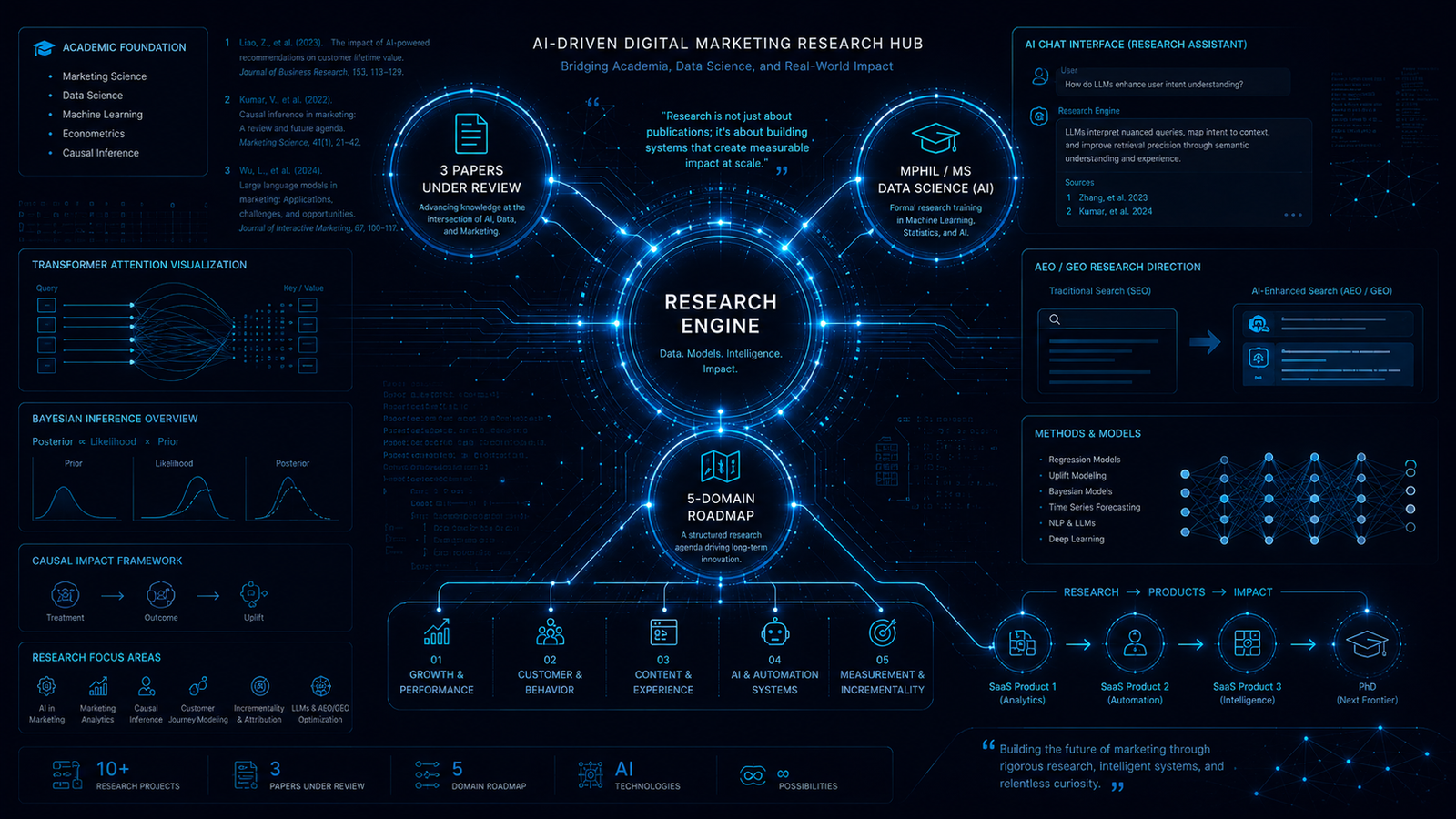
Three papers have emerged directly from this academic track, all currently under peer review for 2026.
- AI-driven lead scoring for digital marketing: predicting high-intent leads using machine learning
- Predicting high-value leads in e-commerce using deep learning on sequential user behaviour
- AI-driven multi-touch attribution in digital marketing using deep learning
Each paper began as a question raised by real client data, then was formalised using the methodological rigour graduate research requires. This is the loop: practice generates questions, academia provides rigorous answers, and those answers improve practice.
The PhD track
This degree is not the destination. It is the bridge. The thesis research and the three papers emerging from it form the foundation for PhD applications targeted for 2027.
The PhD track will extend this direction — AI-driven marketing intelligence, predictive analytics and causal inference applied to digital marketing — at a depth and scale beyond what a master’s thesis can cover.
The long-term academic goal
To be one of the few people globally who holds all four of the following at once:
- 12+ years of real-world digital marketing practitioner experience
- A PhD in a data science or AI-related field
- A body of published research connecting the two
- An active practice applying that research to real client outcomes, continuously
That combination, at PhD level, is genuinely rare — and it is the direction this journey is deliberately heading (Insha’Allah).
Why this matters if you are considering working with this practice
When a typical consultant says they use AI and data, it usually means they use a chat assistant for content ideas and look at a dashboard with “AI-powered” in its marketing copy.
When this practice says it, it means four specific things.
Foundations, not features
Peer-reviewed research
A traceable line
A long-term trajectory
This is not marketing language. It is the academic infrastructure behind every strategic recommendation made in this practice.
Questions about this academic path
What is Usman Saeed studying, and where?
MS Data Science with an AI focus, on the thesis track, enrolled in 2025. It builds on a Master of Computer Science completed between 2015 and 2017 at Global Institute Lahore. The thesis research is the basis for the three papers currently under peer review and for PhD applications targeted at 2027.
Why does a digital marketing consultant need a data science degree?
Because the limitation was structural. Twelve years of client work surfaced problems — lead scoring, attribution, predicting customer value — that off-the-shelf marketing tools do not solve well. Building models that genuinely work, rather than models that only look like they work, requires the statistical and evaluation training a graduate programme provides.
Does the academic work slow down client engagements?
The opposite, in practice. The coursework runs on live client data rather than textbook datasets, so concepts studied in a semester reach an active engagement within weeks. The table on this page maps each coursework area to where it is applied.
Do you need a data science degree to build AI agents for marketing?
Not for workflow agents. Anyone comfortable with n8n, Make.com or Zapier can build sequences that fire on a trigger, and those are genuinely useful. Autonomous agents are different — someone has to build the model, choose the objective and design an evaluation that proves it works. That part is where the training matters, and where most AI marketing claims quietly fall apart.
How does this compare to certifications from Google or Meta?
They answer different questions. Platform certifications confirm you know how a specific product works today; graduate research training covers why the underlying methods work at all, and how to tell when they are failing. Both are held here, but only one of them survives the next platform update.
What should someone in Pakistan take from this if they want the same path?
That the sequence matters more than the speed. The practitioner years came first and produced the questions; the academic work came second and produced rigorous answers. Doing it in the other order — credentials before real client data — tends to produce theory with nothing to test it against.

Usman Saeed
AI-Driven Digital Marketing Intelligence Consultant & Growth Engineer in Pakistan. Usman Saeed specializes in engineering resilient digital growth architectures — helping enterprise brands eliminate tracking data drops, secure conversion signals, and maximize profitability through E-commerce Engineering, server-side Signal Engineering, and Predictive Intelligence. With 12+ years of experience and advanced data science expertise, marketing guesswork is replaced with mathematical precision — automated systems that bridge execution with business intelligence, ensuring your investment delivers measurable scale.
Where to go next
Want this applied to your data?
The first conversation is about data gaps and pipelines, not credentials. If your data cannot support the modelling, you will be told that directly.