
Research Papers: AI-Driven Marketing Research Under Peer Review
Most digital marketing consultants read research papers, if they read them at all. This practice writes them.
Every paper below originated from a real pattern observed across 12+ years and 100+ client engagements, then was formalised through rigorous academic methodology for international peer review. These are not theoretical exercises disconnected from practice — they are direct extensions of real problems existing marketing tools do not solve well enough.
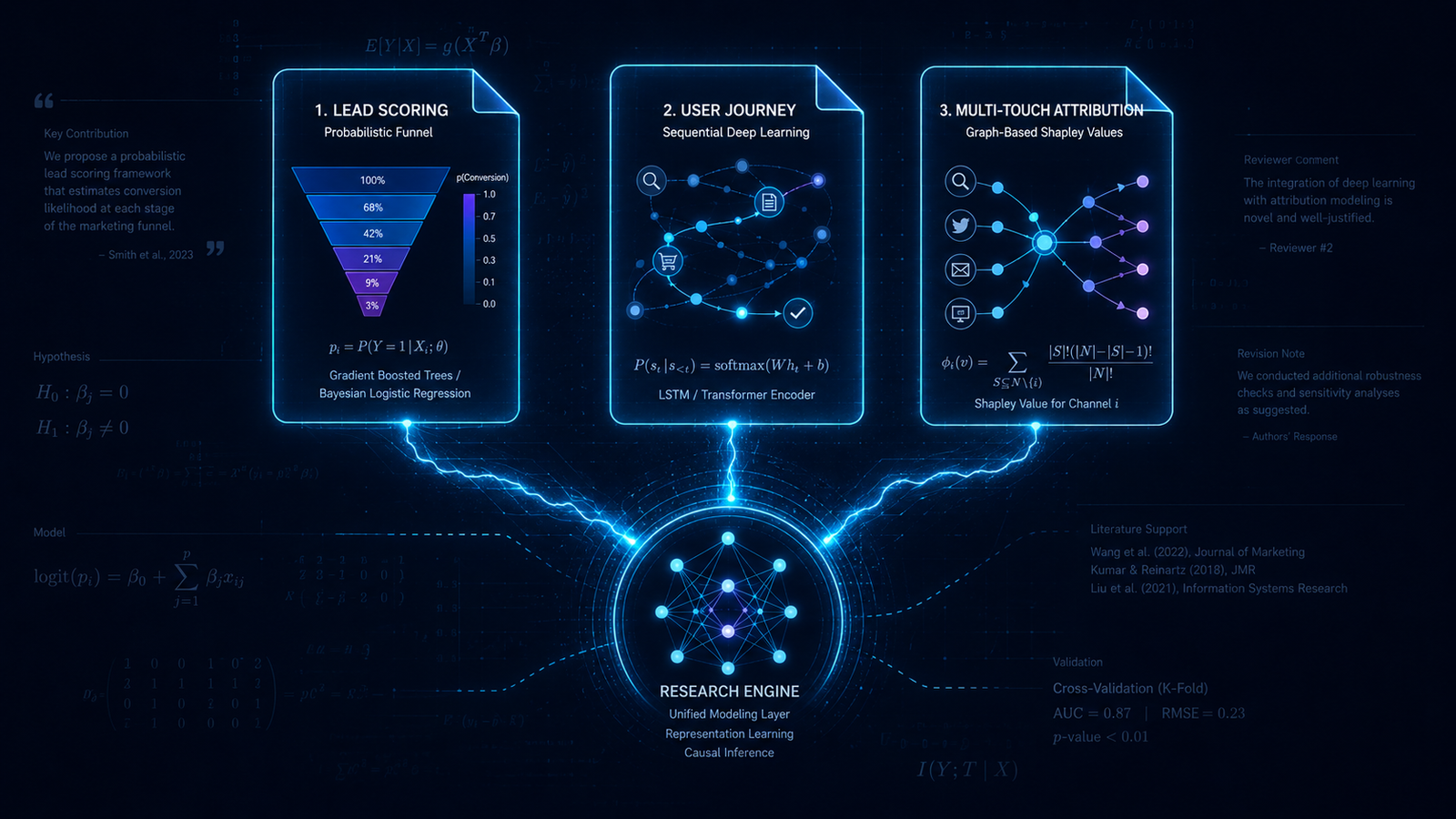
AI-driven lead scoring for digital marketing: predicting high-intent leads using machine learning
Under peer review · 2026 · Machine learning · B2B marketing · Lead generation
The problem this paper addresses
Most B2B and lead-generation businesses score leads using static rules — job title, company size, form fields completed. These rules treat every lead within a segment as identical, ignoring the behavioural signals that actually predict purchase intent. The result: sales teams waste time on low-intent leads while genuinely high-intent prospects receive the same generic follow-up as everyone else.
What this research explores
This paper applies supervised machine learning models, including gradient boosting architectures, to historical lead and conversion data — identifying behavioural and firmographic patterns that static scoring systems miss entirely. It moves lead scoring from rule-based classification to probability-based prediction, assigning each lead a mathematically derived likelihood of conversion learned from actual historical outcomes.
Why it matters
For businesses running B2B lead generation, especially in competitive markets like the UK, USA and UAE, the difference between contacting a 20% likely lead first versus an 80% likely lead first compounds into significant pipeline velocity and revenue impact over time.
Predicting high-value leads in e-commerce using deep learning on sequential user behaviour
Under peer review · 2026 · Deep learning · Ecommerce · Sequential modelling
The problem this paper addresses
Ecommerce platforms generate enormous amounts of sequential behavioural data — page views, time spent, scroll depth, cart additions and removals, search queries — in the order they happen. Most marketing analytics treats this as isolated snapshots, losing the sequence entirely. But the order of actions matters. A user who views a product, leaves, returns three days later and adds to cart behaves very differently from one who adds immediately and abandons, even if both eventually convert.
What this research explores
This paper applies deep learning architectures designed for sequential data — capable of learning patterns across entire user journeys rather than isolated events — to identify which behavioural sequences predict high lifetime value versus one-time, low-value transactions.
Why it matters
For ecommerce brands, particularly DTC and subscription businesses, identifying high-value users early enables proactive retention, personalised offers and resource allocation toward the customers who actually drive long-term revenue. This research directly informed Loop 4 of the Cognitive Marketing Engine — specifically the BG/NBD customer dropout tracking and predictive CLV modelling applied in client engagements.
The three papers, explained without the jargon
Placeholder — no video yet. Delete this box and drop in the Elementor Video widget when the recording is ready, or hide this whole section from Advanced → Responsive until then.
AI-driven multi-touch attribution in digital marketing using deep learning
Under peer review · 2026 · Deep learning · Attribution modelling · Causal inference
The problem this paper addresses
Every major ad platform — Google, Meta, TikTok — reports attribution in a way that favours itself. Last-click models overcredit bottom-of-funnel channels. First-click models overcredit awareness. Linear models assume every touchpoint matters equally, which is almost never true. The result: businesses allocate budget based on attribution data that is structurally biased toward whichever platform is reporting it.
What this research explores
This paper applies deep learning models to map the full multi-touch customer journey across channels, identifying the true incremental contribution of each touchpoint independent of platform-reported attribution — which is increasingly unreliable due to privacy changes, cross-device limitations and platform self-interest.
Why it matters
For any business running multi-channel campaigns, this research provides a path toward causally validated budget allocation rather than allocation based on numbers platforms have a financial incentive to inflate. It directly informed Loop 2 of the Cognitive Marketing Engine — specifically the Markov chain multi-touch pathing graph engine and CausalML-based incremental lift measurement used in client reporting.
How this research connects to client work
Research conducted in isolation, disconnected from real client data, produces elegant models that do not survive contact with messy reality. Marketing practice conducted without research rigour produces frameworks built on correlation, assumption and “this worked for one client so it must work for everyone.”
Every paper above exists because of a pattern observed in real client engagements, and every finding feeds back into how the Cognitive Marketing Engine is applied. This is not research for the sake of credentials — it is the intelligence layer that makes strategic recommendations mathematically defensible rather than merely experientially confident.
What this research makes buildable in AI agents
Marketing AI agents come in two architectures. Workflow agents — n8n, Make.com, Zapier — run a sequence you defined in advance when a trigger fires. Autonomous agents decide their own next step from live data, which requires a model underneath.
These three papers are that model layer. Without research like this, an “AI agent” is just a rule with better branding.
| Research | What it enables | Why a rule alone is not enough |
|---|---|---|
| Paper 01 — lead scoring | An autonomous agent that scores every inbound lead on live behavioural data and routes it by predicted intent | A workflow agent can notify sales when a form is filled — it cannot rank the lead |
| Paper 02 — sequential behaviour | An autonomous agent that flags high-lifetime-value users early in the journey and triggers retention treatment | A workflow agent can send a cart-abandonment email — it cannot tell who deserves a discount |
| Paper 03 — causal attribution | An autonomous agent that reallocates budget on measured incremental lift rather than platform-reported ROAS | A workflow agent can pause a campaign at a CPA threshold — it cannot judge true contribution |
MCP — Model Context Protocol
Skills — packaged expertise
How these architectures apply channel by channel sits in the AI agents section.
The research pipeline
Research is not a one-time academic requirement. It is an ongoing component of the practice.
Currently in progress
Planned direction
Why this matters for anyone considering this practice
When you work with most digital marketing consultants, their expertise is a combination of experience and whatever blog posts or courses they have consumed.
Here, the strategic frameworks applied to your business are backed by original research — research that has gone through peer review, been mathematically validated, and directly shapes the methodology used in your engagement. That is a different category of expertise entirely.
Practice generates the questions. Academia provides rigorous answers. Those answers improve practice.
Questions about this research
Are these papers published yet?
No — all three are under peer review for 2026, which is stated plainly rather than implied otherwise. Peer review means independent reviewers whose job is to find flaws in the argument are examining the methodology. Until that process completes, they are described here as under review, not as published work.
Where did the research questions come from?
Real client accounts. Lead scoring came from B2B engagements where static rules were misdirecting sales effort; the sequential behaviour paper came from ecommerce data where session snapshots were losing the journey; the attribution paper came from repeatedly seeing platform-reported numbers disagree with actual revenue. Each began as a practical problem, not a literature gap.
Can clients read the full papers?
Not while they are under review — journals generally restrict circulation during the process. What can be shared is the methodology as it applies to a specific account, which is exactly what happens during an engagement: the model, the assumptions and the evaluation are explained rather than presented as a black box.
Does an AI digital marketing expert in Pakistan really need to publish research?
Not to run campaigns, no. It matters when the claim is that decisions are model-driven. A model can look convincing and still be wrong; peer review is one of the few mechanisms that tests whether a method holds up under scrutiny from people with no incentive to agree.
How do these papers affect what a client actually receives?
Directly. Paper 1 underlies the propensity scoring used in Loop 4, Paper 2 informs the CLV and dropout modelling in the same loop, and Paper 3 underlies the Markov chain attribution and incremental lift measurement in Loop 2. Every one of those appears in client reporting.

Usman Saeed
AI-Driven Digital Marketing Intelligence Consultant & Growth Engineer in Pakistan. Usman Saeed specializes in engineering resilient digital growth architectures — helping enterprise brands eliminate tracking data drops, secure conversion signals, and maximize profitability through E-commerce Engineering, server-side Signal Engineering, and Predictive Intelligence. With 12+ years of experience and advanced data science expertise, marketing guesswork is replaced with mathematical precision — automated systems that bridge execution with business intelligence, ensuring your investment delivers measurable scale.
Where to go next
Want this research applied to your data?
The first conversation is about data gaps and pipelines, not credentials. If your data cannot support the modelling, you will be told that directly.