
The Cognitive Marketing Engine: A Computational Marketing Framework
Most marketing frameworks are built on assumptions — keyword calendars built on SaaS tool scores, ad budgets distributed by gut feel, campaign decisions made by reading last week’s dashboard and guessing what to do next.
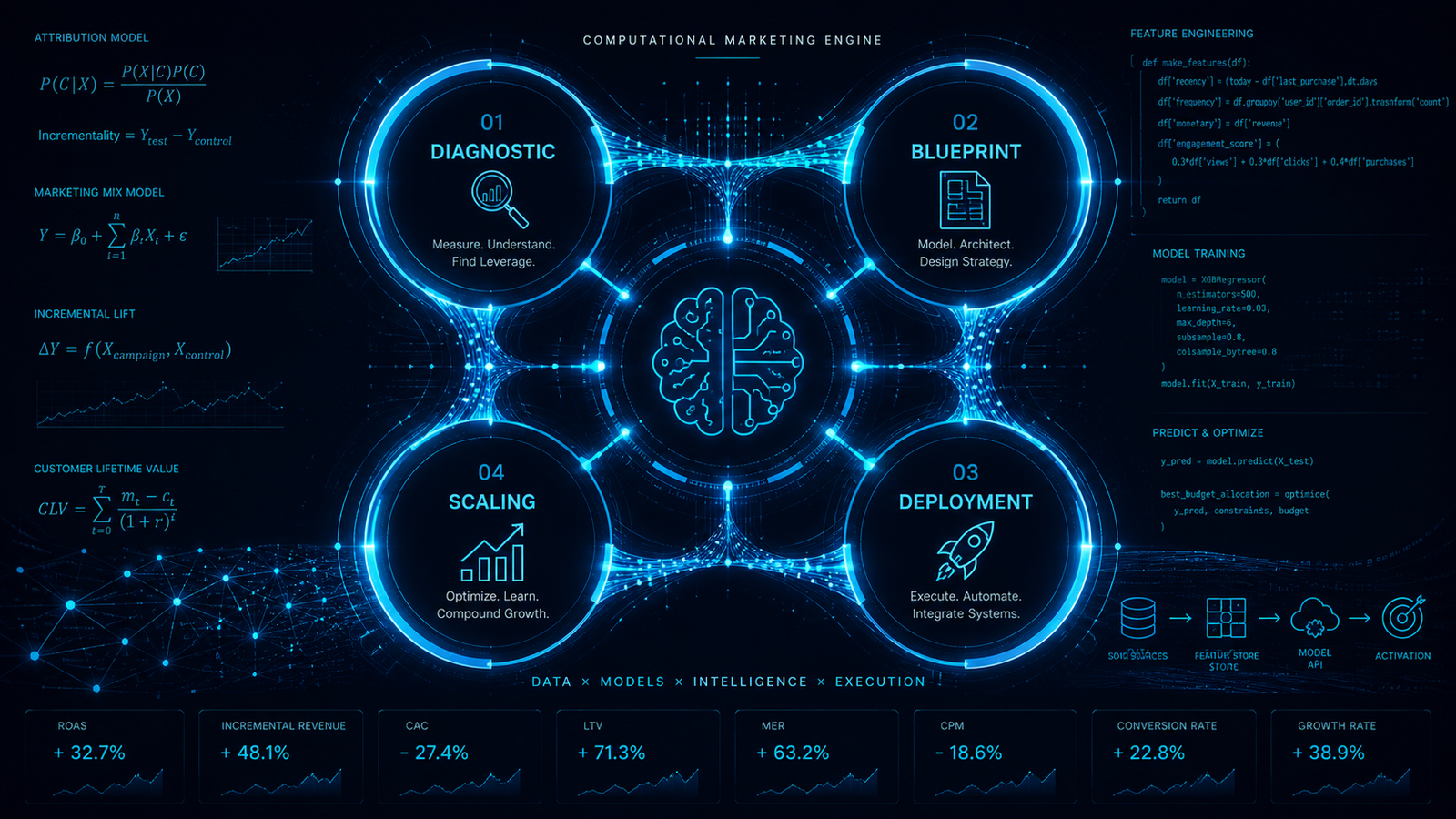
The Cognitive Marketing Engine (CME) replaces all of that. Not with another checklist and not with another automated tool, but with a mathematically rigorous, machine-learning-driven, causally validated system that treats marketing as an empirical science rather than a creative guessing game.
Why a new framework was necessary
Traditional agencies start at execution. They write 50 blog posts because a tool gave a keyword a difficulty score of 30. They scale ad budgets because the native dashboard shows a green ROAS number. They report impressions and click-through rates because those numbers look good in a slide deck. None of that is strategy. That is expensive guesswork.
Standard SaaS tools — Ahrefs, Semrush, native ad dashboards — only show post-mortem data. They tell you what already happened. They cannot tell you why it happened, what is about to happen, or what the mathematically optimal response is.
The Cognitive Marketing Engine was built because data never sleeps, and every day spent executing without empirical diagnostics is a day of budget bleeding that could have been prevented.
The four critical loops
The engine runs as four sequential loops. Each one produces the input the next one requires, which is why the order is fixed and never skipped.
Loop 1 — The diagnostic
Loop 2 — The blueprint
Loop 3 — The deployment
Loop 4 — The scaling
Empirical anomaly and drift identification
We do not guess. We extract. Before any strategy is built or any campaign is touched, the engine goes directly to raw data sources that standard tools never access.
Raw sources, not processed views
- Google BigQuery GA4 raw database dumps — not the processed dashboard view
- Ad platform API logs — not the native reporting interface
- Server crawl logs — not the sanitised SEO tool output
What is applied to that data
- Unsupervised machine learning (Isolation Forests) to identify statistical anomalies invisible to standard tools
- Sentence-BERT (SBERT) embedding tracking to detect semantic vector drift — when Google’s understanding of a topic has mathematically shifted away from the client’s content
- Bot-fraud detection pipelines to identify fraudulent traffic bleeding ad budgets before a single optimisation decision is made
The result: a mathematically precise diagnostic showing exactly where the problem is — not where the tool thinks it might be.
Causal strategy and portfolio architecture
We do not build creative calendars. We build mathematical probability maps. Once the empirical diagnostic is complete, strategy is constructed using econometric and causal modelling.
- Bayesian Media Mix Modeling (MMM) for privacy-safe, mathematically optimal budget distribution across all channels simultaneously, without relying on cookie-based attribution that platforms manipulate
- Markowitz Efficient Frontier — the same portfolio optimisation model used in financial markets, applied to ad spend allocation to maximise ROI while minimising budget risk
Every budget decision, every channel allocation and every strategic priority is backed by a mathematical probability — not an opinion.
The Cognitive Marketing Engine, explained
Placeholder — no video yet. Delete this box and drop in the Elementor Video widget when the recording is ready, or hide this whole section from Advanced → Responsive until then.
Programmatic API and algorithmic execution
We do not push buttons. We deploy pipelines. Execution is not done manually through ad manager interfaces or basic automation rules.
- Custom Python pipelines connected directly to the Google Ads API and Meta Graph API
- Automated programmatic guardrails — bid shifts triggered by real-time NLP sentiment velocity, inventory levels (days of supply) and live market signals
- Algorithmic execution that responds to data in real time, not the next time someone logs into a dashboard
The difference between manual execution and programmatic deployment is the difference between reacting to yesterday’s data and responding to today’s signals.
Continuous ML optimisation and drift monitoring
Data science assets decay. We prevent it. This is the step most practitioners skip entirely, and it is where most marketing systems silently fail. Predictive models trained on historical data experience concept drift — the environment changes, consumer behaviour shifts, platform algorithms update, and the model’s predictions become progressively less accurate.
- Dynamic model retraining using fresh monthly transaction data — XGBoost return propensity classifiers retrained continuously as new behavioural data arrives
- BG/NBD customer dropout tracking — probabilistic models calculating the mathematical probability a customer is still active, enabling accurate customer lifetime value forecasting
- Markov chain multi-touch pathing graph engines to measure the true fractional economic value of every content asset and ad touchpoint across the full customer journey
The system does not plateau. It improves continuously by design.
The AI and data science integration matrix
This framework does not add AI as a feature. AI is the foundation. Every static IF/THEN marketing automation rule has been replaced with stochastic, probabilistic and causal machine learning models.
Natural language processing
Supervised learning
Probabilistic modelling
Computer vision
| Dimension | Traditional marketing | Cognitive Marketing Engine |
|---|---|---|
| Optimisation signal | Historical CPA, CTR and ROAS | Predictive uplift and persuadability scoring |
| Bidding | Manual bid adjustments | Algorithmic, inventory-constrained bidding |
| Attribution | Platform attribution models | True incremental lift via causal ML |
| Creative fatigue | Noticed late, after performance drops | Predicted in advance, before the platform flags it |
| Automation logic | Static IF/THEN rules | Dynamic ML model retraining |
Where AI agents fit inside the engine
An AI agent is software that pursues a goal across multiple steps rather than performing a single action. In marketing, agents come in two architectures and rely on two capability layers. The architectures are a choice — you pick one per task. The capability layers are not: both architectures use them.
Two architectures
Autonomous agents
Workflow (trigger-based) agents
Two capability layers
MCP — Model Context Protocol
Skills — packaged expertise
| Question | Autonomous agent | Workflow (trigger-based) agent |
|---|---|---|
| What decides the next step | The model, from live data | A rule you defined in advance |
| Best suited to | Diagnosis, prediction, budget allocation, retraining | Alerts, handoffs, reporting, guardrails, data movement |
| Typical stack | Python, ML models, custom pipelines | n8n, Make.com, Zapier |
| Fails when | Training data is thin or the outcome is unmeasurable | The situation is one the rule never anticipated |
| Cost to build | High — needs data, modelling and validation | Low — hours to days |
| Where it sits in the CME | Loops 1, 2 and 4 | Loop 3, plus monitoring across all four |
How agents map onto the four loops
- Loop 1 — autonomous, plus MCP. Anomaly and drift detection runs continuously against raw BigQuery and log data rather than waiting for someone to open a dashboard.
- Loop 2 — autonomous, plus skills. Budget allocation and causal modelling follow a packaged, repeatable analytical standard on every run.
- Loop 3 — workflow agents, plus MCP. Guardrails, bid shifts, alerts and escalations fire on defined triggers through the Google Ads and Meta APIs.
- Loop 4 — autonomous, plus skills. Retraining schedules, drift checks and model evaluation run to the same criteria every cycle, so quality does not depend on who is watching.
What is deliberately not automated
- Deciding what the real problem is. Diagnosis sets the direction of everything downstream; an agent optimises within a frame it cannot question.
- Approving spend reallocation above a set threshold. A model can recommend it. A person signs it off.
- Anything where the outcome cannot be measured. An agent with no reliable feedback signal will confidently optimise toward the wrong thing.
- Brand voice and claims. Generated at scale, these become a legal and reputational liability faster than they become a saving.
The channel-level detail — how these architectures apply to SEO, PPC, media buying and content marketing specifically — sits in the AI agents section.
Why this order is non-negotiable
A real case — the cost of skipping Loop 1. An ecommerce brand spending $50,000 per month deployed automated 20% cart-abandonment discount sequences to every user who abandoned checkout. Standard optimisation logic: recover the cart, offer the incentive.
Because Loop 1 was never run, they never identified that 65% of those users would have purchased at full price without any discount. The automation was not recovering revenue. It was systematically destroying net margin at scale — thousands of dollars per month — while the ROAS dashboard showed green numbers.
- You cannot build a mathematically sound strategy on undiagnosed data
- You cannot deploy programmatic execution on a flawed strategic architecture
- You cannot optimise a system that was never properly calibrated
Data never sleeps. And neither does budget bleeding when the root cause goes unmeasured.
A real-world application: the vector drift crisis
The client: a scaling enterprise whose top-performing organic pages dropped from page 1 to page 3 on Google, despite every standard SEO tool showing perfect on-page optimisation scores.
The standard response would have been more backlinks, rewritten meta descriptions or increased publishing frequency. All of it would have failed.
The CME response: traditional keyword audits were bypassed entirely. Raw data was extracted via the Google Search Console API and fed into the SBERT pipeline. We mapped the multi-dimensional semantic vector space of the live SERP and identified a search intent vector drift — the mathematical intent centroid of Google’s ranking model had shifted, leaving the client’s content structurally misaligned with what the algorithm now understood the topic to mean.
No tool flagged this. No dashboard showed it. The math found it. The content vectors were mathematically re-aligned to match the econometric drift.
The pages recovered page 1 positions within 18 days — without purchasing a single backlink.
What working with this framework looks like
The process begins with a data security check and client credentials intake for a full data architecture audit. We do not discuss creative ideas in the first call. We analyse data gaps, server crawl logs and raw data pipelines via BigQuery.
What the client must provide
- Complete raw access to Google Analytics BigQuery exports
- Historical transaction database logs (SQL or Shopify APIs)
- Google Search Console API credentials
- Historical ad spend platform log files
Strategy readiness timeline: the initial empirical audit pipeline requires 14 to 21 business days to process historical raw data, clean the datasets and generate the algorithmic model base.
This is not slow. This is the difference between a strategy built on mathematical certainty and one built on a 30-minute discovery call and a pre-made slide deck.
Who this framework is built for
The engine is designed for organisations where media spend accountability is non-negotiable and the data volume is large enough for modelling to be meaningful.
High-scale ecommerce brands
Venture-backed B2B SaaS
Enterprise lead generation networks
International businesses
This is not a standard marketing engagement. This is a precision operation.
Questions about the framework
What is the Cognitive Marketing Engine?
A four-loop computational marketing framework that replaces assumption-based marketing with empirical diagnosis, causal strategy modelling, programmatic execution and continuous machine learning optimisation. It was built over 12+ years of client work and uses methods from econometrics, machine learning and causal inference rather than SaaS tool scores and dashboard readings.
Why can the four loops not run out of order?
Because each loop produces the input the next one needs. Strategy built on undiagnosed data optimises the wrong thing; programmatic execution deployed on a flawed strategy scales that error faster; and a system that was never calibrated cannot be meaningfully optimised. The order is the safeguard.
How do AI agents fit into this framework?
Two architectures and two capability layers. Autonomous agents handle work where the correct action cannot be defined in advance — diagnosis in Loop 1, allocation in Loop 2, retraining in Loop 4. Workflow agents built on n8n, Make.com or Zapier handle Loop 3 guardrails and alerts, where the action is known in advance. MCP gives either architecture access to real tools and data; skills package the expertise so every run meets the same standard.
Does this replace hiring an AI digital marketing expert in Pakistan?
No — it is how the work gets done, not a substitute for it. Agents remove repetition and monitoring latency, but the diagnosis of what the real problem is, the decision to reallocate significant spend, and anything without a measurable feedback signal stay with a person. Automation scales judgement; it does not supply it.
Why does the initial audit take 14 to 21 business days?
Because raw data has to be extracted, cleaned and modelled before any recommendation is defensible. That covers BigQuery exports, transaction logs, Search Console data and historical ad platform files. A faster answer is available anywhere; it is just an answer built on the same dashboards that caused the problem.
What size of business is this suitable for?
Organisations with enough historical data volume for modelling to be statistically meaningful — typically high-scale ecommerce, venture-backed B2B SaaS, enterprise lead generation networks, and international businesses in Tier 1 markets. Below a certain data threshold, simpler methods give better returns, and that gets said directly rather than sold around.

Usman Saeed
AI-Driven Digital Marketing Intelligence Consultant & Growth Engineer in Pakistan. Usman Saeed specializes in engineering resilient digital growth architectures — helping enterprise brands eliminate tracking data drops, secure conversion signals, and maximize profitability through E-commerce Engineering, server-side Signal Engineering, and Predictive Intelligence. With 12+ years of experience and advanced data science expertise, marketing guesswork is replaced with mathematical precision — automated systems that bridge execution with business intelligence, ensuring your investment delivers measurable scale.
Where to go next
Start with the audit, not the pitch deck
The first conversation is about data gaps and pipelines, not creative ideas. If the data cannot support the modelling, you will be told that directly.