
Computational Marketing in Pakistan: Why This Practice Is Different
That single line separates me from most people in this industry. Not because it sounds humble, but because it is the only honest position for someone who believes the intersection of AI, data science and marketing has barely been explored — and that the most important work is still ahead.
What follows is not positioning language. These are structural differences in how this practice is built, staffed, researched and measured.
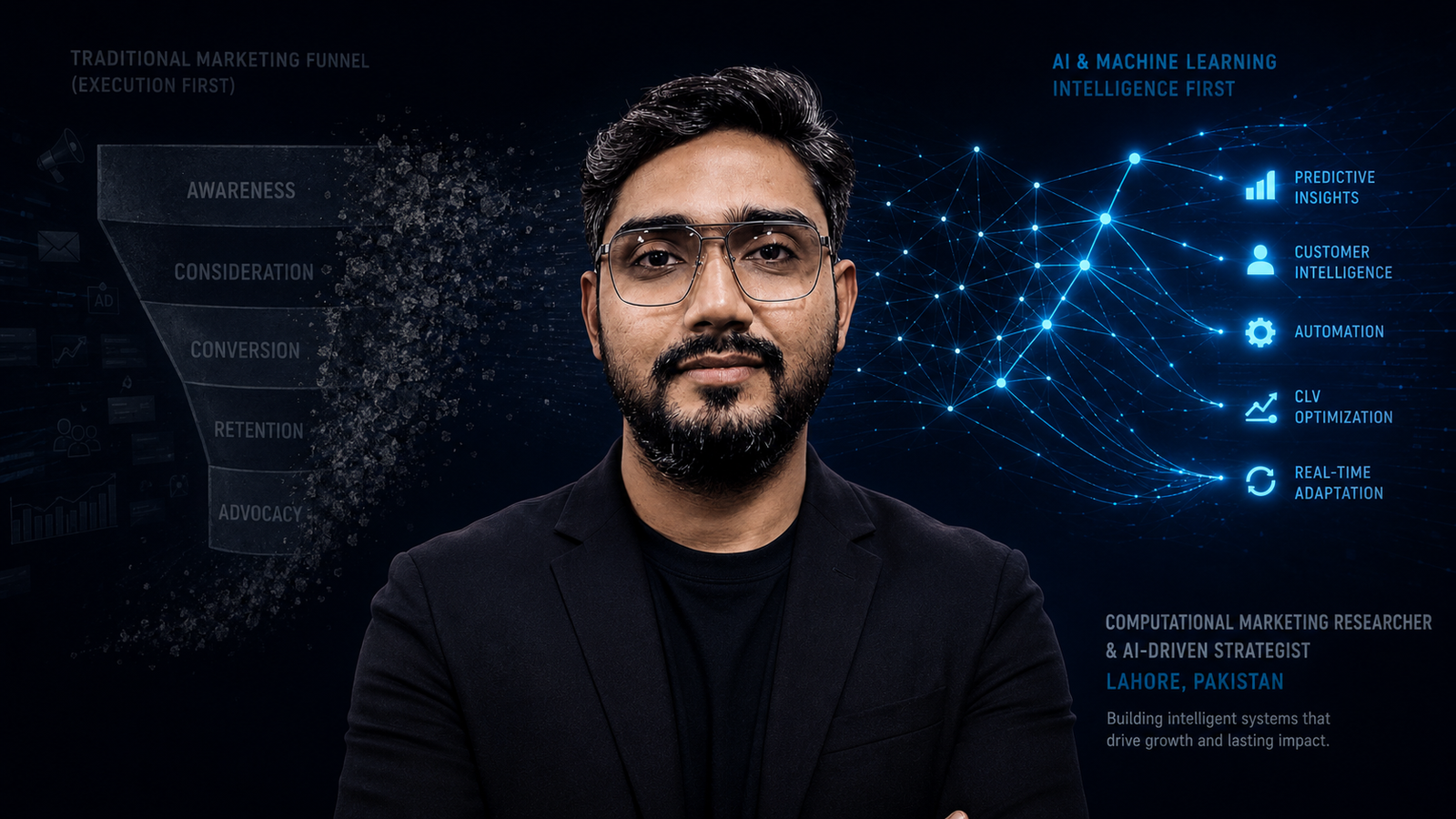
I practise computational marketing, not manual intuition
Computational marketing is the application of mathematical and algorithmic thinking to marketing problems — modelling audiences, forecasting outcomes and optimising spend with data science methods instead of dashboard guesswork. Most of the industry still works the other way: keyword research done by feel, audiences built on demographic assumptions, and campaign decisions made by looking at last week’s numbers.
Computational marketing
Predictive audience modelling
Advanced marketing intelligence
Instead of manual campaign execution, I help brands build machine-learning-driven growth strategies, optimise algorithmic performance, and stand up predictive analytics that compound. Most consultants do not offer this. Most have not studied it, and most cannot implement it. In Pakistan, the combination of cognitive marketing, computational marketing and academic research does not currently exist in one practitioner.
12+ years of real client data, not borrowed case studies
Every framework I use and every recommendation I make is backed by data from real clients with real budgets. I did not learn digital marketing from a course and start consulting the next week — I spent years in the field as a junior, an expert, a trainer, a project head and an agency owner before claiming to know anything. That earned experience is the foundation; the data science layer is what I am building on top of it.
I am an active international researcher, not only a practitioner
Most consultants read research. I write it. Three international research papers are currently under peer review in 2026, each one a direct extension of a problem encountered in real client work — problems that existing tools do not solve well enough, analysed with academic rigour and submitted for international review.
AI-driven lead scoring
Deep learning for e-commerce
Multi-touch attribution
Currently enrolled in MS Data Science with an AI focus on the thesis track, with PhD applications planned for 2027 (Insha’Allah). Certifications span digital marketing, AI and data science across the Google, Meta and data science tooling ecosystems. The combination of practitioner experience and academic research output in one person is genuinely rare.
Diagnose first. Prescribe second. Always.
The industry standard is to understand the client’s budget, recommend services that fill the invoice, and deliver reports that look good. Every engagement here begins instead with understanding the real problem rather than assuming the solution. I have turned down work because the client did not actually need what they were asking for, and redirected budgets away from channels that would have wasted money — even when those channels would have been easier to manage.
- Real problem identification
- Intelligence-led strategy
- Precision execution
- Data-backed reporting
- Continuous optimisation
What I never do, regardless of what competitors are doing
- Report vanity metrics — impressions, reach and likes disconnected from business outcomes
- Sell cookie-cutter packages without proper diagnosis
- Promise overnight results to close a deal
- Use black-hat tactics under any pressure
- Execute manually what should be optimised algorithmically
- Tell clients what they want to hear instead of what is actually true
The results are measurable, not vague
Below is what the work has actually produced. No projected figures and no illustrative examples — these are outcomes from live accounts.
UK natural products e-commerce
Google Ads & Meta Ads
SEO rankings in Pakistan
Client retention
Not an agency. Not a freelancer. Not a typical consultant.
Agencies optimise for scale, and the strategic depth I bring cannot be productised without losing what makes it valuable. Freelancers optimise for tasks — deliver, invoice, move on. Typical consultants bring frameworks borrowed from other consultants, selling the same slide decks with different logos. I operate as a Strategic Growth Partner, embedded in the client’s strategic thinking rather than working through a timesheet.
| Dimension | Agency | Freelancer | This practice |
|---|---|---|---|
| Primary optimisation goal | Scale — more clients, more staff, more standardised process | Task completion and invoicing | Compounding outcomes for a small number of clients |
| Who actually does the work | A junior team, reviewed by a senior | The freelancer, within the agreed scope | Usman Saeed, end to end, with full accountability |
| Where the strategy comes from | Standardised internal playbooks | The client’s own brief | Original research plus 12+ years of first-party client data |
| Core method | Manual execution | Manual execution | Algorithmic optimisation and predictive modelling |
| Reporting | Packaged dashboards | Task deliverables | Data-backed and attribution-verified before it is reported |
| Account ownership | Sometimes held by the agency | Varies by arrangement | Always in your name — ad accounts, Search Console, GTM, analytics |
The personal differentiators that actually matter
Technical capability is only half of it. These are the working principles that determine what the capability gets pointed at.
Intrinsic motivation
Necessary suffering, with purpose
Solo operator, full accountability
Health as professional discipline
A genuine lifelong student
What is being built right now
The differentiators below are not yet complete. They are listed because they are underway and because the direction of the practice matters as much as its current state.
2027 — first micro SaaS product
2027 — PhD track begins
Marketing Intelligence Lab — already live
A global practice, in progress
Three commitments I will hold to
I do not publish client testimonials I cannot verify. These are the standing commitments every engagement is held to instead.
Every rupee is traceable
Weekly optimisation, not monthly check-ins
You own every account
The honest summary
There are thousands of digital marketing consultants in Pakistan, hundreds who offer SEO, Google Ads and Meta Ads, and dozens who talk about AI and data science in marketing. Very few are doing original research in it. Almost none have 12+ years of real client data to validate their frameworks. And none are building practice, research, tooling and content simultaneously.
That is the real difference. Not a service list. Not a pricing model. A fundamentally different way of approaching the work.
A short walkthrough of how this practice works
Placeholder — no video yet. Delete this box and drop in the Elementor Video widget when the recording is ready, or hide this whole section from Advanced → Responsive until then.
Questions people ask before working with me
What is computational marketing?
Computational marketing is the practice of solving marketing problems with mathematical and algorithmic methods rather than intuition. Instead of estimating which audience will convert, a model is trained on first-party behavioural data to predict it; instead of reallocating budget after a monthly report, the allocation is driven by measured signal. In practice it combines statistics, machine learning and marketing domain knowledge in the same workflow.
How is this different from hiring a digital marketing agency in Pakistan?
An agency is built to scale — more clients, more staff and standardised processes, with your account usually run day to day by a junior team member. This is a single-practitioner practice: the person who designs the strategy is the person who implements and reports on it. The trade-off is honest — an agency can take on far more volume, while this model gives you depth, direct access and full accountability on a smaller number of engagements.
Do you work with clients outside Pakistan?
Yes. Work spans Pakistan, the UK, the USA, the UAE and other Tier 1 markets, delivered remotely. Research output is written for international peer review and the tooling being built is designed for global use cases rather than a single market.
What does “Strategic Growth Partner” actually mean?
It means being embedded in your commercial decision-making rather than executing a task list. That includes diagnosing the real constraint before proposing anything, saying no when a requested service will not solve the problem, and building measurement infrastructure you keep. Every account — ads, Search Console, tag manager, analytics — stays in your name.
Do I need data science expertise on my team to work with you?
No. The modelling, pipeline and measurement work is handled on my side, and the output is delivered as decisions and dashboards in plain business language. What is required from your side is access to your own data — analytics, ad accounts and, where relevant, order or CRM exports — because predictive work is only as good as the first-party data behind it.

Usman Saeed
AI-Driven Digital Marketing Intelligence Consultant & Growth Engineer in Pakistan. Usman Saeed specializes in engineering resilient digital growth architectures — helping enterprise brands eliminate tracking data drops, secure conversion signals, and maximize profitability through E-commerce Engineering, server-side Signal Engineering, and Predictive Intelligence. With 12+ years of experience and advanced data science expertise, marketing guesswork is replaced with mathematical precision — automated systems that bridge execution with business intelligence, ensuring your investment delivers measurable scale.
Where to go next
My story
Journey & timeline
Research papers
Let’s diagnose the real problem first
No packages, no pitch deck. A conversation about what is actually constraining growth, and an honest answer about whether I am the right person to fix it.