
TikTok Ads LTV Prediction Service for Value-Based Optimization
A TikTok Ads LTV prediction service models what each customer will be worth over 90 to 365 days and streams that figure into the TikTok Events API as the conversion value, so Value-Based Optimization bids for repeat buyers instead of impulse checkouts. On TikTok there is a prerequisite most pages skip: your event match quality has to be good enough for VBO to run at all. This page covers that first.
The Impulse Trap: Why Scaling TikTok Spend Crashes ROAS
TikTok’s auction is unusually good at finding people who will buy in the next few minutes. That is a genuine strength of the platform and it is also the problem: when every CompletePayment event carries only the immediate order value, the algorithm learns to find the fastest, cheapest checkout available. For a brand that makes its money on the second and third order, that is an expensive lesson to teach it. It shows up three ways.
1. The auction finds bargain hunters
2. The signal is weaker here than elsewhere
3. Short windows hide the value entirely
TikTok is a creative-led platform, so the instinct is to test more hooks. Creative decides who stops scrolling; the conversion value decides who the algorithm goes looking for next. New creative served against an unchanged value signal buys the same customer profile with a better thumb-stop rate. TikTok Value-Based Optimization is the lever that changes the target — and it depends entirely on the number you send.
How the Predictive LTV Pipeline Works on TikTok
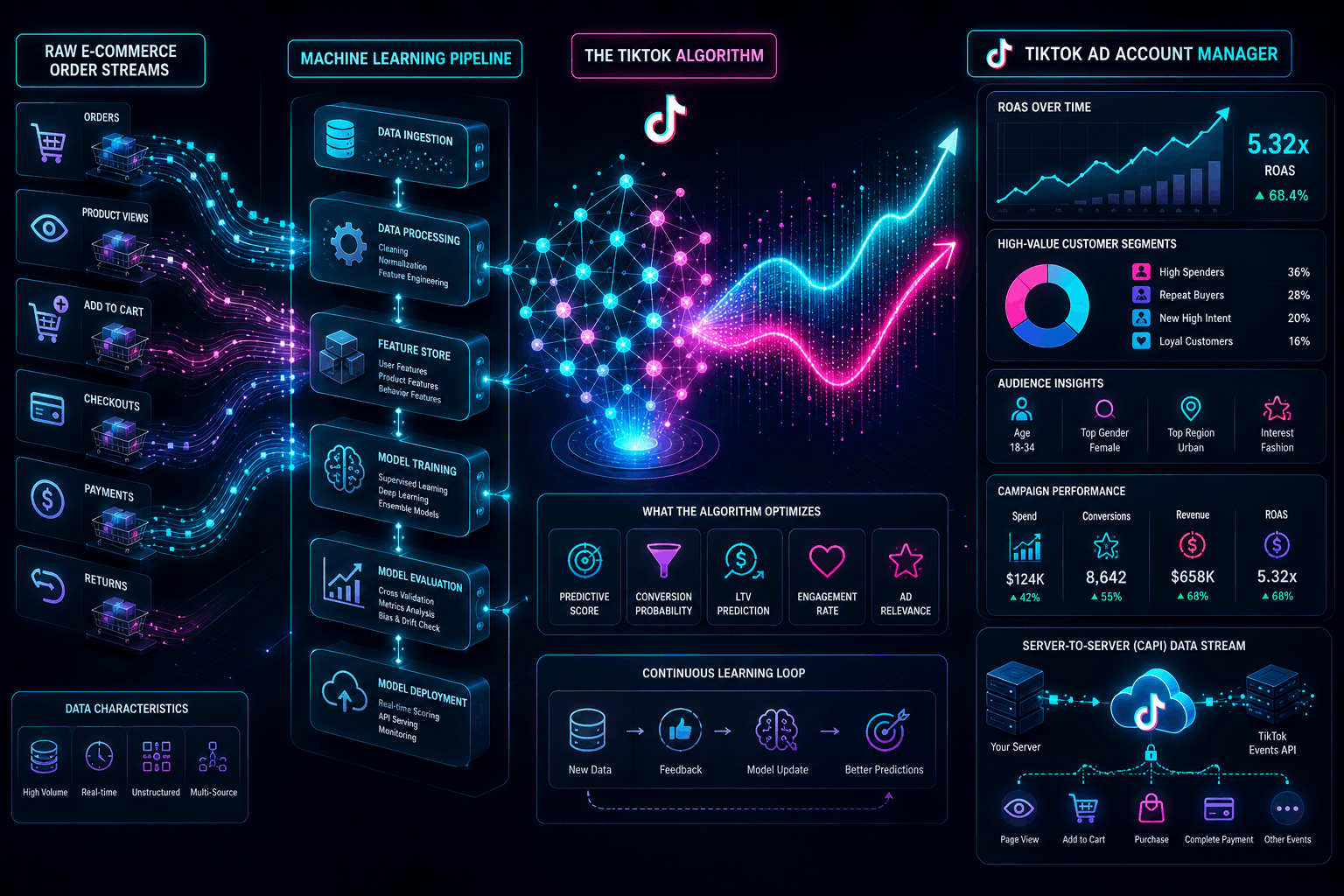
The TikTok Events API predictive data pipeline runs in four stages: capture the click identifier, model forward customer value, hash the identifiers, and post the enriched event server-side. The models are the same ones used for Meta and Google; the identity layer is where TikTok is genuinely different.
Capture ttclid — and keep the pixel
Model forward customer value
Hash and assemble the identity set
Post the enriched event
event_id. Timing matters on TikTok: events sent long after the action match poorly and will not retroactively improve optimisation, so the model has to score at checkout, not overnight. That last constraint shapes the whole architecture. On Google you can backfill an offline conversion days later and it still teaches the bidder something. On TikTok, a late web event is close to wasted — which means the model has to be fast enough to score a customer inside the checkout flow rather than in a nightly batch.
Event Match Quality: The Score That Gates Everything Else
Event Match Quality (EMQ) is TikTok’s own score, from 0 to 10, measuring how reliably an event can be matched back to a real TikTok user for attribution and bidding. It is the single most useful diagnostic on the platform and it sits upstream of everything on this page. Many accounts cannot switch on Value-Based Optimization at all, and the reason is almost always that their data quality is not high enough for TikTok to trust the values being sent. Predictive LTV cannot fix a match problem — it makes one worse, because you are attaching a more valuable number to an event that lands nowhere.
What a strong event carries
Hashed email em, hashed phone ph, the ttclid click identifier, client_user_agent, client_ip_address and your own external_id. Each missing parameter costs match quality, and the two that most often go missing are ttclid and phone.
Where the score actually leaks
ttclid never captured at first touch. Guest checkout with no email retained. Identifiers hashed without normalising first. Browser and server events not deduplicated on event_id, so TikTok counts them twice and trusts neither. These are engineering faults, not media faults.
Fix match quality before touching values
The audit measures your current EMQ and identifies which parameters are absent before any modelling work starts. A predicted value riding on a poorly matched event is spend with no learning attached to it.
Then prove the model separately
Model accuracy is validated on its own terms: the transaction history is split at a date, the model predicts a held-out period, and error is reported as MAE and RMSE in your currency against a naive baseline. These are absolute, scale-dependent measures, not percentages — anyone quoting an accuracy percentage for them is describing something else.
This ordering is the honest version of the offer. Plenty of accounts that arrive asking for predictive customer lifetime value for TikTok Ads turn out to need their identity pipeline fixed first, and the match-quality work alone often changes reported performance before any model ships. When that is the situation, that is what gets said.
TikTok Now Requires the Thing This Page Is About
TikTok’s US operations moved to an Oracle-led joint venture in January 2026, with a US-majority ownership structure. For advertisers the headline is that the acute existential risk is gone — you can plan multi-quarter programmes on TikTok again rather than hedging against a shutdown. The more consequential change for anyone reading this page came with the policy overhaul that followed.
The 2026 advertising framework leans heavily on advertiser-supplied first-party data through the Events API, with business verification and stricter pre-approval for regulated categories. Server-side identity is no longer an optimisation you get around to — it is how the platform expects you to operate.
Review cycles are slower than Meta or Google, so spontaneous flash-sale pivots are harder to run. Audiences and pixel implementation are worth re-verifying against current requirements rather than assuming a pre-2026 setup still behaves the same way. Budget a learning period when scaling back up.
Worth saying plainly: this is a moving picture and governance is still settling. The durable read is that TikTok is becoming a platform that rewards advertisers with clean first-party infrastructure and penalises those without it — which is a structural argument for building the pipeline, not a promise about what your account will do. Confirm current policy in TikTok’s Business Help Center before rebuilding around any specific requirement.
What You Run Once the Values Are Flowing
Two plays do most of the work, and both are standard TikTok mechanics. They behave differently only because the number being optimised against is a forecast rather than a receipt.
Value-Based Optimization on predicted value
VBO tells TikTok to optimise for return rather than conversion count. Fed the immediate order value, it chases large one-off purchases — which on TikTok often means the highest-refund, lowest-repeat segment you have. Fed a predicted 365-day value, it goes looking for the profiles that produce sustained revenue.
The practical caution: VBO needs enough value-carrying events with real variance before it will run properly, and swapping the values without resetting ROAS targets will throttle a campaign to nothing. Both changes happen together.
Value-Based Lookalikes from predicted tiers
Once profiles are ranked by predicted value, the top tiers are pushed to TikTok Ad Manager as the seed for a TikTok Value-Based Lookalike Audience. The seed describes customers who will be valuable, not customers who happened to buy — which is the entire difference between this and a standard purchaser lookalike.
TikTok Custom Audience LTV scaling works the same way in reverse: the bottom tier becomes an exclusion, so budget stops being spent re-acquiring customers the model expects never to return.
How TikTok Differs From Meta and Google
The model is identical across all three channels. What changes is the transport, the identity layer and the timing tolerance — and those differences are large enough that a pipeline built for one platform will not simply be pointed at another.
| TikTok | Meta | ||
|---|---|---|---|
| Transport | Events API, server-to-server, deduplicated on event_id | Conversions API | Data Manager API, offline conversion import |
| Click identifier | ttclid, read from the URL by the pixel — pixel still required | fbclid and fbp, with broader identity matching | GCLID, GBRAID and WBRAID |
| Match diagnostic | EMQ score, 0–10, published in Events Manager | Event match quality rating, less granular | No comparable per-event score exposed |
| Timing tolerance | Low — late web events match poorly and do not retroactively help | Moderate | High — offline conversions can arrive days later and still teach the bidder |
| Browser signal loss | Highest of the three — in-app browser, roughly a third of events lost without server-side | Significant post-iOS 14 | Lower, but rising with cookie restrictions |
| Value bidding surface | Value-Based Optimization, gated on data quality | Value optimisation plus a native pLTV layer | tROAS across Search, Shopping and Performance Max |
The same predicted values running across all three channels is also what finally makes cross-channel comparison meaningful — you are comparing platforms on one definition of customer value instead of three. The Meta Ads and Google Ads pages cover each activation layer in depth.
The Tools That Partly Do This
Two separate tool categories get conflated when TikTok is involved, because the channel has an identity problem and a value problem at the same time. Some tools solve the first, some the second, and very few do both.
| Layer | What it gives you | Where the ceiling is | Model is yours |
|---|---|---|---|
| Event forwarding tools Elevar, Littledata, server-side GTM | Reliable server-side delivery and better EMQ. These genuinely solve the identity half, and for many accounts they are the right first purchase. | They forward the value your store already produced. None of them models what a customer will be worth — a well-matched event carrying the wrong number is still the wrong instruction. | ✗ No model |
| Activation platforms Voyantis, AdZeta, Angler AI, Black Crow AI, Retina AI | Predicted value modelled and pushed into TikTok, Meta and Google as native bidding signals. These do the whole job. | Enterprise pricing, largely unpublished. The model belongs to the vendor and its assumptions are not fully inspectable; leaving means leaving the model behind. | ✗ Vendor-owned |
| LTV reporting suites Lifetimely, Triple Whale, Klaviyo, Peel | Genuine predictive LTV, cohort analysis and profit tracking at accessible pricing, with segment syncing to ad platforms. | A synced segment is not a per-customer predicted value inside the event payload, and the model is a general one applied to your data rather than fitted to it. | ✗ Generalised |
| Attribution platforms Northbeam, Rockerbox, SegMetrics | Multi-touch attribution and channel-level profitability — strong at answering which channel produced a customer. | Routinely compared against LTV tools and should not be. Where a customer came from and what that customer will be worth are different questions with different maths. | ✗ Not the job |
| This service | Match quality repaired first, then open-source models fitted and validated on your data and streamed into the Events API — with the model, the error metrics and the code visible to you. | Needs enough order history for stable cohorts and enough repeat behaviour to be worth modelling. It is a data layer; someone still owns the media decisions. | ✓ Fully |
If your EMQ is low and your repeat rate is thin, an event forwarding tool plus honest cohort reporting will get you further than a predictive model will, at a fraction of the cost. That is a real recommendation, not a rhetorical one.
Who This Is Built For
This suits e-commerce brands with real repeat-purchase behaviour, meaningful TikTok spend and enough order history to fit stable cohorts. It is a poor fit for pure impulse categories, for stores with negligible reorder rates, and for accounts whose event match quality has not been addressed yet.
- VBO unavailable or underperforming — usually a data quality problem rather than a bidding one
- Strong reported ROAS that finance cannot find — the classic gap between Ads Manager and the bank account
- Repeat-purchase or replenishment categories — beauty, supplements, apparel, subscription-adjacent DTC
- Low EMQ scores in Events Manager — missing ttclid, phone, or unnormalised identifiers
- Accounts rebuilding after the 2026 policy shift — pixel and audience setups that predate the current requirements
- Brands already running predictive LTV on Meta or Google — extending the same values to TikTok is the cheapest channel to add
Work is delivered remotely from Lahore, Pakistan, for brands across Pakistan, the United Kingdom, the United States and the UAE. TikTok commerce behaves quite differently across those markets — Gulf and UK accounts in particular tend to lean harder on first-party signal — so the audit reads your own market data rather than applying a single regional assumption.
What Actually Changes in the Numbers
The target is the CAC to LTV ratio, and on TikTok specifically it is about stopping the channel from being judged on a metric it was never going to win. Three things shift.
1. TikTok gets measured on the right horizon
2. Budget splits stop being guesswork
3. Exclusions start paying for themselves
No result is promised. Match quality is measured before and after, the model is backtested against a held-out period, and both numbers are reported as they come — including when they say the channel or the account is not ready for this.
Where AI Agents Fit Into a TikTok LTV Pipeline
A SaaS tool is someone else’s generic model. An AI agent is your own model, run autonomously. Cognitive Intelligence decides what to build; agents are how it keeps running. Two architectures apply, chosen by one test: can the correct next action be written down in advance?
Built on ML and data science. The agent decides its next step from live data — refitting when a cohort drifts, flagging when predicted and realised value diverge, moving value tiers as TikTok’s audience composition shifts. Used where the right action cannot be specified ahead of time.
n8n, Make.com, Zapier. An event fires a defined sequence: score at checkout, post to the Events API, alert when EMQ drops below threshold or a batch returns errors, refresh lookalike seeds weekly. This covers most of the pipeline’s daily operation.
Model Context Protocol lets an agent query BigQuery, your store database and the TikTok Business API directly rather than working from pasted output. Context, not architecture. Platforms such as Ryze AI and Hyper AI are built around this pattern for ad-account operations.
So every run meets the same standard: the same normalisation rules before hashing, the same validation gates before a refitted model ships values, the same reporting format. Skills are what stop an autonomous system from being differently wrong each week.
What Stays With a Person
The part nobody else writes. These are not automation gaps waiting to close — they are judgement calls that should not sit with a system nobody can hold responsible.
- Deciding TikTok is the wrong channel. If the model shows the channel genuinely acquires low-value customers in your category, the correct action is to spend less there — and no system optimising TikTok will propose that.
- Judging whether match quality is good enough to proceed. An agent can report an EMQ score; deciding whether it is sound enough to bid real money against is a person's call.
- Owning the privacy position. Which identifiers are collected, on what legal basis, with what consent. Hashing is a safeguard, not a decision.
- Calling it off. If the backtest cannot beat a naive baseline, someone has to say so and stop the spend. No autonomous system reaches that conclusion about itself.
Channel-level agent work — media buying agents, paid social agents, content marketing agents — is being documented separately. The AI agents hub is the current starting point.
Frequently Asked Questions
How do I send predicted LTV to the TikTok Events API?
The predicted value goes into the value field of the server-side event, alongside the hashed identity set and the ttclid captured at click. In practice the pipeline stores ttclid at landing, waits for the CompletePayment event, runs the model to produce a forecast, hashes the identifiers, and posts the enriched event deduplicated against the browser event by event_id. Value-Based Optimization then bids against the forecast rather than the order total.
Why can't I turn on Value-Based Optimization?
Usually because the account’s data quality is not high enough for TikTok to run it. VBO needs enough value-carrying events with genuine variance, and it needs those events to match reliably to real users. That is an Event Match Quality problem, and it is fixed in the identity layer — ttclid capture, complete hashed identifiers, correct normalisation, proper deduplication — before any predictive value is worth sending.
Does the Events API replace the TikTok pixel?
No, and this is a common and expensive misunderstanding. The pixel is what reads the ttclid parameter from your landing page URL, which is the anchor that lets a server-side event be attributed to a TikTok campaign at all. Remove the pixel and the Events API has nothing to attribute against. Both layers run together, deduplicated on event_id.
What is a good Event Match Quality score?
EMQ runs 0 to 10 and higher is better; strong implementations generally aim for the upper end of that range. Rather than chasing a number, the useful exercise is checking which parameters your events are actually carrying — hashed email, hashed phone, ttclid, user agent, IP and your own customer ID — because a missing parameter is a concrete, fixable cause rather than a vague quality issue.
How is this different from a server-side tracking tool like Elevar?
Different jobs, and they stack rather than compete. Event forwarding tools deliver your existing conversion values reliably and improve match quality — genuinely useful, and for many accounts the right first spend. What they do not do is model what a customer will be worth. This service adds the forecast; if your match quality is already handled by a forwarding tool, that part of the work is already done.
How do I know the predictions are accurate?
The transaction history is split at a date, the model trains on the earlier period and predicts the later one, and predicted values are compared against what those customers actually spent. Error is reported as MAE and RMSE in your own currency — absolute, scale-dependent measures, not percentages — and judged against a naive baseline of assuming every customer is worth the historical average. A model that cannot beat that baseline is not ready, and that gets reported as the result.
Is passing customer data through the TikTok Events API privacy compliant?
One-way SHA-256 hashing and server-side transfer support a compliant setup; they do not create compliance by themselves. Hashed identifiers remain personal data under GDPR, and lawful processing depends on your consent mechanism and legal basis, which are yours to own. The engineering is built to fit whatever position your legal advisers set, and the audit covers what is being collected and on what basis.
Does the same pipeline work for Meta and Google?
The modelling layer is identical; the transport, identity layer and timing tolerance differ. Meta runs through the Conversions API with value optimisation, Google through the Data Manager API with tROAS. Running the same predicted values across all three is also what makes cross-channel budget comparison meaningful.
Do you work with brands outside Pakistan?
Yes. Delivery is remote from Lahore, with clients across Pakistan, the United Kingdom, the United States and the UAE. The pipeline needs access to your transaction data and your TikTok Business account, not a shared time zone. Working hours overlap comfortably with the Gulf and the UK, and partially with US mornings.

AI-Driven Digital Marketing Intelligence Consultant & Growth Engineer in Pakistan. Usman Saeed specializes in engineering resilient digital growth architectures — helping enterprise brands eliminate tracking data drops, secure conversion signals, and maximize profitability through E-commerce Engineering, server-side Signal Engineering, and Predictive Intelligence. With 12+ years of experience and advanced data science expertise, marketing guesswork is replaced with mathematical precision — automated systems that bridge execution with business intelligence, ensuring your investment delivers measurable scale.
Where to Go Next
Customer LTV prediction
LTV for Meta Ads
LTV for Google Ads
Signal Engineering
Start With Your Match Quality, Not Your Model
A discovery audit reads your current Event Match Quality and your transaction history, then reports what is fixable in the identity layer and whether your data can carry a predictive model at all — including when the honest answer is not yet.