
Google Ads LTV Prediction Service for Performance Max and Search
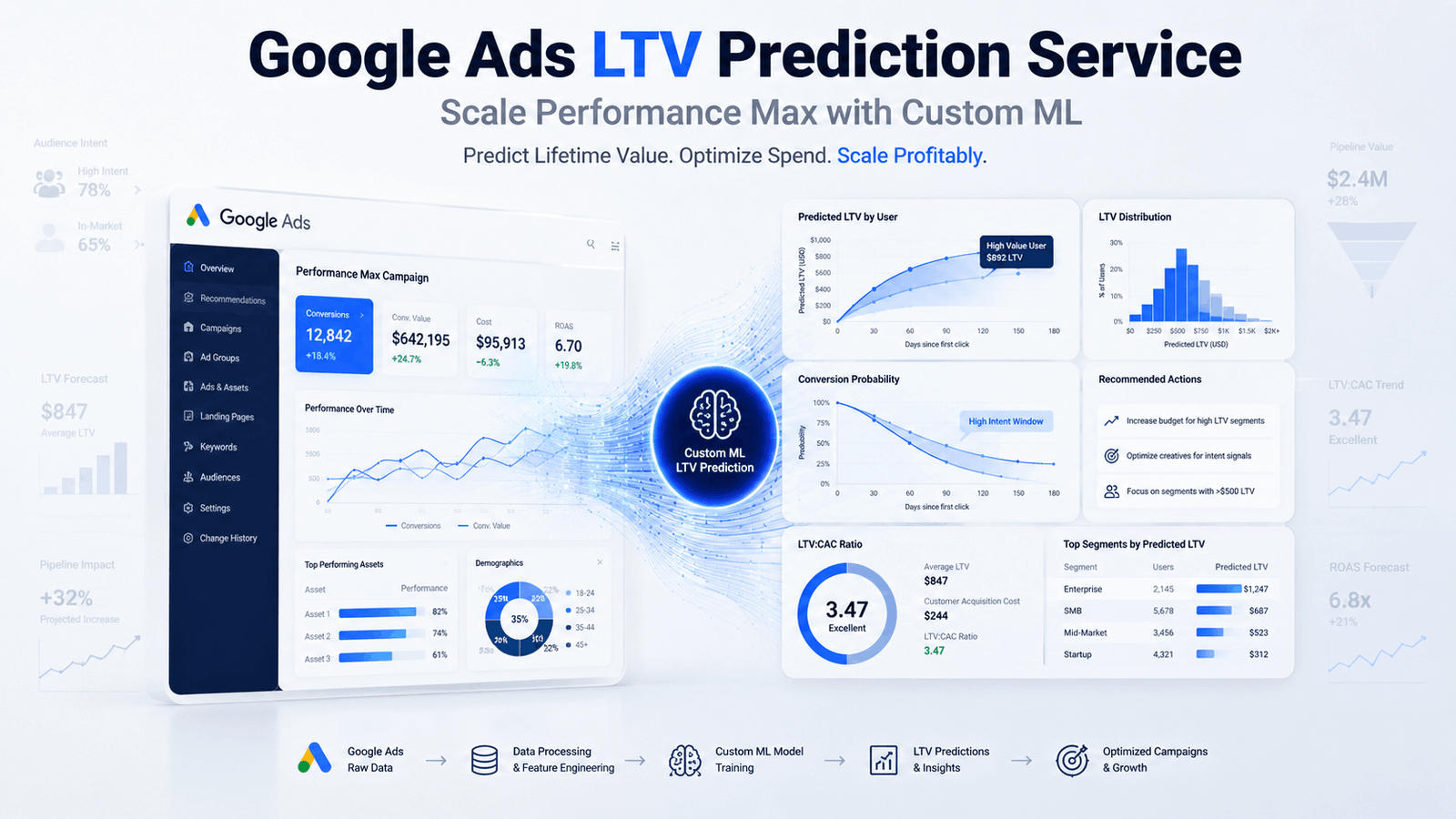
A Google Ads LTV prediction service replaces the immediate order value in your conversion upload with a modelled 90, 180 or 365-day forecast, then streams it back through Google’s Data Manager API so tROAS and Performance Max bid on future customer equity instead of first-purchase revenue. This page covers the models, the validation, the 2026 API migration, and the limits worth knowing before you build it.
The Smart Bidding Trap: Why Scaling Budget Crashes ROAS
Google Smart Bidding is not myopic by design — it is myopic because of what you feed it. A standard conversion upload carries one number: the immediate checkout value. Whether the bid strategy is Maximize Conversions, tCPA or tROAS, the engine optimises against that number and nothing else, so it learns to find whoever converts most cheaply inside the attribution window. For a replenishment or repeat-purchase business, that is the wrong target, and it fails in three specific ways.
1. CPA climbs as budget climbs
2. The auction hunts discount buyers
3. Campaigns bid against each other
Nothing here is solved by better creative, tighter negatives or a new bid strategy. Those operate on top of the same instruction. Google Ads value-based bidding optimization only changes behaviour when the value being bid against changes first — which means the fix lives in the data layer, upstream of the ad account.
How the Predictive LTV Pipeline Works
The pipeline is a custom ML pipeline in four stages: capture the click identifier, model each customer’s forward value, hash the identifiers, and upload the enriched conversion back to Google. The models are standard; the engineering is where the difficulty actually sits.
Capture the click identifier
Model forward customer value
Hash the identifiers
Upload the enriched conversion
Stage one and stage four are the fragile ones. A click token that never gets captured, a conversion uploaded outside Google’s import window, or a credential that expires over a weekend all produce the same outcome: bidding quietly reverts to optimising on whatever partial data it still has, while spend continues at full rate.
How You Know the Model Is Not Lying to You
This is the part that decides whether the whole exercise is worth doing, and it is the part most vendors will not show you. A predictive value that is confidently wrong is more dangerous than no prediction at all, because Smart Bidding will act on it faster and with more budget behind it. So the model gets tested against reality before a single dollar of bidding depends on it.
Temporal train/test split
The transaction history is cut at a date, not shuffled randomly. The model trains on the earlier period and is asked to predict the later one — which is exactly the job it will do in production. A random split leaks future information and flatters the model.
Backtest against what actually happened
Predicted values for the held-out window are compared with realised revenue for the same customers. You are not being asked to trust a projection; you are being shown how the model performed on a period that already has an answer.
Error reported in your currency
MAE gives the average size of the miss per customer in real money. RMSE squares errors before averaging, so it punishes large outliers hard — which is how a single wholesale order gets caught before it inflates a whole segment. Both are absolute, scale-dependent figures, not percentages.
Compared against a naive baseline
The only number that matters is whether the model beats the obvious alternative — predicting that every customer is worth the historical average. A model that cannot beat that baseline is not ready, and the honest answer at that point is to say so.
Outlier scrubbing sits inside this loop rather than beside it: wholesale accounts, internal test orders and bulk corporate buyers are identified and isolated, because a handful of anomalous transactions will skew both the model and the bidding signal it feeds. These model evaluation metrics for LTV are re-run on a schedule, not once at launch — a model that was accurate in March describes a business that no longer exists by October.
Getting the Value Into Google — and the June 2026 Migration
Offline conversion tracking for predictive LTV is what turns a model into bidding behaviour. The mechanism is server-to-server: your backend sends the stored click token, the hashed identifiers and the predicted value directly to Google, bypassing the browser entirely. That matters because client-side pixels lose data to blockers, cookie restrictions and mobile privacy defaults — but bypassing the browser reduces loss rather than eliminating it, and the pipeline still needs monitoring.
GCLID — the base Google Click Identifier appended to your landing page URL on standard web clicks.
GBRAID — the privacy-safe identifier for app-to-web journeys on iOS where the GCLID is unavailable.
WBRAID — the web-to-app equivalent. Capturing all three at session initialisation is what keeps iOS traffic attributable at all.
Google has moved offline conversion imports and enhanced conversions for leads onto the Data Manager API, with the legacy Google Ads API upload path blocked from 15 June 2026. Separately, enhanced conversions for web and leads were combined into a single setting from April 2026.
Any pipeline built before that date on the old upload method needs migrating, and the failure is silent — bidding degrades before anyone notices the uploads stopped.
If you already run a predictive LTV pipeline into Google Ads, the single most useful thing you can do this quarter is confirm who owns that integration and whether it has migrated. Most brands do not run it themselves — a CRM, an agency or a middleware tool does — and a stalled upload looks exactly like a gradual performance decline. Google changes these paths periodically; confirm current requirements in the Google Ads Help documentation before rebuilding around any specific method.
What You Can Actually Run Once the Signal Is Clean
Once predicted values are flowing, two plays do most of the work. Both are ordinary Google Ads mechanics — they simply behave differently when the value being optimised against is a forecast rather than a receipt.
Performance Max value-based scaling with tROAS
Set a Performance Max campaign to maximise conversions and it will find your cheapest available checkouts — brand search terms and low-value remarketing inventory. A tROAS machine learning pipeline changes the input: when a customer buys a $30 item and the model forecasts $350 over 365 days, that is the number Google sees. The bidding engine recalibrates toward the profiles that produced it.
The practical caution is target setting. A tROAS target calibrated against immediate revenue will be wildly wrong against predicted revenue, so targets have to be reset at the same time the values change, or the campaign will throttle itself to almost no volume.
Customer Match seeded on predicted, not past, value
Standard Customer Match lists are built from historical purchasers, which means they age badly — a list built in January describes a customer base that has since moved. Rebucketing users into predicted value tiers on a fixed refresh keeps the seed current.
Feeding Search campaigns a seed composed only of top-tier predicted buyers gives Google a much cleaner signal about which query patterns belong to valuable customers. The same tiers drive exclusions, which is what stops your own campaigns bidding against each other on low-value inventory.
Why GA4 Predictive Audiences Are Not a Substitute
The reasonable first question is why not just use what Google already gives you. GA4 ships purchase probability, churn probability and predicted revenue, and they export straight into Google Ads as predictive audiences. For stores that qualify, they are a genuinely useful free starting point. The problem is qualifying, and staying qualified.
GA4 requires at least 1,000 returning users who triggered the predictive condition and 1,000 who did not, within a rolling 28-day window, with model quality sustained over time. Users in their first seven days do not count toward it.
At typical e-commerce conversion rates that is a large amount of returning traffic every month — a threshold many mid-market Shopify and WooCommerce stores never clear.
If volume dips below the floor, Analytics stops updating the predictions and the audience goes stale. Seasonal lulls, a creative shift, or a move to higher-ticket products with longer consideration cycles can all trigger it — the exact moments you most want the signal.
A model fitted on your own transaction database has no volume gate. It also predicts monetary lifetime value directly, rather than a 28-day revenue estimate, which is the horizon a repeat-purchase business actually bids on.
If you comfortably clear the GA4 threshold and only need a 28-day view, use GA4 — it is free and it works. The custom pipeline earns its cost when your horizon is longer than GA4 models, your volume is too thin to stay eligible, or you need the predicted value inside the bid itself rather than as an audience layer on top of it.
The Tools That Partly Do This
Worth being precise here, because these tools are routinely compared as if they do the same job. They do not. Three distinct layers exist, and only one of them models lifetime value and pushes it into the auction.
| Layer | What it gives you | Where the ceiling is | Model is yours |
|---|---|---|---|
| Activation platforms Voyantis, AdZeta, Angler AI, Black Crow AI, Retina AI | Predicted value modelled and pushed into Google, Meta and TikTok as native bidding signals. These genuinely do the whole job. | Enterprise pricing, largely unpublished. The model and its assumptions belong to the vendor, and leaving means leaving the model behind. | ✗ Vendor-owned |
| LTV reporting suites Lifetimely, Triple Whale, Klaviyo, Peel | Real predictive LTV, cohort analysis and profit tracking, at accessible pricing. Several now sync value segments out to ad platforms. | Segment syncing is not a per-customer predicted value inside the conversion upload, and the model is a general one applied to your data rather than fitted to it. | ✗ Generalised |
| Attribution platforms Northbeam, SegMetrics, Rockerbox | Multi-touch attribution and channel-level profitability. Strong at answering which channel produced a customer. | These are frequently compared against LTV tools and should not be. They answer where a customer came from, not what that customer will be worth — a different question with different maths. | ✗ Not the job |
| Open source and warehouse PyMC-Marketing, CLVTools, BigQuery ML | The actual BG/NBD, Pareto/NBD and Gamma-Gamma implementations, free and inspectable. The models are not the expensive part. | Fitting, validation, click-token capture, hashing, Data Manager transport and monitoring are all still engineering work you own. | ✓ Fully |
| This service | Open-source models fitted and validated on your data, operated as a monitored activation pipeline into Google Ads — with the model, the assumptions, the error metrics and the code visible to you. | Needs enough order history for stable cohorts, and it is a data layer — someone still has to own the media decisions on top of it. | ✓ Fully |
The distinction that matters between pre-trained LTV models and a model fitted to your history is not marketing language. A pre-trained model assumes a cosmetics brand with a 45-day replenishment cycle, a luxury apparel store with two purchases a year and an electronics retailer share cohort behaviour. They do not, and the assumption is invisible until the predictions start moving budget.
Who This Is Built For
This suits e-commerce and lead-generation brands with real order history, active Google Ads spend and a genuine repeat-purchase or long sales cycle. It is a poor fit for new accounts, for one-and-done product categories, and for anyone who wants a dashboard rather than a change in how the auction bids.
- CPA rising in step with budget — the saturation pattern, and the clearest signal that the auction is optimising for the wrong profile
- Performance Max that will not scale profitably — strong reported ROAS that does not appear in the bank account
- Long or offline sales cycles — B2B, real estate, high-ticket retail, where the revenue event lands well after the click
- A pipeline built before June 2026 — still on the legacy upload path and needing migration to the Data Manager API
- GA4 predictive audiences that keep deactivating — volume dipping below the eligibility floor at exactly the wrong moments
- Agencies and in-house teams — this is a data layer that strengthens what your media buyer acts on, not a replacement for them
Work is delivered remotely from Lahore, Pakistan, for brands across Pakistan, the United Kingdom, the United States and the UAE. The Gulf and UK markets in particular have driven demand for first-party value signal, because reduced platform-side personalisation makes advertiser-supplied data materially more important there than it was two years ago.
What Actually Changes in the Numbers
The target is the CAC to LTV ratio — and specifically, moving it from a figure finance recalculates monthly to a figure the auction acts on daily. Three things shift when that happens.
1. The CPA ceiling stops being uniform
2. Campaign structure gets a rationale
3. Reporting reconciles with finance
No specific outcome is promised here. The backtest and the held-out comparison exist so that the data, rather than the pitch, decides whether the model is worth bidding on — including when the answer is that your account is not ready for it yet.
Where AI Agents Fit Into a Google Ads LTV Pipeline
A SaaS tool is someone else’s generic model. An AI agent is your own model, run autonomously. Cognitive Intelligence decides what to build; agents are how it keeps running. Two architectures apply, separated by one question: can the correct next action be written down in advance?
Built on ML and data science. The agent decides its own next step from live data — re-fitting when a cohort drifts, flagging when predicted and realised value diverge in the rolling backtest, adjusting value tiers as the repeat curve moves. Used where the right action cannot be specified ahead of time.
n8n, Make.com, Zapier. An event fires a defined sequence: nightly model refresh, batch upload to the Data Manager API, alert when an upload returns errors or a credential nears expiry, weekly Customer Match rebucketing. This covers most of the pipeline’s daily operation.
Model Context Protocol lets an agent query BigQuery, Search Console, the Google Ads API and your CRM directly rather than working from pasted output. Context, not architecture. Platforms such as Ryze AI and Hyper AI are built around this pattern for ad-account operations.
So every run meets the same standard: the same validation gates before a refitted model is allowed to ship values, the same hashing rules, the same reporting format. Skills are what stop an autonomous system from being differently wrong each week.
What Stays With a Person
The most valuable part of this section, and the part nobody else writes. These are not automation gaps waiting to close — they are judgement calls that should not sit with a system nobody can hold responsible.
- Deciding the model has stopped describing the business. An agent will keep shipping predictions long after a product line, a price point or a market has changed underneath them.
- Setting the tROAS target against predicted value. Getting this wrong throttles a campaign to nothing or lets it overspend; it is a commercial judgement, not a calculation.
- Owning the privacy position. Which identifiers are collected, on what legal basis, with what consent. Hashing is a safeguard, not a decision.
- Calling it off. If the backtest cannot beat a naive baseline, someone has to say so and stop the spend. No autonomous system is incentivised to reach that conclusion about itself.
Channel-level agent work — PPC agents, media buying agents, content marketing agents — is being documented separately. The AI agents hub is the current starting point.
Frequently Asked Questions
How do I send predicted LTV to Google Ads?
You upload it as the conversion value on an offline conversion, matched back to the original ad click. The pipeline stores the GCLID, GBRAID or WBRAID at session start, waits for the order, runs the model to produce a forecast value, hashes the customer identifiers, and uploads the enriched conversion through Google’s Data Manager API. Smart Bidding then optimises against the forecast rather than the receipt.
What changed with the June 2026 Google Ads API migration?
Google moved offline conversion imports and enhanced conversions for leads onto the Data Manager API, blocking the legacy Google Ads API upload path from 15 June 2026. Enhanced conversions for web and leads were also merged into a single setting from April 2026. If your predictive LTV uploads were built on the old method, they need migrating — and because the failure is silent, it usually shows up as unexplained performance decline rather than an error message. Google revises these paths periodically, so confirm current requirements in the Google Ads Help documentation.
Why not just use GA4 predictive audiences?
Use them if you qualify. GA4 needs at least 1,000 returning users who triggered the predictive condition and 1,000 who did not, within a rolling 28-day window, with model quality sustained — and users in their first seven days do not count. Many mid-market stores never clear it, or clear it and then drop below during a seasonal lull. GA4 also predicts 28-day revenue, whereas a repeat-purchase business usually needs a 365-day horizon inside the bid itself.
How is a custom model different from a SaaS pre-trained one?
A pre-trained model applies one set of assumptions across every storefront it serves. It cannot know that your cosmetics line replenishes every 45 days, that your apparel business is heavily seasonal, or that a particular customer segment returns 30% of what it orders. A model fitted to your own transaction history learns those patterns because they are in the data. The trade-off is honest: a custom build takes longer to stand up and needs someone to maintain it.
How do I know the predictions are accurate?
The history is split at a date, the model trains on the earlier period and predicts the later one, and predicted values are compared against what those customers actually spent. Error is reported as MAE and RMSE in your own currency — these are absolute, scale-dependent measures, not percentages — and judged against a naive baseline of assuming every customer is worth the historical average. If the model cannot beat that baseline, it is not ready, and that gets reported as the result.
Is this compliant with GDPR and CCPA?
Server-side transfer and one-way hashing support a compliant setup; they do not create compliance on their own. Hashed identifiers remain personal data under GDPR, and lawful processing depends on your consent mechanism and legal basis, which are yours to own. The engineering is built to fit whatever position your legal advisers set, and the audit covers what is currently being collected and on what basis.
Does this also work for Meta and TikTok?
The modelling layer is the same; only the transport and the bidding surface change. On Meta the route is the Conversions API with value optimisation, covered on the Meta Ads LTV page; TikTok has its own value-based equivalent. Running the same predicted values across channels also makes cross-channel comparison meaningful for the first time.
Do you work with brands outside Pakistan?
Yes. Delivery is remote from Lahore, with clients across Pakistan, the United Kingdom, the United States and the UAE. Nothing in the pipeline is location-dependent — it needs access to your transaction data and your Google Ads account, not a shared time zone. Working hours overlap comfortably with the Gulf and the UK, and partially with US mornings.

AI-Driven Digital Marketing Intelligence Consultant & Growth Engineer in Pakistan. Usman Saeed specializes in engineering resilient digital growth architectures — helping enterprise brands eliminate tracking data drops, secure conversion signals, and maximize profitability through E-commerce Engineering, server-side Signal Engineering, and Predictive Intelligence. With 12+ years of experience and advanced data science expertise, marketing guesswork is replaced with mathematical precision — automated systems that bridge execution with business intelligence, ensuring your investment delivers measurable scale.
Where to Go Next
Customer LTV prediction
LTV for Meta Ads
LTV for TikTok Ads
Signal Engineering
Find Out Whether Your Data Can Carry a Predictive Model
A discovery audit backtests a lifetime value model against your own transaction history and reports what it can and cannot predict — including the case where the honest answer is that your account is not ready yet.