
SEO SaaS Tools vs Cognitive Intelligence
One of your data sources is lying to you. It is the tool.
SEO SaaS has built an industry on proxy metrics. Domain Rating, Keyword Difficulty, Content Score, Authority Score. These feel like measurements of something Google cares about because they correlate with ranking outcomes in historical data. They are mathematical approximations of observable signals, calculated from public data every competitor has equal access to, presented with enough decimal places to feel precise.
The problem is not that the proxies are wrong. It is that Google’s actual signals — semantic vector alignment, intent centroid distance, algorithmic authority distribution, true crawl budget efficiency — are not accessible through the data layer these tools operate on.
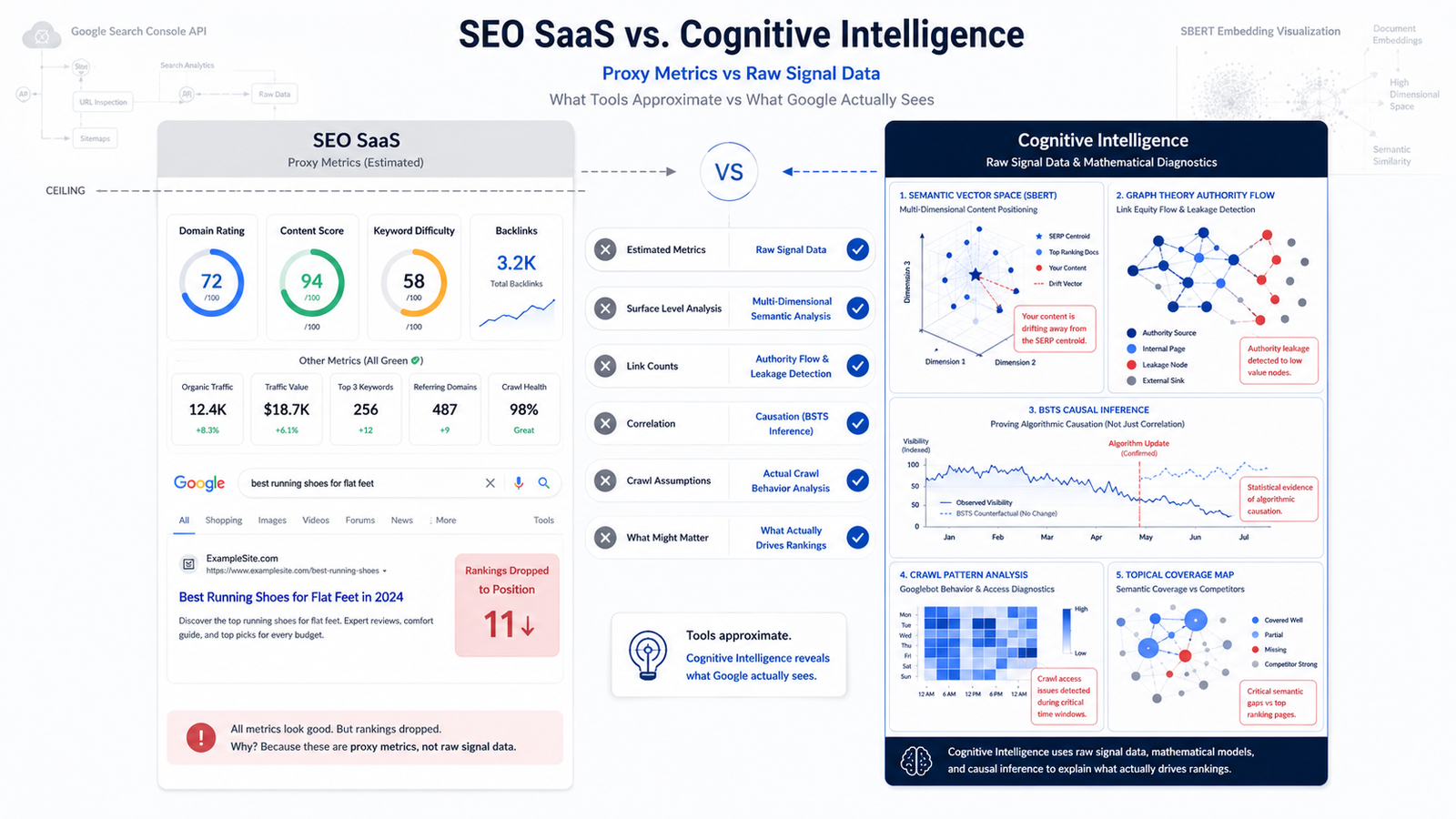
What are SEO SaaS tools?
Competitive intelligence and technical audit platforms built on three data sources: crawled web data from their own crawlers, sampled search data from clickstream panels and suggestion APIs, and public SERP data from tracked queries.
From these they build proxy metrics — Domain Rating, Domain Authority, Keyword Difficulty, Content Score — that correlate with rankings at population level but can be significantly misleading for any specific domain, topic or competitive context.
What they are: competitive intelligence and technical audit tools operating on public, crawled and sampled data. What they are not: diagnostic systems with access to Google’s actual ranking signals, semantic alignment measurement, causal attribution for ranking changes, or predictive SEO intelligence.
Five tiers of SEO tooling
Most comparisons cover tiers 1 and 2. Tier 5 is the one that matters — and it is free. Almost every SEO tool comparison omits the data sources that come directly from Google.
All-in-one SEO suites
- Ahrefs
- Semrush
- Moz Pro
- Similarweb
- SE Ranking
- Serpstat
- Mangools
Keyword research, backlinks, rank tracking and site audit in one subscription. The default stack for most SEO teams and agencies.
Enterprise SEO platforms
- Conductor
- BrightEdge
- seoClarity
- Botify
- Lumar (DeepCrawl)
- OnCrawl
Botify, Lumar and OnCrawl ingest server logs — genuinely closer to real Googlebot behaviour than the tier above, and consistently missing from SMB-focused comparisons.
Technical crawlers
- Screaming Frog (desktop)
- Sitebulb (desktop)
- JetOctopus
- Ryte
- ContentKing
Deep technical extraction. ContentKing and JetOctopus add continuous real-time monitoring rather than point-in-time crawls.
Content optimisation
- SurferSEO
- Clearscope
- MarketMuse
- Frase
- NeuronWriter
- Content Harmony
Score content against what currently ranks. All of them measure term coverage relative to competitors — which is a different thing from semantic alignment with the query.
Google’s own data — free
- Search Console API (free)
- GSC BigQuery bulk export (free)
- Server log files (you already own these)
- PageSpeed Insights API (free)
- Chrome UX Report (free)
- Google Trends
This is the only tier with Google’s actual data rather than an approximation of it — real impressions, real queries, real Googlebot behaviour. The GSC bulk export to BigQuery removes the 1,000-row UI limit entirely. It costs nothing and most SEO teams never touch it.
Honest analysis of the leading platforms
Each assessment covers genuine strengths and where the architecture stops. Every tool here is worth its subscription for the job it was built to do.
Ahrefs
What it doesBacklink analysis, keyword research, content gap analysis, rank tracking and site audit built on the second most active crawler on the web after Googlebot.
Who uses itSEO professionals, content marketers and agencies across every industry.
Genuine strengthsIndustry-leading backlink index — among the most comprehensive available, genuinely excellent for competitive link analysis and prospecting. Strong keyword database. Content Gap analysis is directly actionable for strategy. Reliable rank tracking.
Where the ceiling isDomain Rating is a correlation metric, not a Google ranking factor, and can misrepresent a specific domain’s actual authority. Keyword difficulty is a proxy calculation that cannot reflect Google’s assessment for your domain in your context. And it cannot detect search intent vector drift — the failure mode in this page’s headline.
Semrush
What it doesCombined SEO, PPC, social and content intelligence in one suite, with Authority Score blending link authority, organic traffic and spam signals into a composite metric.
Who uses itAgencies and in-house teams managing organic and paid together.
Genuine strengthsBroad coverage genuinely reduces stack complexity for multi-channel teams. Competitive PPC keyword intelligence is a real differentiator that organic-only tools do not offer. Solid site audit with actionable recommendations. Position tracking with SERP feature monitoring.
Where the ceiling isAuthority Score blends several proxies into one number, adding another abstraction layer between the metric and ranking reality — composites are harder to act on than their components. Its content tools optimise keyword coverage, not semantic alignment with Google’s current understanding of the query.
Moz Pro
What it doesSEO platform best known for introducing Domain Authority, with keyword research, rank tracking, link analysis and local SEO through Moz Local.
Who uses itTeams that use DA as a link quality benchmark, and local SEO practitioners.
Genuine strengthsDomain Authority has become the industry’s de facto communication standard for link quality, which makes it genuinely useful for benchmarking and stakeholder conversations. Moz Local is strong for citation and listing management.
Where the ceiling isMoz states plainly that DA is not a Google ranking factor — but its widespread use as a ranking proxy drives systematic misallocation of link budget toward improving DA rather than the relevance and topical authority signals Google actually weights.
Screaming Frog
What it doesDesktop crawler extracting page elements, response codes, redirects, canonicals, structured data and internal link structure, with a separate Log File Analyser.
Who uses itTechnical SEO specialists and agencies auditing large, complex sites.
Genuine strengthsExtracts more technical data points than any SaaS crawler — the most complete picture of technical structure available. The Log File Analyser gives real Googlebot crawl visibility, which most tools do not offer at all. Unlimited crawl depth. Flexible custom extraction.
Where the ceiling isIt identifies issues; it does not diagnose which are causally responsible for ranking underperformance. An audit finding 847 issues does not tell you which twelve matter. And the Log File Analyser visualises crawl data — the ML modelling to quantify crawl budget waste by URL pattern needs Python.
SurferSEO
What it doesContent optimisation with real-time scoring, briefs and recommendations derived from analysing top-ranking pages for a target keyword.
Who uses itContent writers and teams producing SEO content at scale.
Genuine strengthsGenuinely accessible for writers without SEO expertise — real-time scoring gives actionable guidance in a form content creators can use. SERP-based structural insight. Brief generation cuts research time meaningfully.
Where the ceiling isContent Score measures term presence relative to currently ranking competitors. A page scoring 94/100 has matched the template of pages that ranked before the SERP moved. If Google’s understanding of the intent has shifted since, following that template optimises for the old SERP reality.
Clearscope
What it doesContent intelligence with grading, keyword research and brief generation based on NLP analysis of top-ranking content, integrated into Google Docs and WordPress.
Who uses itEnterprise content teams and agencies producing high volumes of SEO content.
Genuine strengthsStrong NLP term analysis going beyond exact-match to related concepts and entities. Clean Google Docs integration removes workflow friction. Enterprise content performance tracking connecting published work to ranking outcomes.
Where the ceiling isIts NLP identifies terms associated with top-ranking pages. It does not model the semantic vector space of the query as Google understands it. Clearscope tells you what terms ranking pages use; it cannot tell you how far your content sits from the current SERP centroid.
Also assessed: Sitebulb, Conductor, BrightEdge, seoClarity, Botify, Lumar, OnCrawl, JetOctopus, ContentKing, Ryte, MarketMuse, Frase, NeuronWriter, Similarweb, SE Ranking and Serpstat. Botify, Lumar and OnCrawl are the closest any commercial platform gets to limitation 04 — they ingest server logs at enterprise scale, and that is stated here rather than glossed over.
Why a 94/100 content score can lose you eight positions
Placeholder — no video yet. Delete this box and drop in the Elementor Video widget when the recording is ready, or hide this whole section from Advanced → Responsive until then.
Proxy metrics are not Google’s signals
Every SEO SaaS metric is a proxy — a correlation-based approximation of signals Google uses, calculated from data that resembles but does not replicate Google’s inputs.
DR and DA correlate with rankings at population level. Neither reflects Google’s actual PageRank calculation across hundreds of billions of pages with algorithm-specific weighting no third party can replicate.
A DR 72 domain can rank below a DR 45 domain because topical relevance and query-specific authority override domain-level aggregates in the real algorithm.
Bypasses proxies entirely — working directly with raw Search Console API data, server log files and live SERP semantic vector analysis.
The actual signals rather than approximations of them, from sources you already own.
Search intent vector drift is invisible
This is the most important limitation, and the one responsible for the scenario in this page’s headline.
Google’s understanding of what a query means evolves continuously. That evolution is not keyword addition — it is a mathematical shift in the semantic vector centroid of the query.
When it shifts, previously top-ranking content becomes misaligned even though its keywords, links and technical health are unchanged. The page did not deteriorate. The SERP moved away from it. No SaaS tool detects this, because none model the semantic vector space of a SERP.
Applies SBERT semantic embedding analysis — generating vector representations of both your content and the live SERP, calculating the mathematical distance between them.
The output is not “add these terms”. It is precisely how far and in which semantic direction the content must move to re-align.
Authority leakage is not modelled
SEO tools provide internal link analysis — which pages have many internal links and which have few. They do not model authority distribution across the link graph using graph theory.
PageRank distributes authority through link chains according to principles that link counting cannot capture. Authority accumulates at hubs and leaks through low-value clusters — pagination, filters, tag archives.
A site can show strong aggregate authority metrics while systematically starving its commercial pages of the equity they need.
Applies graph theory and eigenvector centrality analysis, modelling full authority distribution across the internal link graph.
The output identifies exactly where equity accumulates, where it leaks, and which specific link additions, removals and redirects redirect it most efficiently.
Crawl budget analysis requires server log ML
SEO tools provide crawl simulation — crawling as a bot would and reporting what is accessible. They do not have Googlebot’s actual behaviour.
True crawl efficiency requires extracting real Googlebot visit data from server logs and modelling which URL patterns consume disproportionate budget relative to indexation value.
Log analysers visualise which URLs were visited and when. The ML modelling to cluster URL patterns, quantify indexation delay and prioritise by projected budget recovery is a Python problem, not a dashboard one.
Applies Random Forest modelling on server log data — identifying waste patterns, quantifying indexation impact, and prescribing the structural changes that recover the most budget for priority content.
Honest exception: Botify, Lumar and OnCrawl do ingest logs at enterprise scale. They go further than most of this category — and stop at reporting rather than causal prioritisation.
Causal traffic attribution is beyond SEO SaaS
When organic traffic rises after an SEO activity, these tools offer no mechanism for determining how much the activity caused.
Seasonal patterns. Brand search growth. Category-wide demand increases. An algorithm update that lifted everyone simultaneously.
Without separating these, the correlation between SEO activity and traffic growth may substantially overstate causal impact — which makes honest ROI evaluation impossible.
Applies Bayesian structural time series modelling, constructing mathematically valid counterfactuals estimating what traffic would have been without the intervention.
The output is a statistically defensible causal impact figure — the kind a CFO can act on.
AEO and GEO optimisation is not supported
As AI-generated answers intercept queries before users reach organic results, the target is shifting from ranking in blue links to being cited as the authoritative answer.
No SEO SaaS tool provides AEO or GEO analysis, because these require understanding how language models represent, weight and retrieve information about topics.
That is transformer-based semantic analysis, not keyword-based SERP analysis — a different discipline running on different data.
Applies transformer-based semantic authority analysis — identifying the structural, semantic and authority signals that correlate with citation in AI-generated responses.
And prescribing the content restructuring that improves citation probability across the growing AI search ecosystem.
SEO SaaS vs Cognitive Intelligence
Not a comparison of tool quality. A comparison of which data layer the analysis runs on.
| Dimension | SEO SaaS | Cognitive Intelligence |
|---|---|---|
| Data source | ×Public crawled and sampled data | ✓Raw GSC API and server logs |
| Core metrics | ×Proxies — DR, DA, KD, Content Score | ✓Google’s actual reported signals |
| Crawl insight | ×Simulated crawl | ✓Actual Googlebot behaviour |
| Content analysis | ×Keyword and term presence scoring | ✓Semantic vector distance measurement |
| Competitor logic | ×What currently ranks | ✓Current SERP centroid alignment |
| Intent drift | ×Undetectable | ✓SBERT drift detection and realignment |
| Internal links | ×Link count analysis | ✓Graph theory eigenvector centrality |
| Crawl budget | ×Simulation and visualisation | ✓Random Forest server log modelling |
| Traffic attribution | ×Correlation only | ✓BSTS causal validation |
| AEO and GEO | ×Not supported | ✓Transformer-based citation analysis |
| Technical issues | ×Identified and listed | ✓Ranked by causal ranking impact |
| Final output | ×A report | ✓An executed SEO strategy |
| Commercial model | ×$99–$100k+ subscription | ✓Custom engagement investment |
When SEO SaaS is the right choice, and when it is not
Every SEO programme needs these tools. The question is what you expect them to explain.
SEO SaaS is genuinely the right choice when
- Keyword research and competitive content gap analysis is the primary requirement
- Backlink prospecting and competitor link profile evaluation is needed
- Standard technical issue identification is sufficient — broken links, redirect chains, missing tags
- Rank tracking and competitive position monitoring is the main need
- Content brief creation for standard production at scale is the use case
Cognitive Intelligence becomes necessary when
- Rankings dropped and the audit shows nothing — the signature of intent vector drift
- Persistent problems have not responded to standard interventions, meaning the cause was never correctly identified
- A large site has crawl budget challenges requiring server log ML rather than simulated crawl data
- Causal proof of SEO ROI is required for a CFO, board or investor
- Semantic-level cannibalisation is suspected, where pages compete for the same intent without triggering keyword-based detection
- AEO and GEO optimisation is a strategic priority
- Authority leakage through complex internal architecture needs graph analysis to quantify
Where AI agents fit in SEO
SEO is the channel where the two agent architectures divide most cleanly. Monitoring and data movement is workflow work. Diagnosis is modelling work. Most “SEO automation” sold today is the former described as the latter.
Workflow agents on n8n, Make.com or Zapier handle GSC exports, rank alerts and publishing pipelines. Autonomous agents handle drift detection, technical prioritisation and crawl budget modelling. MCP gives either governed access to Search Console, BigQuery and the CMS; skills keep every run to the same standard.
| Task | Architecture that fits | Why |
|---|---|---|
| Detecting intent vector drift | Autonomous — SBERT embeddings compared against live SERP centroids on a schedule | A rule watches rank positions, which is the symptom rather than the cause |
| Prioritising technical fixes | Autonomous — causal impact modelling ranks the 847 issues by projected effect | A rule sorts by severity label, which is the tool’s opinion not your data |
| Modelling crawl budget waste | Autonomous — Random Forest on server logs clusters URL patterns by cost | A rule cannot cluster patterns it was not told to look for |
| Pulling GSC data daily | Workflow with MCP — API exports scheduled into BigQuery | Ideal for a rule; this is the free tier most teams never automate |
| Alerting on ranking drops | Workflow — position threshold crossed, owner notified with context | Ideal for a rule, and speed matters more than intelligence here |
| Publishing content changes | Workflow with human approval — staged, reviewed, then deployed | The change is mechanical; approving what goes live under your brand is not |
What stays with a person
- Deciding what the page is for. An agent can align content to a centroid; whether that intent is worth serving commercially is a business decision.
- Approving published content. Anything under your brand name carries liability that no efficiency gain offsets.
- Structural site architecture changes. A model can quantify authority leakage; migrating a URL structure is a decision with consequences a rollback cannot fully undo.
- Interpreting a causal result that contradicts the team. When BSTS says the content programme did not cause the growth, that needs human validation before budgets move.
The channel-by-channel breakdown sits in the SEO AI agents section.
Questions about SEO tools
Our rankings dropped but every tool says the site is fine. What is happening?
This is the signature of search intent vector drift. Google’s understanding of the query shifted, and your page — unchanged — is now semantically misaligned with what the SERP has become. No SaaS tool detects this because none model the semantic vector space of a SERP; they measure keyword presence and competitor overlap. Diagnosing it requires embedding your content and the live SERP and measuring the distance.
Is Domain Rating or Domain Authority worth optimising for?
For stakeholder communication, yes — they are the industry’s shared language for link quality. As an optimisation target, no. Moz states plainly that DA is not a Google ranking factor, and both metrics ignore the topical relevance and semantic alignment dimensions that Google actually weights. Link budget spent raising a number rather than earning relevant authority is spent on the wrong thing.
Should I cancel Ahrefs or Semrush?
No, and almost no engagement does. They remain excellent at keyword research, competitive gap analysis and link prospecting — jobs the raw data layer does not do. What changes is what you ask them to explain: they identify opportunities and monitor competitors; they do not diagnose why a ranking moved.
What free Google data are most SEO teams not using?
The Search Console bulk export to BigQuery, which removes the 1,000-row UI limit and gives you every query and page at full granularity, permanently. And your own server logs, which contain real Googlebot behaviour rather than a simulation of it. Both are free, and together they are a better diagnostic foundation than any subscription.
Do enterprise platforms like Botify solve the log file problem?
They go genuinely further than most of the category — Botify, Lumar and OnCrawl ingest server logs at scale, which is a real capability. Where they stop is causal prioritisation: they report which URLs consumed crawl budget without modelling which structural changes would recover the most indexation value for the least disruption.
Is AEO and GEO worth investing in yet?
It is worth understanding now and worth investing in selectively. AI answers already intercept a meaningful share of informational queries, and the signals that drive citation differ from the ones that drive ranking. The honest position is that this is an emerging discipline with limited established evidence — which is precisely why it is listed as an open research domain rather than sold as a solved service.

Usman Saeed
AI-Driven Digital Marketing Intelligence Consultant & Growth Engineer in Pakistan. Usman Saeed specializes in engineering resilient digital growth architectures — helping enterprise brands eliminate tracking data drops, secure conversion signals, and maximize profitability through E-commerce Engineering, server-side Signal Engineering, and Predictive Intelligence. With 12+ years of experience and advanced data science expertise, marketing guesswork is replaced with mathematical precision — automated systems that bridge execution with business intelligence, ensuring your investment delivers measurable scale.
Where to go next
SEO AI agents
The SEO diagnosis starts with raw data from Google, not approximations of it
The audit runs on your Search Console API exports and server logs. If your current tools are genuinely answering your questions, you will be told that directly.