
AutoML & Data Science SaaS vs Cognitive Intelligence
AutoML platforms represent a genuine advance in the democratisation of machine learning. DataRobot, Alteryx, H2O.ai, SageMaker AutoPilot and Vertex AI are sophisticated products with real capability. This democratisation is real. It is also misunderstood.
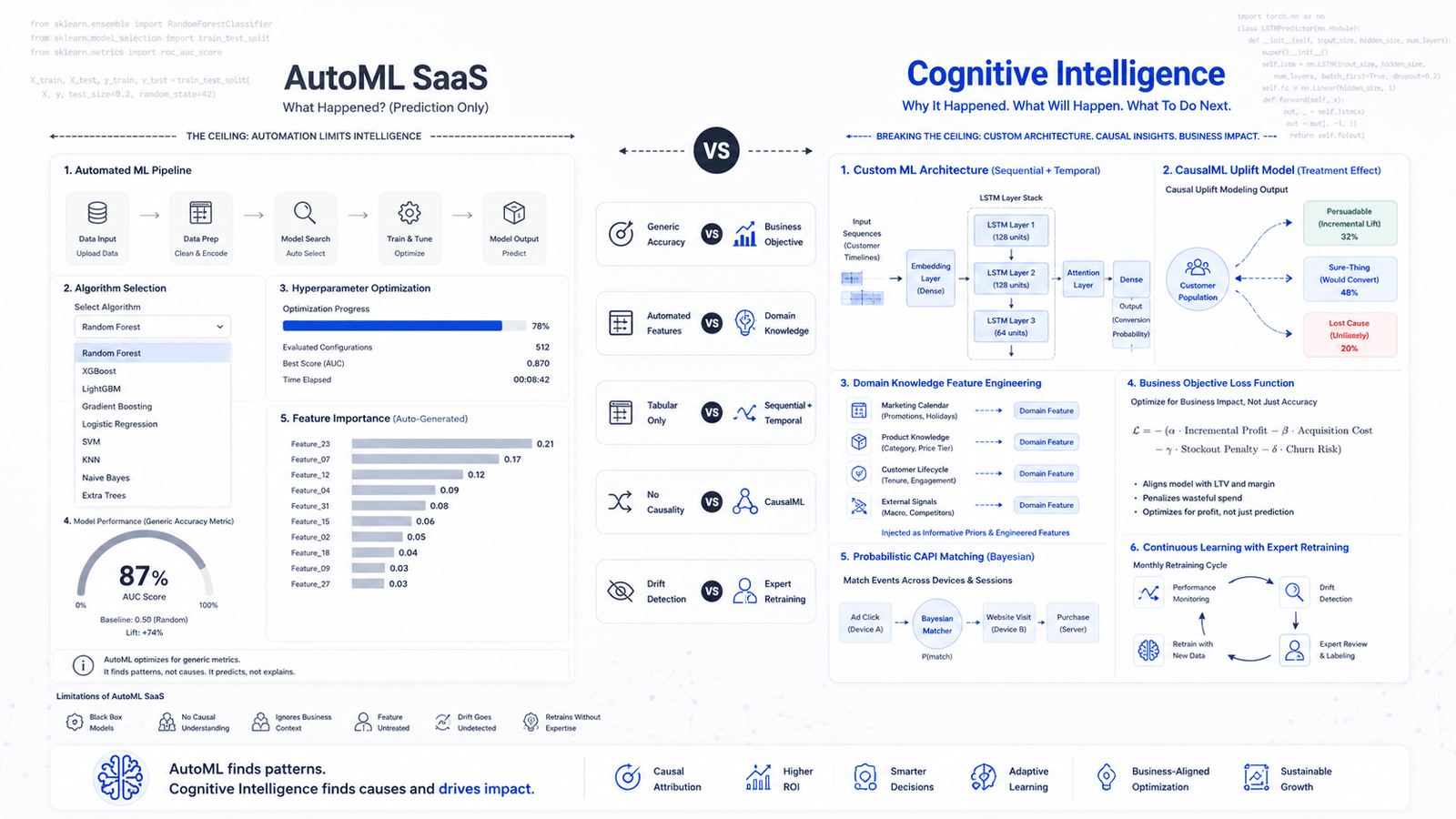
Their ceiling is not algorithmic sophistication. It is the structural impossibility of automating domain expertise — knowing which model architecture suits your problem, which features carry genuine signal versus spurious correlation, how to encode business logic the algorithm cannot learn from data, and how to validate that a model is causally sound rather than merely accurate on a historical holdout.
What are AutoML and data science platforms?
Platforms that let organisations build ML models with reduced coding — automating algorithm selection, hyperparameter optimisation, feature engineering, training and deployment that previously required significant expertise to perform manually.
The category spans a wide range of technical sophistication, from no-code tools requiring no ML knowledge, through low-code platforms requiring data science literacy, to configurable platforms and cloud ML infrastructure with AutoML features attached.
What they are: platforms that automate ML development workflows for teams with data science literacy but limited deep ML expertise. What they are not: replacements for domain expertise, causal inference capability, business logic injection, or the empirical data diagnostics that determine whether any model will be useful in production.
Five tiers of AutoML and ML tooling
Comparisons in this category routinely mix five different things — a no-code prediction tool and a cloud ML platform are not competitors. Knowing which tier you are actually shopping in eliminates most of the confusion.
Enterprise AutoML platforms
- DataRobot
- Dataiku
- H2O Driverless AI
- Alteryx
- SAS Viya
- Domino Data Lab
Full lifecycle automation with MLOps, governance and champion-challenger testing. Built for enterprise data science teams needing throughput and standardisation.
Cloud ML platforms
- AWS SageMaker AutoPilot
- Google Vertex AI
- Azure ML AutoML
- Databricks AutoML
- BigQuery ML
AutoML attached to broader cloud data infrastructure. Chosen for proximity to where the data already lives rather than for modelling capability. BigQuery ML is worth knowing for marketing teams — it trains models in SQL directly on GA4 exports.
Open-source AutoML
- H2O AutoML (open source)
- AutoGluon (open source)
- auto-sklearn (open source)
- FLAML (open source)
- PyCaret (open source)
- TPOT (open source)
Free, and competitive with commercial AutoML on raw benchmark accuracy. AutoGluon in particular performs strongly. The cost is infrastructure and the expertise to run it — which is the same expertise the paid tier was meant to replace.
The libraries underneath
- XGBoost
- LightGBM
- CatBoost
- scikit-learn
- PyTorch
- TensorFlow
Every platform above is orchestrating these. Worth knowing, because it clarifies what you are paying for: the orchestration and governance, not the algorithms.
Causal inference libraries
- CausalML (Uber)
- DoWhy (Microsoft)
- EconML (Microsoft)
- CausalImpact (Google)
No AutoML platform in tiers 1 to 3 includes these. They are the frameworks that turn a prediction into an intervention decision — and they are all free and open source.
Honest analysis of the leading platforms
Each assessment covers genuine strengths and where the architecture stops. None of these are criticisms of algorithmic quality — the algorithms are good.
DataRobot
What it doesEnterprise AI platform automating the end-to-end lifecycle — training hundreds of candidate models across algorithm families, evaluating them against configurable metrics, and deploying through its MLOps infrastructure.
Who uses itEnterprise data science teams in financial services, insurance and healthcare needing model development throughput and standardised MLOps.
Genuine strengthsGenuinely sophisticated AutoML with broad algorithm coverage. Enterprise-grade MLOps — monitoring, champion-challenger testing, automated retraining triggers. SHAP-based explainability for regulatory communication. Strong governance for regulated industries.
Where the ceiling isOptimises for generic accuracy metrics on historical holdout data. It cannot optimise for a business objective that is not reducible to one metric — maximising retention of high-LTV customers specifically, or tolerating false positives in one segment to eliminate false negatives in another. Feature engineering applies standard transformations without domain knowledge of which carry causal signal.
Alteryx
What it doesData analytics automation combining preparation, blending and analysis with predictive modelling through a drag-and-drop workflow interface.
Who uses itBusiness analysts and data teams where data preparation and modelling are tightly coupled.
Genuine strengthsGenuinely strong data preparation and blending — the core competency, and a real bottleneck-remover where data quality is the primary constraint. Integrated workflow from ingestion to output. Broad connectivity. Accessible to analysts without heavy coding.
Where the ceiling isPredictive capability is secondary to the data preparation core. The ML available is less sophisticated than purpose-built AutoML and considerably less capable than custom architecture. Organisations choosing it primarily for prediction are using a data preparation tool for a job it was not principally designed to do.
H2O.ai
What it doesOpen-source ML platform with AutoML alongside full access to underlying algorithms, available as a free library or enterprise cloud product.
Who uses itData science teams with ML expertise needing a capable, extensible platform.
Genuine strengthsGenuine algorithmic flexibility — practitioners can implement custom algorithms, loss functions and architectures that proprietary platforms do not permit. Strong GBM and XGBoost implementations. Free open-source tier. Active community and documentation.
Where the ceiling isIts flexibility is also its ceiling. Extending beyond the automation requires exactly the expertise AutoML was meant to remove the need for. Without it, H2O AutoML produces the same generic selection as simpler platforms — and marketing-specific feature engineering and causal work sit outside it either way.
AWS SageMaker AutoPilot
What it doesAmazon's automated ML service within SageMaker, training and tuning models on tabular data with full visibility into the generated notebooks and training scripts.
Who uses itOrganisations on AWS wanting AutoML inside existing infrastructure.
Genuine strengthsNative AWS integration reducing data movement friction across S3, Redshift and Glue. Transparent code generation — it produces the underlying notebooks, so practitioners can inspect, modify and extend rather than accept a black box. MLOps within SageMaker. Consumption pricing.
Where the ceiling isA cloud infrastructure service with AutoML features, not a marketing intelligence platform. Automated feature engineering and algorithm selection apply standard approaches without knowing which features carry causal marketing signal or which architectures suit behavioural time-series data.
Google Vertex AI AutoML
What it doesGoogle Cloud's AutoML service training custom models on tabular, image, text and video data, integrated with BigQuery and the wider Vertex AI platform.
Who uses itOrganisations on Google Cloud, particularly marketing teams with GA4 data already in BigQuery.
Genuine strengthsNative BigQuery integration enabling training directly on warehouse data without extraction — genuinely valuable for marketing teams whose GA4 exports already live there. Strong tabular performance benefiting from Google's internal research. Google Ads integration.
Where the ceiling isThe BigQuery proximity is real value, but the model it trains is constrained by the same generic algorithm selection and automated feature engineering as every other platform in the tier. Marketing-specific applications still require the same domain configuration to produce output that is useful rather than statistically impressive.
Dataiku
What it doesCollaborative data science platform supporting visual no-code workflows alongside full Python and R environments, with governance and MLOps at scale.
Who uses itEnterprise data science and analytics teams needing collaboration across skill levels.
Genuine strengthsGenuine flexibility spanning analyst and engineer workflows in one environment. Strong model monitoring, retraining triggers and deployment management. Enterprise governance and lineage.
Where the ceiling isA platform, not a solution. Without custom architecture and domain-specific feature engineering, its visual workflows produce the same generic models as far cheaper tools — in a considerably more expensive package.
Also assessed: Azure ML AutoML, Databricks AutoML, BigQuery ML, SAS Viya, Domino Data Lab, AutoGluon, auto-sklearn, FLAML, PyCaret and TPOT. On raw benchmark accuracy, the open-source options are competitive with the enterprise tier. What the paid platforms genuinely add is governance, MLOps and support — not better predictions.
What AutoML automates, and what it cannot
Placeholder — no video yet. Delete this box and drop in the Elementor Video widget when the recording is ready, or hide this whole section from Advanced → Responsive until then.
Optimisation for accuracy metrics, not business objectives
AutoML optimises for prediction accuracy — AUC-ROC for classification, RMSE for regression, F1 for imbalanced classes. These measure how well the model predicts held-out historical data. They do not measure how well it serves the objective it was built for.
A churn model with 88% AUC that systematically misclassifies high-LTV customers as low risk is statistically impressive and operationally catastrophic — because the entire value of churn prediction is concentrated in retaining the highest-value customers, and it fails precisely there.
The platform cannot detect this. It has no mechanism to encode the objective; it only optimises the metric in its configuration.
Designs training with business-objective-specific evaluation criteria — custom loss functions, stratified evaluation by customer segment, and validation frameworks that test performance on the subpopulations where performance actually matters.
Aggregate accuracy becomes a diagnostic, not the target.
Automated feature engineering without domain knowledge
AutoML generates candidate features automatically — applying standard transformations to raw variables and keeping whichever improve accuracy on historical data.
It cannot incorporate knowledge that is not in the data itself.
That in subscription SaaS, the ratio of features used in week two to week one predicts churn better than either count alone, because it captures momentum. That in ecommerce, time between first and second purchase predicts LTV better than 30-day AOV. That in B2B, funding stage interacts with employee count non-linearly in ways polynomial transformations miss.
Engineers features using domain knowledge — designing the specific variables and transformations that carry genuine predictive signal for the marketing problem being solved.
Based on 12+ years across the relevant business contexts, not discovered from data patterns alone.
No causal inference capability
AutoML builds predictive models — probability estimates based on historical patterns. It does not build causal models identifying which variables are genuinely causing the outcome.
For marketing this gap is decisive, because interventions are causal by design — you are trying to change behaviour through targeted action.
A model identifying who is likely to churn does not tell you who will respond to retention. Budget spent on that score alone funds the persuadable, the sure-things, the lost causes and the sleeping dogs equally.
Applies CausalML, DoWhy and EconML — building the uplift models that translate prediction into intervention strategy with validated incrementality.
These frameworks are free and open source. No AutoML platform includes them, because using them requires designing the experiment, not selecting an algorithm.
Sequential and temporal data limitations
Most AutoML platforms are optimised for tabular, cross-sectional data — a row per customer with columns representing static or aggregated attributes.
Marketing prediction is frequently sequential. The order in which a user adopts features predicts churn with information that usage totals destroy. Demand forecasting needs autocorrelation and seasonality dynamics. Content analysis needs transformer architectures.
Row-level aggregation discards exactly the signal that sequences carry.
Applies LSTM deep learning, Temporal Fusion Transformers and transformer-based NLP architectures — modelling the sequential and temporal patterns tabular AutoML cannot represent.
In ecommerce and SaaS, the sequence is frequently the strongest predictor available.
Production reliability without concept drift management
AutoML trains on historical data and deploys. What happens afterwards — as conditions shift and the relationship between inputs and outcomes changes — determines whether the model stays accurate or silently degrades.
Concept drift is the primary cause of production ML failure. Platforms with MLOps include basic monitoring — detecting when prediction distributions shift relative to training data.
What they cannot do is distinguish genuinely significant drift requiring recalibration from benign distributional variation. So they either retrain too often or too late.
Implements monthly retraining cycles on fresh behavioural and transaction data, with domain-knowledge-informed monitoring that separates real drift from noise.
The trigger is a judgement about what changed in the market, not a statistical threshold alone.
AutoML SaaS vs Cognitive Intelligence
AutoML searches model space very well. The gap is that most marketing problems are lost in problem space, before any model is selected.
| Dimension | AutoML SaaS | Cognitive Intelligence |
|---|---|---|
| Optimisation target | ×Generic accuracy metrics | ✓Business-objective-specific criteria |
| Feature engineering | ×Automated standard transformations | ✓Domain-knowledge feature design |
| Model architecture | ×Standard algorithm selection | ✓Custom architecture per problem |
| Data structure | ×Tabular and cross-sectional | ✓Sequential and temporal deep learning |
| Causal inference | ×Absent | ✓CausalML, DoWhy, EconML |
| Intervention design | ×Out of scope | ✓Uplift modelling determines who to treat |
| Business logic | ×Not encodable | ✓Encoded in model design |
| Data quality | ×Assumed clean | ✓Empirical diagnostics run first |
| Concept drift | ×Statistical monitoring only | ✓Domain-informed retraining triggers |
| Customisation | ×Platform-constrained | ✓Unlimited Python and R |
| Model families | ×Standard algorithm library | ✓LSTM, TFT, SBERT, CLIP, CausalML |
| Deployment | ×MLOps within the platform | ✓Custom pipeline into your stack |
| Commercial model | ×$0–$500k+ subscription or usage | ✓Custom engagement investment |
When AutoML is sufficient, and when it is not
For a well-posed prediction problem on clean tabular data, AutoML frequently outperforms manual model development. Stated plainly.
AutoML is sufficient when
- The problem is standard classification or regression on well-structured tabular data with sufficient volume
- Your team has data science literacy but limited deep ML expertise, so automation beats manual development
- The business objective maps cleanly onto a standard accuracy metric
- Data is clean and complete, needing no domain-knowledge feature engineering beyond standard transformations
- The problem involves no sequential data, causal requirements or external factor injection
Cognitive Intelligence becomes necessary when
- The problem involves sequential behavioural data — journeys, time series, or NLP requiring transformers
- The objective cannot be reduced to a standard metric, needing custom loss or stratified evaluation
- The model must support causal inference — uplift, incrementality, intervention targeting
- Features require domain-knowledge engineering that automated generation cannot discover
- The model must stay accurate under changing market conditions, needing expert-supervised drift management
- Business logic — pricing structures, segment definitions, market dynamics — must be encoded rather than learned
Where AI agents fit in an ML workflow
This category has an unusual relationship with agents, because AutoML is already an autonomous agent — software pursuing a goal (maximise a metric) across many steps without human intervention. It is the clearest working example of the architecture in this entire silo.
Which makes its limits instructive. An autonomous agent optimises brilliantly within the frame it is given, and cannot question the frame. Workflow agents handle serving, promotion gates and alerting. MCP connects models to real data; skills keep every run to the same standard.
| Task | Architecture that fits | Why |
|---|---|---|
| Defining the target variable | Neither — this is the problem framing, and it precedes everything | Get it wrong and every downstream step is accurate about the wrong outcome |
| Searching model space | Autonomous — this is precisely what AutoML already automates well | A rule cannot search a hyperparameter space; the platform does this better than a human |
| Engineering domain features | Neither — knowing which ratio predicts churn is practitioner knowledge | It is not in the data, so no search over the data can find it |
| Retraining on drift | Autonomous — drift detection triggers refits on its own schedule | A fixed monthly rule retrains too often in stable periods and too late in volatile ones |
| Promoting a model to production | Workflow, with human approval — evaluation gates then a sign-off | The checks automate; the decision to trust the model does not |
| Serving predictions to the stack | Workflow with MCP — scores written to CRM, ads and warehouse | Ideal for a rule; no modelling in the transport |
What stays with a person
- Framing the problem. Choosing the target variable, the population and the horizon. No search over data can correct a wrong frame.
- Domain feature engineering. The signal that is not in the data cannot be discovered from the data.
- Accepting a model into production. Evaluation automates; the judgement that it is safe to act on does not.
- Deciding what the model is allowed to do. A prediction becomes an action only through a decision someone owns.
The full breakdown sits in the AI agents section.
Questions about AutoML platforms
Is open-source AutoML as good as DataRobot?
On raw benchmark accuracy, largely yes — AutoGluon, FLAML and H2O AutoML are competitive with the enterprise tier on standard tabular problems. What enterprise platforms genuinely add is governance, MLOps, monitoring, support and audit trails. If you are paying six figures expecting better predictions, you are paying for the wrong thing; if you are paying for regulated-industry governance, that is a reasonable purchase.
Our AutoML model has 88% AUC but has not improved results. Why?
Almost always one of two things. Either the metric does not match the objective — the model is accurate overall while failing on the segment where value is concentrated — or the model predicts correctly but nobody built the intervention layer, so accurate scores sit in a table unused. Neither is fixed by a different platform.
Why do no AutoML platforms include causal inference?
Because causal inference is not an algorithm selection problem. CausalML, DoWhy and EconML require you to specify a causal structure, design a treatment assignment, and choose an estimation strategy — all decisions about the world rather than the data. Automating a search over models cannot substitute for them. The frameworks themselves are free; the design is what is scarce.
Can BigQuery ML replace an AutoML platform for marketing?
For a surprising amount of marketing work, yes. If your GA4 exports and transaction data already sit in BigQuery, BigQuery ML trains models in SQL where the data lives, with no extraction and no separate subscription. It will not give you sequential deep learning or causal inference — but for standard propensity and forecasting work it is genuinely underused.
Is AutoML an AI agent?
Functionally, yes — it pursues a goal across many steps without human intervention, which is the definition. That is why it makes such a clear case study: it optimises brilliantly inside the frame it is given, and has no capacity to question whether the frame is right. Every limitation on this page is a version of that one property.
Do I need a data science team to work this way?
No — that is generally the reason to engage rather than a prerequisite for it. What is required from your side is access to your own data and a willingness to hear what it says. The modelling, causal design and validation happen on this side, delivered as decisions in plain business language.

Usman Saeed
AI-Driven Digital Marketing Intelligence Consultant & Growth Engineer in Pakistan. Usman Saeed specializes in engineering resilient digital growth architectures — helping enterprise brands eliminate tracking data drops, secure conversion signals, and maximize profitability through E-commerce Engineering, server-side Signal Engineering, and Predictive Intelligence. With 12+ years of experience and advanced data science expertise, marketing guesswork is replaced with mathematical precision — automated systems that bridge execution with business intelligence, ensuring your investment delivers measurable scale.
Where to go next
The model is not the hard part. Framing the problem is
The audit examines what you are predicting, whether the metric matches the objective, and whether the data supports it. If AutoML genuinely fits your problem, you will be told that directly.