
Ad Attribution & Cookieless Tracking SaaS vs Cognitive Intelligence
Attribution is the most commercially consequential measurement problem in digital marketing, and the one with the most misleading solutions.
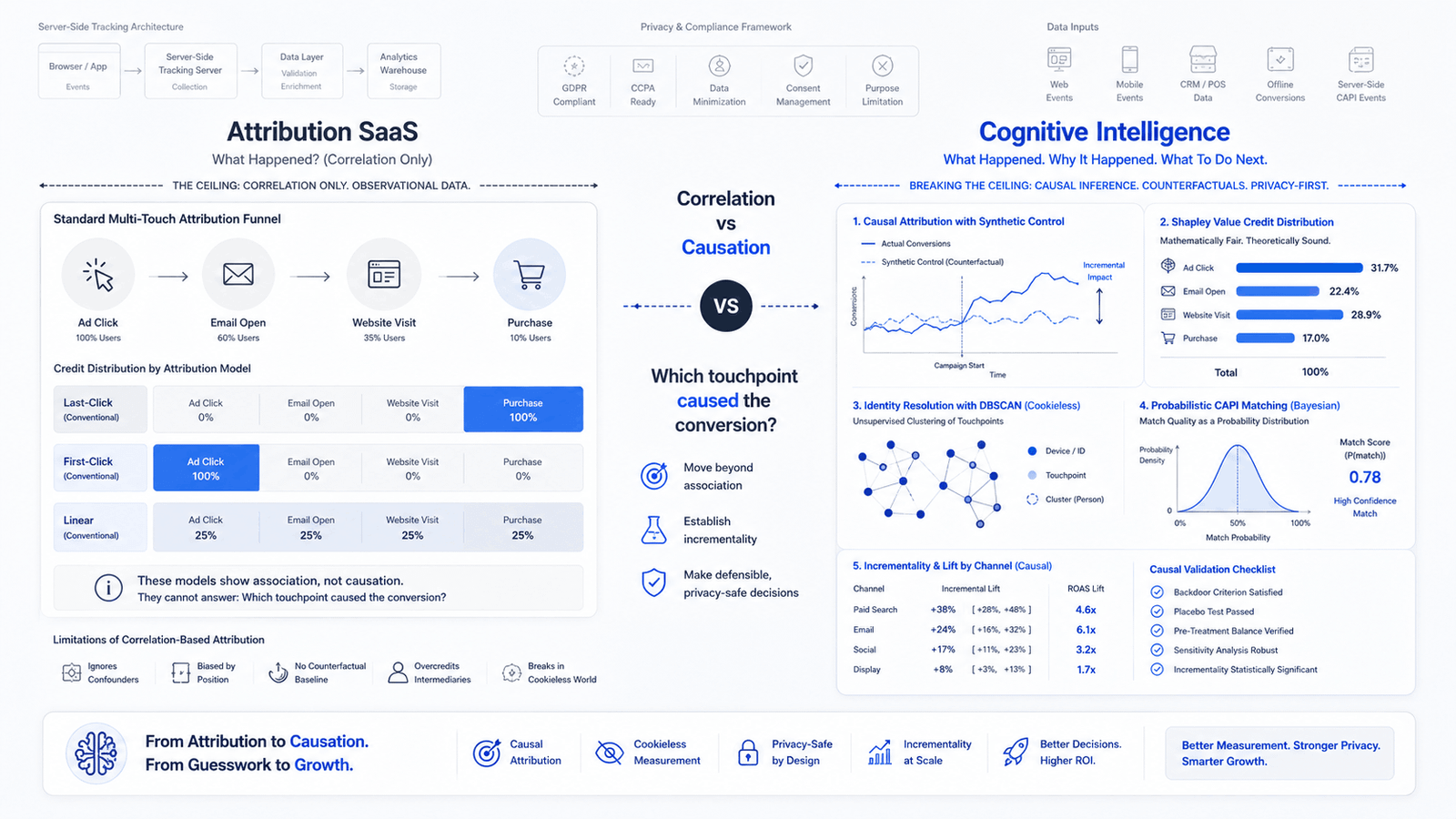
The fundamental problem is not technical. It is causal. Budget allocation does not need to know which touchpoint occurred before the conversion — every model answers that. It needs to know which touchpoint caused it: without which the conversion would not have happened, or would have happened at meaningfully lower probability.
Post-iOS, these platforms have invested serious engineering into server-side tracking and probabilistic matching. That effort is valuable. It makes the correlational problem more tractable — it does not solve the causal one.
What are ad attribution and cookieless tracking tools?
Measurement tools that track the relationship between marketing touchpoints and conversion events — connecting ad clicks, email opens and social interactions to purchases, leads and revenue.
The category was fundamentally disrupted by Apple’s App Tracking Transparency changes, which eliminated the device-level identifiers platforms used for conversion attribution and optimisation. The SaaS response was server-side tracking, first-party collection, probabilistic identity matching and ML-enhanced models attempting to rebuild accuracy without cookies.
What they are: measurement tools that track touchpoints and attribute conversions using various methodologies. What they are not: causal attribution systems that validate whether touchpoints genuinely caused conversions, or incrementality platforms that distinguish demand generation from demand capture.
Five tiers of attribution software
Most comparisons cover tier 1 only. Tier 5 is the one that matters most for this discussion — a small group of platforms doing genuine causal measurement, and they are almost never mentioned alongside the trackers.
Post-iOS server-side trackers
- Hyros
- Cometly
- Wicked Reports
- RedTrack
- TripleWhale Pixel
- Elevar
- Stape
- Addingwell
- Analyzify
Rebuild the conversion signal lost to privacy changes through server-side collection and Conversions API. Elevar, Stape and Addingwell are pure infrastructure — they improve signal quality without claiming to model attribution.
Enterprise multi-touch attribution
- Rockerbox
- Northbeam
- Adobe Analytics
- Marketing Evolution
- Nielsen Attribution
ML-weighted multi-touch modelling at enterprise scale, usually bundled with MMM. More defensible than last-click — still learning correlations rather than causation.
B2B revenue attribution
- Dreamdata
- Factors.ai
- HockeyStack
- Ruler Analytics
- Attribution App
- Bizible
Built for long, multi-stakeholder B2B cycles — connecting touchpoints to CRM-recorded revenue rather than pixel-fired events. Frequently missing from ecommerce-focused comparisons despite being the right category for many buyers.
Mobile measurement partners
- AppsFlyer
- Branch
- Adjust
- Singular
- Kochava
App install and in-app event attribution under SKAdNetwork and Privacy Sandbox constraints. A different technical problem from web attribution, with its own aggregation and delay limits.
Incrementality and geo-testing specialists
- Haus
- INCRMNTAL
- LiftLab
- Measured
- Google Meridian (open source)
- GeoLift (open source)
These are the honest exception in this category. They run geo holdouts and synthetic control experiments — genuine causal measurement, not correlational attribution. If you are choosing between attribution tools and have not evaluated this tier, evaluate it. Meta’s GeoLift and Google’s Meridian make the same methodology available at zero licence cost to teams with the capability to run it. Where even this tier stops: experiments answer the channels and periods you tested, and each test costs real spend and weeks of calendar. They validate; they do not continuously attribute every conversion in between.
Honest analysis of the leading platforms
Each assessment covers genuine strengths and where the architecture stops.
Hyros
What it doesAdvanced tracking for high-ticket and info-product businesses, using AI-weighted attribution, email tracking, call tracking and multi-touch journey visualisation across complex funnels.
Who uses itHigh-ticket ecommerce, course businesses, coaching and consulting, and agencies with multi-step funnels.
Genuine strengthsStrong multi-step funnel tracking connecting initial ad exposure to eventual revenue across journeys involving email, phone calls and multiple visits. Email and call tracking integration genuinely extends visibility where pixels lose it.
Where the ceiling isThe AI model distributes credit on historical touchpoint-to-conversion correlation, not causal contribution. Journey capture is more complete — but completeness of capture is not validation of causation. It cannot answer whether removing a touchpoint would have changed the outcome.
Cometly
What it doesServer-side ad tracking for post-iOS attribution recovery, using first-party cookies and Conversions API integration, focused on Meta and Google for ecommerce and lead gen.
Who uses itDTC brands and lead generation businesses that lost significant Meta attribution after iOS 14.
Genuine strengthsStrong server-side implementation improving Conversions API event match rates. Clean setup for Shopify. Genuine improvement in Meta signal quality over standard pixel. Accessible SMB pricing.
Where the ceiling isServer-side tracking improves the technical quality of event matching; the attribution model applied to those events stays correlational. For multi-step funnels — lead to qualification to demo to close — event-level tracking loses the thread across extended cycles.
Wicked Reports
What it doesMulti-touch attribution offering first-click, last-click and time-decay models across email, paid and organic, focused on connecting activity to CRM-recorded revenue rather than pixel events.
Who uses itEmail-first businesses, coaches, consultants and info-product companies.
Genuine strengthsStrong CRM integration enabling more accurate revenue attribution where the pixel-to-purchase path is indirect. Multiple models available side by side. Email attribution more precise than UTM tracking alone.
Where the ceiling isIt offers several models without helping you determine which reflects your causal reality. Multiple options only help when there is a principled basis for choosing one — which requires causal validation. Without it, you get several different answers and no way to rank them.
RedTrack
What it doesPerformance marketing tracking for media buyers and affiliates — click tracking, conversion tracking, traffic source analysis and basic fraud detection with server-side capability.
Who uses itPerformance marketers, affiliates and media buying agencies running direct response with complex traffic routing.
Genuine strengthsGranular click-level visibility across traffic sources that aggregated platform reporting obscures. Server-side capability. Flexible conversion tracking for diverse funnel architectures.
Where the ceiling isIt is a click tracking platform — credit is assigned to clicks rather than modelled across the full exposure journey. Where impression-based awareness and content touchpoints contribute meaningfully, click-only attribution systematically undercredits them.
Rockerbox
What it doesEnterprise multi-touch attribution unifying paid, owned and earned channels, with MMM and incrementality testing available alongside the MTA layer.
Who uses itMid-market to enterprise brands running many channels who need one measurement view across all of them.
Genuine strengthsBroad channel coverage including offline and direct mail that most competitors ignore. Combining MTA with MMM and experiments in one platform is methodologically stronger than MTA alone.
Where the ceiling isThe MTA layer remains correlational, and combining three methodologies in one interface risks conflicting signals whose reconciliation is not fully transparent. The incrementality component is the causally valid part — and it is used far less than the dashboard.
Dreamdata
What it doesB2B revenue attribution connecting every touchpoint across the account journey to CRM-recorded pipeline and closed revenue, with account-level rather than contact-level modelling.
Who uses itB2B SaaS and technology companies with long, multi-stakeholder buying cycles.
Genuine strengthsAccount-level attribution is the correct unit for B2B, where five people from one company touch fifteen assets before a deal. Strong CRM and product-data integration. Handles cycle lengths that break ecommerce tools.
Where the ceiling isStill correlational: it maps which touchpoints appeared in journeys that closed, not which ones changed the outcome. In B2B the sample sizes are usually too small for statistically confident credit distribution — a limitation the interface does not surface.
Also assessed: TripleWhale Pixel, Northbeam, Factors.ai, HockeyStack, Ruler Analytics, Attribution App, Elevar, Stape, Addingwell, Analyzify, AppsFlyer, Branch, Adjust, Singular, Kochava, Haus, INCRMNTAL and LiftLab. The incrementality tier is the exception — limitation 01 below does not apply to it, and that is stated plainly rather than glossed over.
The difference between a click before a sale and a cause of a sale
Placeholder — no video yet. Delete this box and drop in the Elementor Video widget when the recording is ready, or hide this whole section from Advanced → Responsive until then.
Correlation masquerading as causation
This is the foundational limitation of every attribution tool outside the incrementality tier, regardless of methodological sophistication.
Every model — last-click, first-click, linear, time-decay, ML-weighted — distributes credit based on which touchpoints were present in converting journeys. The implicit assumption is that presence implies contribution.
A customer who had already decided, from word of mouth, will still click a branded search ad before buying. Last-click gives it full credit. No model here answers whether removing that touchpoint would have changed the outcome. Budget shifted toward branded search on that signal is budget shifted from demand generation to demand capture.
Applies true incrementality measurement — synthetic controls, CausalML and matched market holdout testing — to validate which touchpoints genuinely cause conversions.
Combined with Shapley value and Markov chain removal-effect modelling for continuous fractional credit between experiments.
Complex funnel visibility loss
These tools assume conversion events are directly trackable — a purchase pixel fires, a lead form submits. For multi-step funnels, the thread between early touchpoints and eventual conversion is frequently lost entirely.
A customer clicks a Meta ad, joins an email list, attends a webinar three weeks later, has a phone consultation two weeks after that, and converts four weeks later.
Standard tools capture the click, maybe the email open, and lose the consultation and the decision that followed it completely.
Custom server-side architecture built for the client’s actual funnel — webhook integrations at every conversion step, CRM connection to revenue outcomes.
Visibility is maintained across the full journey regardless of length or complexity, because the tracking was designed around the funnel rather than the funnel squeezed into the tracking.
Identity resolution limitations
The same customer across mobile, desktop and tablet appears as multiple separate users. The mobile click that started the journey, the desktop research that informed it, and the tablet purchase that completed it look like three disconnected people.
Platforms address this with probabilistic matching on shared identifiers — email, phone, device characteristics.
Accuracy depends entirely on what proportion of customers authenticate at some point, giving the matching a deterministic anchor. For businesses with high anonymous traffic, standard matching recovers only a fraction of cross-device journeys.
Applies DBSCAN entity resolution and graph neural network identity graphing, extending matching beyond email and phone hashing.
Behavioural session patterns, device characteristics, temporal proximity and network signals all become matching inputs — recovering journeys that hashing alone cannot connect.
Privacy regulation compliance gaps
These tools collect and process behavioural data about identifiable individuals, creating obligations under GDPR, CCPA, PECR and equivalent frameworks that differ by market.
Standardised collection and processing approaches may not accommodate the specific consent requirements, retention limits and processing restrictions of every relevant jurisdiction.
For regulated industries — financial services, healthcare, legal — generic platform configuration can create compliance exposure the default setup does not address.
Designs attribution infrastructure with jurisdiction-specific requirements built into the collection architecture rather than applied as a configuration afterwards.
Consent state, retention and processing basis are decisions made at design time, per market.
Attribution window misalignment
Every platform applies default windows — typically 7-day click and 1-day view on Meta, 30-day click on Google — calibrated for average conversion latency across all advertisers.
B2B with 90-day cycles. High-ticket ecommerce with extended consideration. Subscription businesses where trial-to-paid takes 30 to 45 days. Supplement brands where repurchase follows consumption rate.
For all of these, defaults produce systematic gaps — crediting channels at the end of the journey while under-crediting those that initiated it weeks earlier.
Applies time-to-conversion hazard function modelling, estimating the full distribution of conversion latency from your own historical data.
Attribution windows are then configured to your actual customer decision timeline rather than a platform default calibrated for someone else.
Attribution SaaS vs Cognitive Intelligence
The engineering in this category is genuinely good. It is pointed at the tractable problem rather than the important one.
| Dimension | Attribution SaaS | Cognitive Intelligence |
|---|---|---|
| Statistical basis | ×Correlational attribution | ✓Causal incrementality validation |
| Credit logic | ×Touchpoint presence equals credit | ✓Causal contribution equals credit |
| Holdout testing | ×Not performed | ✓Synthetic controls and CausalML |
| Attribution method | ×One model, or several unranked | ✓Shapley value and Markov chain |
| Attribution windows | ×Platform defaults | ✓Hazard function latency modelling |
| Funnel complexity | ×Simple, directly trackable events | ✓Custom multi-step architecture |
| Identity resolution | ×Email and phone hashing | ✓DBSCAN plus graph neural networks |
| Signal source | ×Platform-reported and pixel-derived | ✓Raw API and server-side extraction |
| CAPI matching | ×Standard implementation | ✓Bayesian probabilistic matching |
| Compliance | ×Generic configuration | ✓Jurisdiction-specific by design |
| Final output | ×A dashboard | ✓An executed budget strategy |
| Commercial model | ×$150–$10,000+ subscription | ✓Custom engagement investment |
When attribution SaaS is sufficient, and when it is not
For a large share of businesses, a good tracker plus an occasional geo test is the correct answer.
Attribution SaaS is sufficient when
- The funnel is simple and direct — ad click to purchase with minimal intermediate steps
- The sales cycle sits inside standard platform attribution windows
- Attribution decisions are directional — which channels to scale — rather than high-stakes allocation
- You operate in a single jurisdiction with straightforward compliance requirements
- Conversion volume is sufficient — roughly 50+ per week per channel — for ML-weighted models to be statistically reliable
Cognitive Intelligence becomes necessary when
- The funnel is complex — multiple steps, consultations, sales team involvement — and tools lose journey visibility
- The sales cycle extends beyond platform windows, requiring custom latency modelling
- You need causal validation for allocation decisions with significant financial stakes
- You operate across jurisdictions where generic compliance configuration may be insufficient
- Cross-device identity resolution rates are low due to high anonymous traffic
- You suspect current attribution is systematically overcrediting certain channels and need independent analysis
Where AI agents fit in attribution
Attribution has an unusual property: the tracking layer is almost entirely workflow work, and the measurement layer is almost entirely modelling work. Confusing the two is why so many businesses buy a tracker and expect a measurement answer.
Workflow agents on n8n, Make.com or Zapier handle event transport, CAPI firing and match-rate alerting. Autonomous agents handle credit assignment, latency modelling and identity stitching. MCP gives either governed access to the ad APIs and warehouse; skills keep every run to the same standard.
| Task | Architecture that fits | Why |
|---|---|---|
| Assigning causal credit | Autonomous — Shapley and Markov removal-effect on the full journey graph | A rule applies a fixed window, which is the limitation itself |
| Designing a holdout test | Neither — experiment design is statistical judgement | Choosing geos, duration and power is where most incrementality tests fail |
| Modelling conversion latency | Autonomous — hazard functions fit to your own conversion distribution | A rule uses the platform default calibrated for someone else |
| Cross-device identity stitching | Autonomous — graph clustering on behavioural and device signals | A rule matches on hashed email only, missing anonymous journeys |
| Firing server-side conversion events | Workflow with MCP — events pushed to CAPI on trigger | Ideal for a rule; this is transport, not modelling |
| Alerting on match-rate collapse | Workflow — match quality drops below threshold, team notified | Ideal for a rule, and it catches tracking breakage early |
What stays with a person
- Experiment design. Which geos, how long, what power. Most incrementality tests fail here rather than in the analysis.
- Accepting a counterintuitive result. When the test says your best-reported channel is not incremental, that conclusion needs human validation before budget moves.
- Reallocation above the agreed threshold. A model recommends. A person signs it off.
- What data gets collected, and under what consent basis. This is a legal decision, not an optimisation one.
The full breakdown sits in the AI agents section.
Questions about ad attribution
Our Meta, Google and Hyros numbers all disagree. Which one is right?
Usually none of them, and the disagreement is the most useful signal you have. Each platform attributes using its own methodology and its own commercial incentive, which is why platform-claimed conversions routinely sum to well over 100% of actual orders. The only way to settle it is measuring what happens when spend is removed — a holdout or geo test — which no tracker performs.
Is Hyros or Cometly better?
They solve different problems. Cometly is stronger on straightforward ecommerce server-side signal recovery at a lower price. Hyros is stronger on multi-step, high-ticket funnels involving email and phone calls. Neither performs causal validation, so the choice is about which correlational picture is more complete for your funnel shape — not which is more accurate.
What are incrementality platforms like Haus and INCRMNTAL, and should I consider them?
They run geo holdouts and synthetic control experiments — genuine causal measurement rather than correlational attribution. If you are evaluating attribution tools and have not looked at this tier, you should. Their limitation is scope and cost: each experiment answers the channel and period you tested, consumes real spend, and takes weeks. They validate; they do not attribute every conversion in between.
Can I do incrementality testing without paying for a platform?
Yes, with capability. Meta’s GeoLift and Google’s Meridian are both open source and implement the same synthetic control methodology the commercial platforms use. The honest constraint is the same as with MMM: the methodology is free, the experiment design and interpretation are not, and a badly designed test produces confident wrong answers.
Does server-side tracking fix the iOS attribution problem?
It materially improves event match quality, which is real value. It does not fix attribution, because the model applied to those better-matched events is still assigning credit by presence rather than causation. Better data through the same correlational model produces a more precise correlational answer.
Is this relevant for businesses in Pakistan or COD-heavy markets?
Particularly, because COD breaks pixel attribution in a way Western tools rarely account for — the conversion event fires at order placement while the actual revenue event happens at delivery, days later, with a 25–45% failure rate in between. Attribution built on order-placement pixels systematically overstates channel performance in these markets.

Usman Saeed
AI-Driven Digital Marketing Intelligence Consultant & Growth Engineer in Pakistan. Usman Saeed specializes in engineering resilient digital growth architectures — helping enterprise brands eliminate tracking data drops, secure conversion signals, and maximize profitability through E-commerce Engineering, server-side Signal Engineering, and Predictive Intelligence. With 12+ years of experience and advanced data science expertise, marketing guesswork is replaced with mathematical precision — automated systems that bridge execution with business intelligence, ensuring your investment delivers measurable scale.
Where to go next
Attribution starts with your raw data and your actual funnel
The audit examines tracking integrity, match rates and where credit is being overstated. If your current tracker genuinely covers your funnel, you will be told that directly.