
No-Code Predictive AI SaaS vs Cognitive Intelligence
No-code predictive AI tools are a genuine innovation. For the first time, businesses without data science teams can generate ML-powered churn forecasts, lifetime value estimates and demand projections through guided interfaces. That is valuable. It is not sufficient for every prediction problem.
The ceiling is not a competitive claim. It is architectural: pre-built AutoML applies generalised algorithms to your data without understanding your behavioural patterns, external market dynamics or the causal relationships between variables.
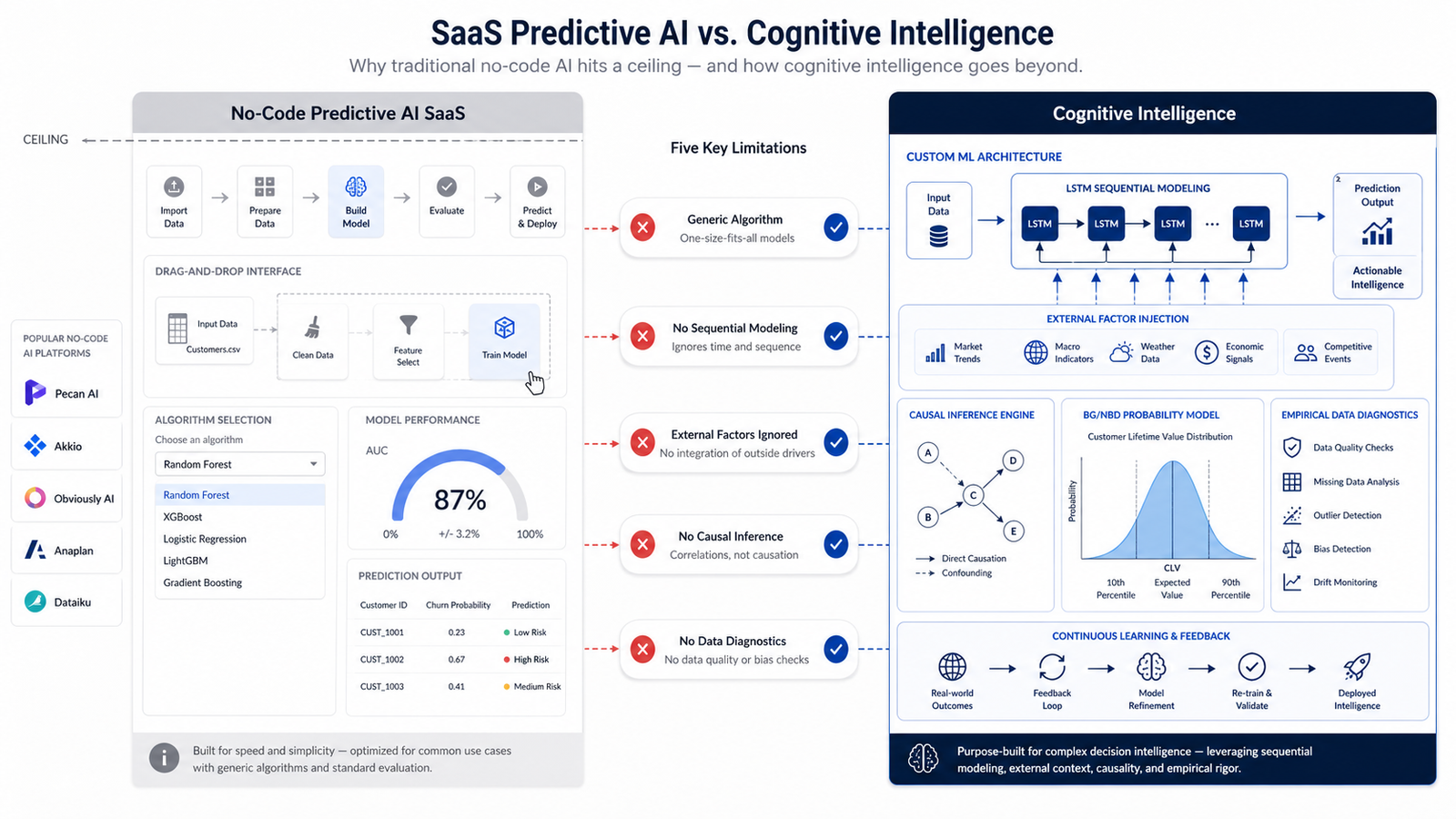
What are no-code predictive AI SaaS tools?
SaaS products that let you connect a data source — CRM, ecommerce platform, analytics system — and generate ML predictions through a guided interface without writing Python, R or SQL. The core technology underneath most of them is AutoML: automated algorithm selection, hyperparameter tuning and prediction generation from structured input with minimal human configuration.
Their value proposition is democratisation, and it is real. The question this page answers is where that democratisation stops.
The four tiers of predictive AI in marketing
Most comparisons only cover tier 1. In practice, businesses evaluating predictive AI are choosing between four different things — and many are already paying for tier 2 without knowing it.
Dedicated no-code predictive platforms
- Pecan AI
- Akkio
- Obviously AI
- Graphite Note
- Faraday
- Qlik Predict
- BigML
- Kumo.ai
- Peak AI
Built specifically to turn business data into predictions. This is the category most people mean by “predictive AI SaaS”.
Predictive features inside tools you already own
- Klaviyo Predictive Analytics
- Salesforce Einstein Prediction Builder
- HubSpot Predictive Lead Scoring
- Zoho Zia
- Pendo Predict
- Shopify Segments
Check this tier before buying anything. Klaviyo already produces predicted CLV and churn risk; HubSpot already scores leads. For many businesses this is enough, and the cost is zero.
Customer success platforms with churn scoring
- Gainsight
- ChurnZero
- Totango
- Vitally
- Custify
- Planhat
Built to act on churn risk, not primarily to predict it. Health scores here are often rule-based composites rather than trained models — worth knowing before treating the number as a prediction.
Ecommerce pLTV specialists
- Decile
- Admetrics
- Lifetimely
- Retention.com
- Saras Analytics
Narrow by design — predicted lifetime value and cohort economics for DTC. Strong within that scope, and not intended to solve prediction problems outside it.
Honest analysis of the leading platforms
Each assessment covers what the tool genuinely does well and where its architecture stops. None of these are criticisms of engineering quality — they are the structural consequences of building software for thousands of customers at once.
Pecan AI
What it doesPredictive analytics for business teams via a SQL-based interface, with a GenAI layer that turns a plain-English goal into model configuration.
Who uses itMid-market ecommerce, subscription and DTC teams with analysts but no data scientists.
Genuine strengthsAccessible to SQL-proficient analysts. Pre-built templates for churn, LTV and propensity. Connects directly to Snowflake, BigQuery and Redshift.
Where the ceiling isAutoML selects from a standard library — gradient boosting, logistic regression, random forest. It flattens relational data into a single table, so multi-hop behavioural patterns are out of reach, and it cannot inject external market signals.
Akkio
What it doesGenuinely no-code drag-and-drop model building for lead scoring, churn, forecasting and segmentation, with natural-language querying.
Who uses itAgencies and small-to-mid marketing teams needing fast deployment without coding.
Genuine strengthsThe most accessible interface in the category. Fast time to a working model. Agency-friendly pricing and white-labelling.
Where the ceiling isStandard classification and regression only — no deep learning, no sequential modelling, no causal inference. Dataset size limits make it unsuitable for large behavioural histories. Simplification always involves information loss.
Obviously AI
What it doesUpload a CSV or connect a source, pick a target variable, and the platform handles feature selection, algorithm choice and training.
Who uses itSmall businesses and non-technical marketers needing basic prediction with no infrastructure.
Genuine strengthsMinimal setup — predictions from a CSV in minutes. Genuinely usable without technical skill. API deployment for integration.
Where the ceiling isSingle-table prediction cannot model sequential behaviour, multi-source signals or time-series dynamics. For anything with real complexity the output is directionally approximate at best.
Kumo.ai
What it doesRelational deep learning that predicts directly on connected database tables without manual feature engineering.
Who uses itEnterprise data teams with relational warehouses and complex entity relationships.
Genuine strengthsGenuinely addresses the single-table ceiling that limits most of this category. No manual feature engineering. Fast inference on relational data.
Where the ceiling isStill a platform choosing its own representation of your problem. Business objectives, intervention design and causal validation remain outside its scope — it predicts accurately, it does not tell you what to do about it.
Peak AI
What it doesApplied AI for commercial decisions — pricing, inventory and customer decisioning — delivered as decision products rather than raw models.
Who uses itRetail, consumer goods and manufacturing enterprises.
Genuine strengthsDecision-oriented rather than model-oriented. Strong commercial framing. Deployment support included rather than left to the buyer.
Where the ceiling isProductised decisioning means productised assumptions. Where your commercial logic differs from the template the product encodes, that difference is not configurable.
Qlik Predict
What it doesAutoML integrated into the Qlik analytics stack, generating predictions alongside BI dashboards.
Who uses itOrganisations already standardised on Qlik for business intelligence.
Genuine strengthsNo separate procurement or data movement. Predictions sit next to the reporting stakeholders already use. Explainability features built in.
Where the ceiling isTied to the Qlik data model. AutoML with the same generic algorithm library as the rest of the tier, and no sequential or causal capability.
Faraday
What it doesConsumer prediction for DTC — propensity, churn and LTV enriched with third-party consumer data.
Who uses itDTC and consumer brands wanting prediction plus demographic enrichment in one step.
Genuine strengthsThird-party enrichment genuinely helps thin first-party datasets. Consumer-focused templates that match DTC problems closely.
Where the ceiling isEnrichment introduces dependency on data whose provenance and accuracy you do not control, and which privacy regulation is progressively restricting.
Graphite Note
What it doesNo-code predictive analytics and decision intelligence with guided model creation and narrative explanations.
Who uses itSMB and mid-market teams wanting predictions plus a plain-English explanation of them.
Genuine strengthsExplanation quality is a real differentiator — output that non-technical stakeholders can act on. Accessible pricing.
Where the ceiling isNarrative explanation is not causal explanation. It describes what the model weighted, not what would happen if you intervened.
Dataiku
What it doesA collaborative data science platform supporting both visual no-code workflows and full Python and R environments.
Who uses itEnterprise data science and analytics teams needing governance and MLOps at scale.
Genuine strengthsGenuine flexibility across skill levels. Strong model monitoring, retraining triggers and deployment management. Enterprise governance.
Where the ceiling isA platform, not a solution. Without custom architecture and domain-specific feature engineering, its visual workflows produce the same generic models as simpler tools in a more expensive package.
A note on Anaplan: it appears in many predictive AI comparisons, including an earlier version of this page. It is an enterprise connected-planning platform for finance and operations with forecasting add-ons — not a predictive AI product. If you are evaluating it for marketing prediction, you are evaluating the wrong category of software.
Where no-code prediction stops working
Placeholder — no video yet. Delete this box and drop in the Elementor Video widget when the recording is ready, or hide this whole section from Advanced → Responsive until then.
Generic algorithm selection
AutoML selects algorithms using generic optimisation metrics — AUC, RMSE, F1 — computed against a holdout subset of your training data. It cannot optimise for your actual business objective.
Optimises a statistical score. A model with 87% AUC that systematically misclassifies your highest-value segment as low churn risk is mathematically impressive and operationally catastrophic.
The platform cannot detect this, because it does not know which customers are high value. It only knows what the training labels say.
Optimises against the business objective — maximising retention of high-LTV customers specifically, or minimising false negatives in a particular segment.
The loss function is chosen deliberately, and performance is evaluated segment by segment rather than in aggregate.
Sequential behaviour blindness
Most marketing prediction problems are fundamentally sequential. The order in which a customer acts carries information that aggregate features destroy.
Works on tabular, aggregated feature sets. A customer who viewed, left, returned after three days, added to cart, removed, then returned after seven days before purchasing has identical aggregate statistics to one who added and purchased immediately.
To the model, those two customers are the same person.
Applies LSTM and transformer architectures to sequential behavioural data, capturing the temporal patterns tabular ML cannot represent.
The sequence is the signal — and in ecommerce and SaaS it is frequently the strongest predictor available.
External factor blindness
No-code platforms train on your internal data. They cannot incorporate signals from outside it — and those signals routinely determine the outcome being predicted.
When inflation reduces category spending, a competitor launches aggressive pricing, or a platform algorithm changes delivery, the model keeps applying historical correlations that no longer hold.
Confidence intervals remain unchanged. Predictions drift from reality with no warning signal.
Strategic intelligence injects external context as domain knowledge — economic indicators, competitive movement, platform change documentation, category demand shifts.
Encoded into the model as priors and features, rather than left outside it entirely.
Causal inference absence
These platforms produce predictions — probability estimates based on historical patterns. They do not produce causal explanations, and marketing interventions operate causally.
Tells you who is likely to churn. It cannot tell you which of them will respond to intervention.
So retention budget goes to customers who would have churned regardless, customers who were never going to churn, and occasionally to customers whose treatment accelerates disengagement.
Causal inference frameworks — CausalML, DoWhy, difference-in-differences — identify which interventions actually change the outcome.
Uplift modelling separates the persuadable from the already-decided, which is the difference between spending a retention budget and wasting one.
Data quality assumed, never checked
Every platform in this category assumes your input data is clean, complete and accurately structured. None of them perform diagnostics before training.
If your CRM has systematic attribution errors, your event tracking fires duplicates, or transaction records have missing fields that correlate with the outcome being predicted — the model trains on corrupted inputs.
And it reports the result with full algorithmic confidence.
Empirical data diagnostics run before any model is trained. Tracking integrity, pipeline gaps, duplicate events, label leakage.
No subscription software can do this, because no software has the domain knowledge to know what your specific data should look like.
Predictive AI SaaS vs Cognitive Intelligence
Every row below is architectural rather than featural — true of any platform serving thousands of customers with one codebase.
| Dimension | No-code predictive AI SaaS | Cognitive Intelligence |
|---|---|---|
| Algorithm selection | ×Pre-built AutoML library | ✓Custom ML and DL architecture |
| Optimisation target | ×Generic metrics (AUC, RMSE) | ✓Business-objective-specific |
| Feature engineering | ×Automated and generic | ✓Domain-knowledge driven |
| Data structure | ×Tabular, usually single-table | ✓Sequential and relational modelling |
| External signals | ×Internal data only | ✓Injected as priors and features |
| Statistical basis | ×Correlation-based prediction | ✓Causal inference framework |
| Data quality | ×Assumed clean | ✓Diagnosed before modelling |
| Model decay | ×Degrades silently | ✓Drift monitoring and retraining |
| Business logic | ×Not encodable | ✓Encoded in model design |
| Intervention design | ×Out of scope | ✓Uplift modelling determines who to treat |
| Deployment | ×Platform-locked | ✓Custom API deployment |
| Deliverable | ×A prediction score | ✓An executed intervention strategy |
| Commercial model | ×$75–$200k+ subscription | ✓Custom engagement investment |
When no-code predictive AI is sufficient, and when it is not
Not every business needs Cognitive Intelligence for every prediction problem. Stated plainly.
No-code predictive AI is the right choice when
- The problem is standard — churn, LTV or demand for a business with typical data structure and typical behaviour
- Data is clean and complete, with 10,000+ labelled examples for the model to train on
- Financial stakes are manageable relative to the cost of a systematically inaccurate model
- The team has no data science capability and needs a reasonable improvement on intuition
- Tier 2 covers it — Klaviyo, HubSpot or Salesforce predictive features you already pay for may be sufficient
Cognitive Intelligence becomes necessary when
- The prediction depends on sequential behaviour where order and timing carry the signal
- External market factors materially affect the outcome and no pipeline captures them
- The business has non-standard logic — custom pricing, unusual segments, multi-market behaviour
- The intervention needs causal validation, not just a risk score
- Data has quality problems requiring diagnosis first — true of most businesses past two years of history
- The cost of a systematically biased model exceeds the cost of building a correct one
Where AI agents fit in a prediction workflow
A predictive SaaS subscription gives you a model you did not choose. An AI agent built on custom modelling gives you one you did — and runs it without anyone opening a dashboard.
Workflow agents on n8n, Make.com or Zapier handle alerts, transport and scheduling. Autonomous agents handle scoring, intervention selection and retraining. MCP gives either governed access to the warehouse and CRM; skills keep every run to the same standard.
| Task | Architecture that fits | Why |
|---|---|---|
| Scoring every customer nightly | Autonomous — the model runs on fresh behavioural data and rescores | A rule can trigger the run; it cannot produce the score |
| Choosing who receives an intervention | Autonomous — uplift modelling separates persuadable from decided | A rule targets everyone above a threshold, which is the waste this page describes |
| Retraining when accuracy decays | Autonomous — drift detection triggers retraining on its own schedule | A monthly rule retrains too often or too late, never at the right moment |
| Alerting the team to a churn spike | Workflow — threshold crossed, task created, owner notified | Ideal for a rule; the threshold comes from the model |
| Pushing scores into the CRM | Workflow with MCP — scores written to Salesforce or HubSpot on a schedule | Ideal for a rule; no modelling involved in the transport |
What stays with a person
- Defining what is being predicted. A wrong target variable produces a model that is accurate about the wrong thing.
- Deciding the intervention itself. The model says who; what you offer them is a commercial decision.
- Accepting a model into production. Evaluation can be automated; the decision to trust it cannot.
- Anything where the outcome cannot be measured. Without a feedback signal an agent optimises confidently toward the wrong objective.
The full breakdown sits in the AI agents section.
How Cognitive Intelligence handles each prediction problem
The same four problems these tools target, approached with custom architecture. Each links to the full Predictive Intelligence solution.
Churn prediction
Customer lifetime value
Lead scoring
Demand forecasting
Questions about predictive AI tools
Which no-code predictive AI tool is best?
It depends on where you sit. Pecan suits analysts comfortable with SQL and a warehouse; Akkio suits non-technical teams needing speed; Obviously AI suits the simplest single-table problems; Kumo.ai genuinely addresses the relational ceiling at enterprise scale. Before buying any of them, check what your existing stack already includes — Klaviyo, HubSpot and Salesforce all ship predictive features most users never switch on.
Why is Anaplan not treated as a predictive AI tool here?
Because it is not one. Anaplan is an enterprise connected-planning platform for finance and operations with forecasting add-ons. It appears in many comparison lists because its forecasting features sound adjacent, but evaluating it against Pecan or Akkio is a category error — different buyer, different problem, different architecture.
How much data do I need before predictive AI works?
As a working minimum, around 10,000 labelled examples — meaning outcomes the model can learn from, not just rows. Below that, AutoML tends to overfit and report confident accuracy that does not survive contact with new data. Simpler cohort analysis usually outperforms it at that stage, and that gets said directly rather than sold around.
Our SaaS model produces predictions but they are not improving results. Why?
Almost always one of the five limitations on this page. In practice the most common are causal absence — you are targeting people who would have churned anyway — and undiagnosed data quality, where the model is confidently learning from corrupted inputs. The answer is rarely a different subscription; it is diagnosing which limitation is binding.
Can AI agents replace a predictive AI subscription?
They replace the interface, not the modelling. An autonomous agent running a custom model can score, select interventions and retrain without anyone opening a dashboard — but something still has to build and validate that model. Buying a subscription gives you a model you did not choose; building one with agents to operate it gives you a model you did.
Is this worth it for a business in Pakistan or a smaller market?
The qualifier is data volume, not location. A Pakistani ecommerce brand with two years of transaction history and meaningful order volume is a better candidate than a larger business with fragmented tracking. Where the data cannot support modelling, a Tier 2 predictive feature or a simple cohort analysis is recommended instead.

Usman Saeed
AI-Driven Digital Marketing Intelligence Consultant & Growth Engineer in Pakistan. Usman Saeed specializes in engineering resilient digital growth architectures — helping enterprise brands eliminate tracking data drops, secure conversion signals, and maximize profitability through E-commerce Engineering, server-side Signal Engineering, and Predictive Intelligence. With 12+ years of experience and advanced data science expertise, marketing guesswork is replaced with mathematical precision — automated systems that bridge execution with business intelligence, ensuring your investment delivers measurable scale.
Where to go next
The prediction starts with your data, not a SaaS template
The audit identifies which of the five limitations is actually binding on your account. If a subscription genuinely solves your problem, you will be told that directly.