
Marketing SaaS Tools vs Cognitive Intelligence: Where Every Tool Hits Its Ceiling
This is not an anti-SaaS page. Marketing SaaS tools are genuinely useful. Some have democratised capabilities that previously required enterprise data science teams.
But every SaaS tool — regardless of algorithm, interface or subscription price — has a structural ceiling that no software update can remove. Understanding where that ceiling sits, and what Cognitive Intelligence provides beyond it, is the difference between a marketing operation that reports data and one that generates decisions.
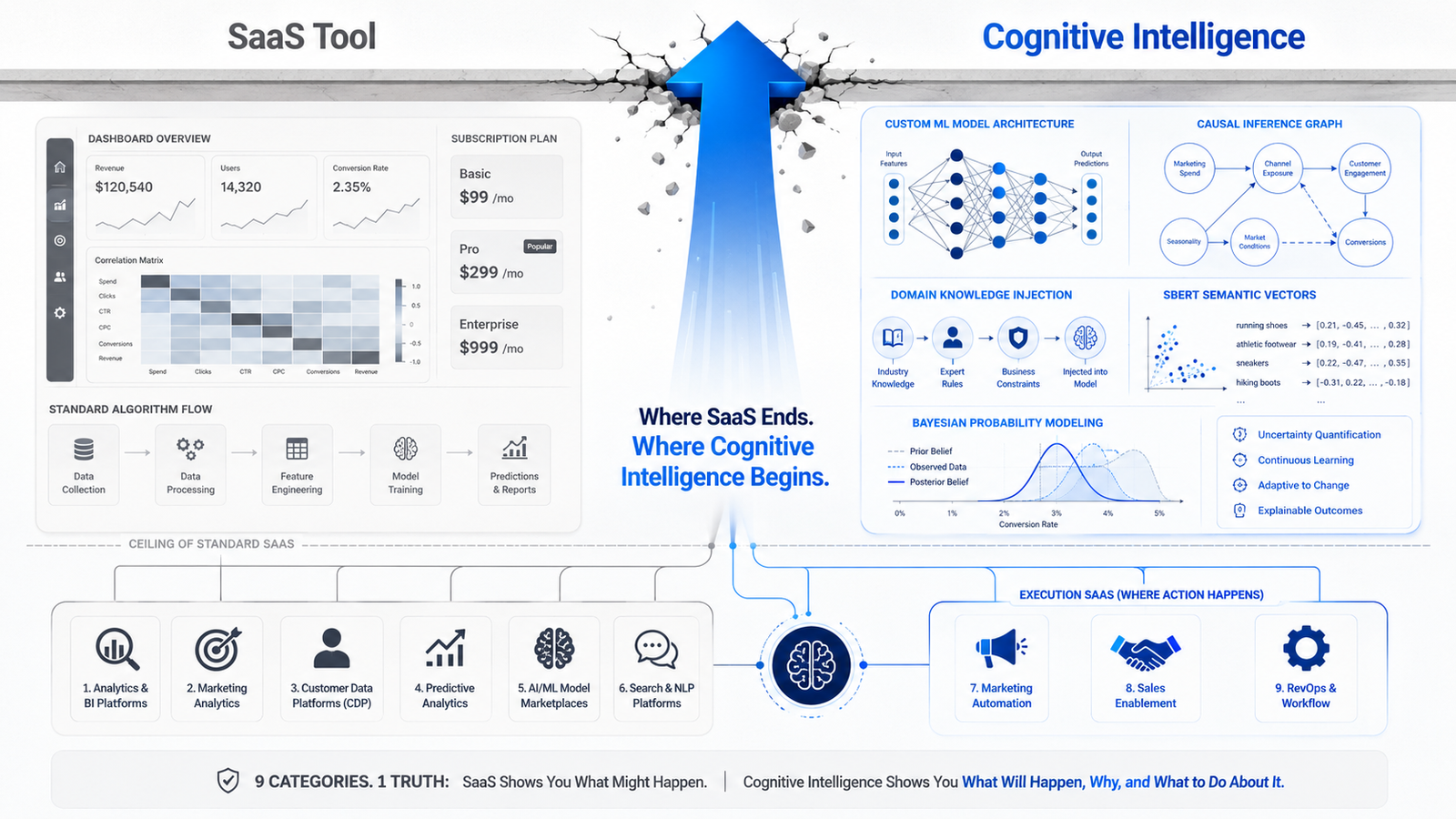
What is the difference between SaaS tools and Cognitive Intelligence?
Both use algorithms. Both use data. The difference is who the model was built for.
Software products built to solve generalised problems for the broadest possible customer base. Algorithms are pre-built, models are trained on generic data patterns, and outputs are designed to be interpretable without analytical expertise.
They are optimised for the average use case — not any specific business’s situation.
Custom ML models, causal inference frameworks, domain expertise and empirical data diagnostics — directed by strategic intelligence to solve specific problems that generalised algorithms cannot address.
It is not a rejection of AI or technology. It is using AI and ML tools intelligently, on your actual problem.
SaaS tools apply standard solutions to generalised problems. Cognitive Intelligence builds specific solutions to your actual problem.
The five intelligences Cognitive Intelligence combines
Each one is available separately. The combination is what is rare.
Custom ML & deep learning
Computational intelligence
Applied intelligence
Strategic intelligence
Practitioner intelligence
SaaS tools cannot clean your data before modelling
Every SaaS tool assumes your data is clean, complete and accurately structured. In practice, marketing data almost never is. Broken pixels fire on wrong events. CRM records contain duplicates. GA4 generates sessions that do not correspond to real behaviour. Pipelines have gaps nobody has audited since the last migration.
Processes whatever data it receives and generates results without flagging quality issues — because the tool has no way to know what your data should look like.
Corrupted data in, and the output is a confident, well-formatted, mathematically precise wrong answer.
Performs empirical data diagnostics first — auditing tracking integrity, cleaning infrastructure, validating input quality before any model runs.
This step alone frequently reveals that months of insights were built on corrupted foundations.
SaaS tools show what happened. Cognitive Intelligence shows why.
Every marketing SaaS tool operates on correlation — identifying patterns in historical data and presenting them as insight. In marketing, the difference between knowing what happened and knowing why is the difference between a report and a decision.
“Churn increased 15% last month.”
“Churn increased 15% because the onboarding sequence sent Step 3 before Step 2 completed — causing 23% of new users to reach a feature they had not been introduced to, abandon the product, and not return.”
“ROAS dropped from 4.2 to 2.8 across Meta campaigns.”
“ROAS dropped because the top creative hit a predicted fatigue threshold on day 14 — which CLIP-based analysis identified six days before the decline appeared on the dashboard.”
The causal layer is what turns data into decisions. SaaS tools are architecturally incapable of providing it, because causal inference requires custom model design, domain knowledge injection and experimental framework construction that no pre-built algorithm performs.
SaaS algorithms are built for the average business
Every SaaS tool serves thousands of customers simultaneously, which requires algorithms generalised enough to apply across all of them. Your business is not the average business.
A generic algorithm meets your specific data, and the result is a model optimised for the average case — not your case.
Your customer behaviour, price point, acquisition channels, data architecture and business logic are all specific to you. None of that is encoded.
Custom architecture, custom feature engineering, custom business logic integration, and validation against your actual historical outcomes.
The computational layer is not generalised. It is specific — and specificity is what produces accuracy in complex real-world problems.
SaaS tools cannot account for the world outside their data
SaaS models respond only to what they ingest — your spend, your conversions, your behavioural data. They cannot see the world beyond it.
When an economic shift changes spending behaviour, an MMM keeps applying historical correlations that no longer hold. When a competitor enters with aggressive pricing, a churn model keeps using features that predicted churn before the landscape changed. When a platform alters delivery, an attribution model keeps assigning credit on patterns that predate the change.
Strategic intelligence injects external context into models — economic signals, competitive intelligence, platform algorithm change documentation, market demand shifts.
This is not only a technical capability. It is domain knowledge: understanding what is happening in the real world, and encoding it into the analytical framework.
SaaS tools end at the report. Cognitive Intelligence ends at revenue.
Every SaaS tool ends at an output — a dashboard, a report, a prediction score, a recommendation. What happens next requires intelligence to translate that output into executed action.
A churn score is not a retention strategy. A budget recommendation is not a media buying decision. A ROAS dashboard is not an optimisation plan.
The tool stops at the point where the actual work begins.
Takes the data, applies causal reasoning, makes strategically sound decisions, and executes them through programmatic pipelines that compound over time.
It starts where the dashboard ends.
Where SaaS ends and Cognitive Intelligence begins
Placeholder — no video yet. Delete this box and drop in the Elementor Video widget when the recording is ready, or hide this whole section from Advanced → Responsive until then.
SaaS tools vs Cognitive Intelligence
Thirteen structural dimensions. None of these gaps close with a software update, because they are architectural rather than featural.
| Dimension | SaaS tool | Cognitive Intelligence |
|---|---|---|
| Algorithm | ×Pre-built and generic | ✓Custom-built for your problem |
| Data assumption | ×Assumes clean data | ✓Empirical diagnostics first |
| Statistical basis | ×Correlation-based output | ✓Causal inference framework |
| Question answered | ×Shows what happened | ✓Explains why it happened |
| Feature engineering | ×Generic | ✓Domain-specific by design |
| Model architecture | ×Standard AutoML pipeline | ✓Custom ML and deep learning |
| External factors | ×Ignored — outside the data | ✓Injected as domain knowledge |
| Final output | ×A report | ✓An executed strategy |
| Data access | ×Platform data only | ✓Raw API plus proprietary data |
| Relationship to dashboards | ×Dashboard dependent | ✓Starts where the dashboard ends |
| Strategic context | ×Missing by design | ✓Embedded in the model |
| Practitioner knowledge | ×Absent | ✓12+ years of first-party client data |
| Commercial model | ×Subscription pricing | ✓Custom engagement investment |
When SaaS is enough, and when it is not
Stated plainly, because the goal here is accuracy rather than universal anti-SaaS positioning.
SaaS tools are the right choice when
- Monthly marketing investment is below $5,000, where the cost of custom work exceeds the optimisation value available at that spend level
- Data is clean, simple and single-channel, so generic algorithms are unlikely to meet the complexity that causes them to underperform
- The business problem is genuinely standard, without unique business logic or external complexity
- The team is non-technical and operational simplicity is a real priority over analytical depth
- The business is early stage, where insufficient data history makes custom model training unreliable
Cognitive Intelligence becomes necessary when
- Monthly spend exceeds $10,000, where the optimisation delta typically justifies the investment
- Data is complex, messy or structured in ways generic algorithms cannot handle — which describes most businesses operating more than two years
- The business has unique logic: specific pricing structures, non-standard segments, complex multi-market operations
- Causal answers are required, not correlational patterns — when stakeholders ask why, and the answer determines budget
- External factors are materially affecting performance and current models do not account for them
- A SaaS model has underperformed and the actual cause needs identifying, not replacing with another subscription
- Marketing ROI must be defended to CFOs, boards or investors with causal evidence rather than platform-reported numbers
Where AI agents fit between the two
This silo argues that generalised tools have a ceiling. The AI agents section argues for automation. Those are not in tension, and the distinction is worth stating precisely.
- Level 1 — SaaS toolSomeone else’s generic model, run on your data. You configure it; you cannot change what it is.
- Level 2 — Cognitive IntelligenceThe layer that decides what should be built, on what data, validated how. This is where the ceiling is broken.
- Level 3 — AI agentYour own model, operated autonomously. Not a substitute for the thinking — the mechanism that runs it without a human clicking through.
Put simply: Cognitive Intelligence decides what to build. Agents are how it runs. Workflow agents on n8n, Make.com or Zapier handle alerts, handoffs and guardrails where the correct action is known in advance. Autonomous agents handle diagnosis, allocation and retraining, where it is not. MCP gives either architecture governed access to real tools and data; skills package the method so every run meets the same standard.
A SaaS subscription gives you a model you did not choose. An agent built on custom modelling gives you one you did. The full breakdown sits in the AI agents section.
Nine SaaS categories, analysed tool by tool
Every tool in every category is worth the investment when used for what it is actually good at, and wasted spend when used as a substitute for what only Cognitive Intelligence provides. Each page below applies that framework — genuine strengths, precise limitations, and the exact point where the ceiling is reached.
AI & predictive SaaS tools
No-code predictive AI SaaS
- Pecan AI
- Akkio
- Obviously AI
- Peak AI
- Kumo.ai
- Qlik Predict
Genuinely good atPre-built AutoML for churn, LTV and demand prediction without writing code — fast time to a first working model.
Ceiling reached atFlat-table modelling. These platforms flatten relational data into a single table, so multi-hop behavioural patterns are structurally out of reach.
Marketing mix modelling SaaS
- Measured
- Recast
- SegmentStream
- Sellforte
- Lifesight
- Keen
- Adobe Mix Modeler
- Google Meridian (open source)
- Meta Robyn (open source)
Genuinely good atCross-channel budget optimisation on aggregated, privacy-safe time-series data — genuinely valuable where click tracking does not exist.
Ceiling reached atPriors and external context. Generic MMM cannot encode your promotions calendar, competitor moves or market shocks as model priors.
Ecommerce & DTC analytics SaaS
- Triple Whale
- Northbeam
- Lifetimely
- Polar Analytics
- Peel Insights
- Daasity
- Decile
- Admetrics
- Saras Analytics
Genuinely good atUnified ecommerce dashboards consolidating LTV, cohort and attribution views that would otherwise take a data team to assemble.
Ceiling reached atDescriptive ceiling. Cohort charts show what happened; probabilistic CLV and uplift modelling on raw API data show what will happen and to whom.
Ad attribution & cookieless SaaS
- Hyros
- Cometly
- Wicked Reports
- RedTrack
- Rockerbox
- Dreamdata
- Factors.ai
Genuinely good atPost-iOS server-side tracking and cross-platform conversion consolidation in one interface, at accessible price points.
Ceiling reached atCorrelation, not causation. Deterministic matching still assigns credit — only holdout design and causal lift measure genuine incrementality.
AutoML & data science platforms
- DataRobot
- Dataiku
- H2O.ai
- Alteryx
- SageMaker Autopilot
- Google Vertex AI
- Databricks AutoML
Genuinely good atGuided model building, versioning and deployment for teams with some technical capability — real infrastructure, not toys.
Ceiling reached atFeature engineering and business logic. AutoML searches model space, not problem space; the domain framing still has to come from a person.
Business intelligence SaaS
- Tableau
- Power BI
- Looker Studio
- Qlik Sense
- Sisense
- ThoughtSpot
- Domo
- Metabase (open source)
Genuinely good atData visualisation, self-serve exploration and reporting at scale — the operational reporting backbone of most marketing teams.
Ceiling reached atDescriptive by design. BI answers what and where; predictive, prescriptive and causal layers sit above it, not inside it.
Marketing execution SaaS tools
SEO intelligence SaaS
- Ahrefs
- Semrush
- Moz
- SurferSEO
- Clearscope
- MarketMuse
- Conductor
- seoClarity
- Screaming Frog (desktop)
Genuinely good atKeyword research, backlink graphs, technical auditing and rank tracking at a scale no manual process matches.
Ceiling reached atThird-party approximations. Tool difficulty scores are proprietary estimates; SBERT analysis on raw Search Console API data measures what Google actually sees.
Paid media management SaaS
- Optmyzr
- Madgicx
- Revealbot
- Adalysis
- WordStream
- Skai
- Marin Software
- Smartly.io
Genuinely good atRule-based automation, bulk editing and cross-account management that removes hours of manual platform work every week.
Ceiling reached atRules cannot predict. Automation reacts to thresholds after they are crossed; fatigue prediction and LTV-weighted bidding act before.
CRM & marketing automation SaaS
- HubSpot
- Salesforce
- Marketo
- Pardot
- ActiveCampaign
- Klaviyo
- Braze
- Iterable
- Customer.io
Genuinely good atLead management, pipeline tracking and lifecycle automation — the operational system of record that everything else feeds.
Ceiling reached atScoring by assumption. Native lead scoring applies rules you defined; ML scoring learns what actually predicted conversion in your own history.
Cognitive Intelligence does not replace your stack
In most engagements, SaaS tools remain part of the operational stack. The relationship is layered, not competitive.
Handles operational execution — campaign management, reporting dashboards, email automation, rank tracking — where generalised capability is sufficient and cost-effective.
Handles the analytical layer above the tools — custom modelling, causal inference, empirical diagnostics, strategic decisions and programmatic execution — where specificity matters more than generalisation.
The practical result: SaaS tools become significantly more effective with the cognitive layer above them, because every decision about how to configure, target and optimise them is informed by custom modelling rather than generic best practice.
Where the gap is widest
Marketing mix modelling
Ad attribution
Custom ML modelling
Questions about SaaS tools and Cognitive Intelligence
What is Cognitive Intelligence in simple terms?
Custom modelling directed by human judgement. Instead of buying software with a pre-built algorithm trained on generic patterns, the model is designed for your data, your business logic and your objectives — and validated against your own historical outcomes. It combines custom ML, causal inference, applied research, strategic context and 12+ years of practitioner pattern recognition.
Is this saying SaaS tools are bad?
No, and the page says so plainly. Below roughly $5,000 monthly marketing investment, with clean single-channel data and a standard business problem, a SaaS tool is usually the correct choice. The argument is about a ceiling, not about quality — and the ceiling is structural, not a flaw any particular vendor could fix.
Do I have to cancel my subscriptions to work this way?
Usually not. In most engagements the existing tools stay in the operational stack for campaign management, dashboards and automation. What changes is what informs their configuration. Tools generally perform better with a cognitive layer above them, not worse.
How is this different from an AI agent doing the same job?
They operate at different levels. A SaaS tool is someone else’s generic model run on your data. Cognitive Intelligence decides what should be built and validates it. An AI agent is how that model then runs without a human clicking through. Buying a subscription gives you a model you did not choose; building one gives you a model you did.
What spend level makes custom work worth it?
As a working rule, below $5,000 monthly the optimisation available rarely exceeds the cost of custom work; above $10,000 it usually does. Between the two it depends on data complexity and how much of the decision is genuinely non-standard. That assessment is made honestly at the audit stage rather than sold around.
Is Cognitive Intelligence available to businesses in Pakistan?
Yes, and the spend thresholds are guidance rather than gatekeeping — what matters is whether enough data history exists for modelling to be statistically meaningful. Where it does not, a SaaS tool is recommended instead, and that recommendation is given directly rather than worked around.

Usman Saeed
AI-Driven Digital Marketing Intelligence Consultant & Growth Engineer in Pakistan. Usman Saeed specializes in engineering resilient digital growth architectures — helping enterprise brands eliminate tracking data drops, secure conversion signals, and maximize profitability through E-commerce Engineering, server-side Signal Engineering, and Predictive Intelligence. With 12+ years of experience and advanced data science expertise, marketing guesswork is replaced with mathematical precision — automated systems that bridge execution with business intelligence, ensuring your investment delivers measurable scale.
Where to go next
Not sure whether your tools have hit their ceiling?
The audit answers that specifically. If a SaaS subscription is genuinely the right answer for your stage and spend level, you will be told that directly.