
SaaS & B2B Marketing Intelligence: Unit Economics You Can Actually Optimise
In ecommerce, a customer who buys once and never returns is disappointing. In SaaS, a customer who churns after two months while the business spent six months of subscription revenue acquiring them is an existential problem — multiplied across thousands of accounts.
The mathematics are simple and brutal: lifetime value must exceed acquisition cost by a sufficient margin to fund growth. Most SaaS businesses know the ratio. Far fewer have the infrastructure to optimise it, because doing so requires prediction that standard marketing analytics cannot provide.
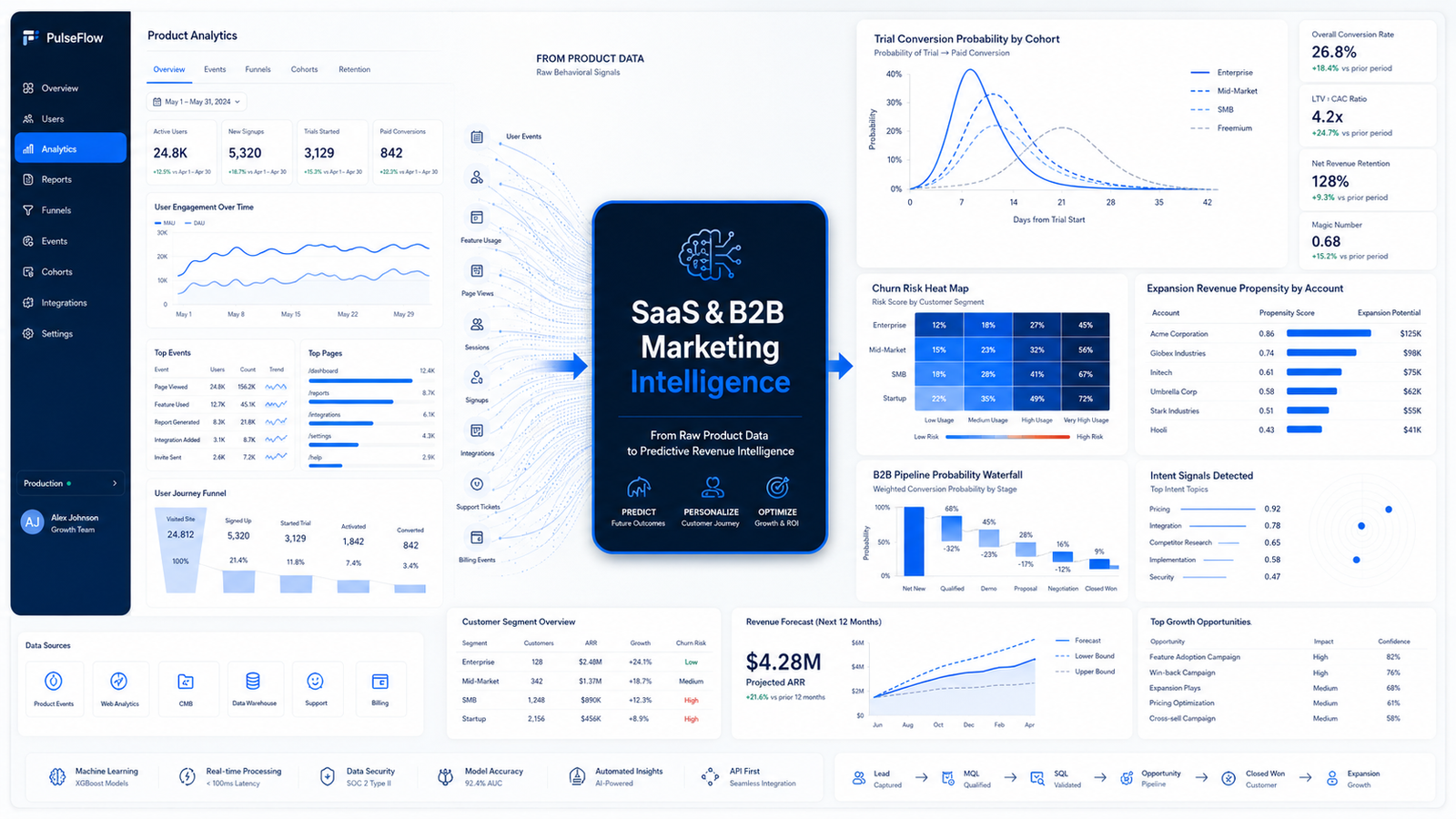
Four predictions standard analytics cannot make
Every one of these is the difference between reacting after the fact and intervening while it still matters.
- Which trial users will convert — Not observing which ones did, after the trial ended. Predicting during the trial enables targeted in-trial intervention at the moments most likely to accelerate the decision.
- Which customers will churn — Not identifying them after they have cancelled. By the time a customer cancels, the signal has been in the behavioural data for weeks.
- Which accounts have expansion potential — Not discovering it when they request an upgrade. Expansion propensity is visible in usage and firmographic growth signals well before the account asks.
- Which leads have genuine pipeline potential — Not after sales teams have spent weeks on contacts who were never going to close.
Markets served
Buying cycles, compliance expectations and competitive intensity differ sharply by market, and each changes what the modelling has to account for.
- Tier 1 English-speaking — United States, United Kingdom, Canada, Australia, Ireland. SaaS companies from seed to enterprise, B2B technology businesses, software vendors and professional services firms in high-competition markets where unit economic precision determines survival.
- Gulf & Middle East — United Arab Emirates, Saudi Arabia, Kuwait, Qatar. Rapidly growing SaaS adoption markets with specific enterprise buying cycle dynamics and regional compliance requirements.
- European markets — Germany, Netherlands, Sweden, France. GDPR-compliant B2B intelligence for companies navigating European enterprise sales cycles and data privacy requirements.
- Asia-Pacific — Singapore, Malaysia, Hong Kong, Australia. Businesses scaling across APAC with cross-border enterprise sales cycles and market entry intelligence requirements.
Seven SaaS and B2B problems this practice solves
Real problems observed across 12+ years of B2B and technology client engagements.
- Trial-to-paid conversion without prediction — Most businesses observe trial conversion after the period ends. Predictive modelling identifies likely converters during the trial, enabling intervention at mathematically identified high-leverage moments rather than generic drip sequences applied uniformly.
- Churn that is visible too late — Churning customers stop using features progressively, login frequency declines, support sentiment shifts. These patterns are detectable by sequence models with enough lead time to intervene before the decision becomes irreversible.
- MQL volume without pipeline quality — Marketing teams measured on MQL volume are incentivised toward quantity. Leads from content downloads and webinar registrations frequently correlate weakly with actual pipeline. ML scoring on firmographic, technographic and behavioural signals replaces volume counting with probability-weighted forecasting sales teams can trust.
- Expansion revenue as an afterthought — Upsells, cross-sells and seat expansion are usually managed reactively — customer success responds to explicit upgrade requests rather than identifying accounts approaching natural expansion trigger points.
- ABM without mathematical account selection — Most programmes select targets by revenue size, industry and relationship history rather than predictive signals. Accounts are pursued because they fit an ICP template, not because current behaviour indicates active buying intent.
- Attribution across long sales cycles — Enterprise cycles regularly extend 6 to 18 months across dozens of touchpoints and multiple stakeholders. Last-click, first-click and even 90-day multi-touch models miss most of what built the relationship and educated the buying committee.
- Product-led growth analytics gaps — PLG companies need granular in-product behavioural analytics to know which actions predict conversion, which usage patterns predict retention, and which adoption sequences correlate with high-LTV behaviour. Standard web analytics is inadequate for this.
Why SaaS needs prediction, not reporting
Placeholder — no video yet. Delete this box and drop in the Elementor Video widget when the recording is ready, or hide this whole section from Advanced → Responsive until then.
The Cognitive Marketing Engine applied to SaaS and B2B
The four-loop framework powering this practice, applied with SaaS and B2B-specific diagnostic logic, data sources and optimisation targets.
SaaS diagnostics
SaaS causal strategy
SaaS programmatic execution
SaaS continuous optimisation
AI agents in SaaS: where the product data makes autonomy possible
Marketing AI agents come in two architectures. Workflow agents — n8n, Make.com, Zapier — run a sequence defined in advance when a trigger fires. Autonomous agents decide their own next step from live data, which requires a model underneath. Two capability layers serve both: MCP for governed access to the CRM, product analytics, billing and intent data, and skills for packaged, repeatable expertise.
SaaS is the vertical best suited to autonomous agents, for one structural reason: the product generates continuous labelled outcome data. Most industries have to construct their feedback signal — SaaS already has it.
| Decision | Architecture that fits | Why |
|---|---|---|
| Trial conversion intervention | Autonomous — in-product behavioural sequences identify the moment intervention matters | A rule sends day-3 and day-10 emails to everyone, regardless of behaviour |
| Churn risk scoring | Autonomous — sequence models detect engagement decay 30 to 60 days out | A rule fires on cancelled subscriptions, which is far too late |
| Expansion propensity | Autonomous — usage volume, adoption depth and team growth predict readiness | A rule waits for a seat limit to be hit, which is the friction point |
| Lead routing and enrichment | Workflow with MCP — new lead enriched, scored, assigned in seconds | Ideal for a rule; the score itself comes from the model |
| Churn alert to customer success | Workflow — score crosses threshold, task created, owner notified | Ideal for a rule; the threshold is set from the model |
| Intent signal campaign activation | Workflow — third-party intent spike triggers a defined sequence | Ideal for a rule; which accounts qualify comes from the model |
What is deliberately not automated
- Pricing and contract terms. A model can predict willingness to expand; what is offered, and at what price, is a commercial decision.
- Disqualifying an account entirely. Low scores change priority and routing, never access — in B2B, a single wrongly-dropped account can outweigh the efficiency gain.
- Direct outreach to a named prospect. Generated at volume this damages sender reputation and brand credibility faster than it produces pipeline.
- Product capability claims. In B2B these become contractual expectations, which makes them a legal exposure rather than a copywriting task.
The full channel-by-channel breakdown sits in the AI agents section.
SaaS and B2B marketing intelligence solutions
The solution suite across six intelligence categories, mapped specifically to SaaS and B2B vertical dynamics.
Predictive intelligence for SaaS and B2B
- Trial conversion prediction — XGBoost + LSTM on in-product sequences. Individual trial user conversion probability from feature adoption sequences, usage frequency, collaboration invitations, integration connections and support interactions — enabling targeted in-trial intervention at high-leverage moments.
- SaaS churn prediction — LSTM + behavioural drift detection. Early warning from product usage sequences, detecting the engagement decay patterns that precede cancellation with 30 to 60 days of lead time.
- B2B lead scoring — XGBoost on firmographic + behavioural signals. Scoring using company size, industry, tech stack and funding stage, technographic signals, content and product behaviour, and third-party intent data — replacing MQL counting with probability-weighted pipeline forecasting.
- SaaS CLV prediction — Contractual CLV + expansion forecasting. Lifetime value accounting for subscription tenure, churn probability and expansion potential simultaneously, so acquisition investment is calibrated to total relationship value rather than first-year contract value.
- Expansion revenue propensity — XGBoost on usage + firmographic growth. Account-level scoring identifying which accounts approach natural upgrade triggers based on usage volume, adoption depth, team growth and firmographic indicators — before they hit a capacity limit.
- SaaS sales forecasting — Temporal Fusion Transformer + pipeline probability. Revenue forecasting combining CRM pipeline weighting with ML-predicted close rates by stage, deal size and representative — substantially more accurate than historical stage-average calculations.
- B2B customer segmentation — DBSCAN + firmographic and behavioural clustering. Distinguishing champion users from occasional users, strategic from transactional accounts, and high-growth from stable accounts, enabling segment-specific resource allocation.
Organic growth intelligence for SaaS and B2B
- SaaS SEO intelligence — SBERT + B2B search intent classification. Search intent vector drift detection, particularly important in fast-moving technology categories where category terminology and buyer intent signals evolve rapidly.
- B2B content intelligence — UMAP + HDBSCAN topic clustering. Topical saturation mapping identifying over-saturated topics in competitive categories and genuine demand gaps with lower competitive intensity.
- SaaS AEO optimisation — Transformer-based answer engine optimisation. Structuring content to be selected as the authoritative answer in AI-generated technology research — critical for product-category queries where AI overview visibility now drives early-stage awareness.
- Causal traffic intelligence — Bayesian structural time series + CausalImpact. Proving which content investments drove genuine incremental organic visibility versus market growth that would have occurred regardless.
Paid search intelligence for SaaS and B2B
- SaaS Google Ads intelligence — LTV-weighted bidding + trial quality. Preventing Smart Bidding from optimising toward high-volume, low-quality sign-ups while under-bidding the firmographic profiles that produce high-LTV customers.
- B2B PPC portfolio — Markowitz optimisation for B2B campaigns. Allocation across brand, competitive, category and problem-aware campaigns, modelled on each campaign’s contribution to pipeline at each stage of the buying cycle.
- SaaS bot fraud filtering — Isolation Forests on sign-up patterns. Detecting fraudulent registrations, competitor research accounts and low-quality sign-ups that inflate trial volume while contributing no conversion potential.
- Match-type dilution shield — SBERT vector distance capping via Google Ads API. Semantic boundary enforcement preventing Broad Match from expanding into adjacent but non-relevant technology categories, protecting trial sign-up quality.
Media buying intelligence for SaaS and B2B
- LinkedIn Ads intelligence — Account-based modelling + intent data. Serving ads to specific job functions within specific accounts showing active buying behaviour, rather than broad professional demographic targeting.
- SaaS Meta Ads intelligence — Behavioural lookalike + trial quality optimisation. Lookalike audiences built from high-LTV converted customers, optimising for the profile of customers who convert and retain — not just those who sign up.
- B2B creative intelligence — CLIP + B2B content performance analysis. Which formats, value proposition framings, social proof elements and calls to action generate the highest quality lead and trial rates among target segments.
- Attribution latency modelling — Time-to-conversion hazard functions. Attribution window extension across 6 to 18 month enterprise consideration cycles that fall entirely outside platform defaults.
Content marketing intelligence for SaaS and B2B
- SaaS content attribution — Markov chain + Shapley value. Which thought leadership, comparison content, case studies, integration guides and ROI calculators genuinely drive pipeline and trials across long consideration cycles.
- B2B content intelligence — UMAP + semantic gap analysis. Topical authority mapping identifying the product category, integration and use-case topics where authoritative content most efficiently improves visibility among target buyer personas.
- Micro-engagement dropout modelling — Survival analysis on content behavioural data. Where white papers, technical guides, case studies and comparison pages lose decision-maker engagement, enabling structural optimisation for completion and downstream conversion.
- B2B content decay detection — LDA + temporal semantic drift. Identifying documentation, feature comparisons and market education that have drifted from current capabilities, competitive landscape or buyer terminology, before visibility reflects it.
Omnichannel data intelligence for SaaS and B2B
- SaaS attribution intelligence — Shapley value + Markov chain. Platform-agnostic attribution across content, paid, events, outbound and product-led channels, replacing siloed channel-level attribution with defensible fractional credit.
- B2B privacy-safe budget allocation — Bayesian Marketing Mix Modeling. Channel contribution evidence across content, paid search, paid social, events and outbound without relying on individual-level tracking increasingly restricted in enterprise data contexts.
- SaaS incremental lift — Synthetic controls + CausalML. Causal contribution of specific activities to trials, pipeline and closed revenue, with statistical evidence defensible to investor and board-level scrutiny.
- B2B cross-stakeholder intelligence — DBSCAN entity resolution + journey mapping. Connecting touchpoints from multiple stakeholders within the same buying organisation into coherent account-level journey profiles.
SaaS and B2B technology stack
The platform and tool infrastructure applied to these engagements. Selected per engagement, never applied as a checklist.
- CRM & sales intelligence — Salesforce, HubSpot, Pipedrive, Monday.com CRM, Zoho CRM, custom CRM API integrations
- Marketing automation — Marketo, Pardot, HubSpot Marketing Hub, ActiveCampaign, Drip
- Intent data & ABM — Bombora, G2 Buyer Intent, 6sense, Demandbase, LinkedIn Sales Navigator, ZoomInfo, Apollo.io, Clearbit
- Product analytics — Mixpanel, Amplitude, Heap, FullStory, Pendo, PostHog
- Paid media — LinkedIn Ads, Google Ads, Meta Ads, G2 Ads, Reddit Ads, Capterra and GetApp advertising
- Analytics & attribution — Google Analytics 4, Google BigQuery, Looker Studio, Tableau, custom B2B attribution dashboards
- Data & ML infrastructure — Python, XGBoost, PyTorch, Scikit-learn, Prophet, dbt, Apache Airflow, Google BigQuery, Snowflake
Ideal client profile
This engagement model is built for a specific kind of SaaS or B2B business. Saying so plainly saves both sides months.
- SaaS businesses at Series A and beyond where LTV:CAC optimisation, churn reduction and expansion revenue identification are the primary growth levers
- B2B technology companies with sales cycles longer than 60 days, where attribution complexity, lead quality variation and multi-stakeholder dynamics require modelling beyond standard analytics
- Product-led growth companies where in-product behavioural analytics, trial conversion prediction and feature adoption modelling are core business intelligence requirements
- Enterprise software vendors where ABM, intent data integration and multi-stakeholder attribution are standard requirements but currently run without modelling infrastructure
- SaaS businesses in competitive categories where content is a primary acquisition channel and organic investment requires causal validation and fractional attribution evidence
The honest answers to SaaS and B2B client questions
We already have HubSpot lead scoring. Why do we need ML-powered scoring?
HubSpot’s native scoring is rule-based — you define which activities add or subtract points, and leads are scored by your rules. ML scoring learns the patterns that actually predict conversion from your historical CRM data, finding signal combinations a human rule-builder would not think to define and weighting them by real predictive power. The difference is between scoring on your assumptions and scoring on evidence from your own customer base.
Our churn rate is within industry benchmarks. Is churn prediction still relevant?
Benchmark churn rates represent the average of businesses without prediction infrastructure. They are not the achievable minimum for a business with early warning and proactive intervention. Moving from 2% to 1.4% monthly churn looks small; compounded across a 24-month cohort, the revenue impact is substantial.
We tried ABM and it did not generate the pipeline we expected. What went wrong?
Underperforming ABM programmes almost universally share one root cause: account selection by ICP template matching rather than behavioural buying intent. Fitting the ideal customer profile is not the same as being in an active buying cycle. Combining third-party intent signals with first-party behavioural data identifies accounts that match the ICP and are showing purchasing behaviour — that intersection is the correct target universe.
Can you guarantee improved SaaS unit economics from this engagement?
No specific metric guarantee is made. What is guaranteed is rigorous identification of the problems limiting current performance — trial conversion gaps, churn early warning failures, lead quality distribution issues, attribution blind spots across extended cycles — with statistical evidence of magnitude before any intervention.
Can AI agents run SaaS marketing automatically?
More of it than in most verticals, because the product generates continuous labelled outcome data that models can learn from. Workflow agents handle lead routing, enrichment, churn alerts and intent-triggered campaigns well. Trial intervention timing, churn scoring and expansion propensity need autonomous agents with models behind them. Pricing, contract terms and product capability claims stay with a person — in B2B those become contractual expectations.
Do you work with SaaS companies in Pakistan and the region, or only Tier 1 markets?
Both. Pakistani and Gulf SaaS companies selling into international markets are a natural fit, since the modelling is the same regardless of where the team sits. The qualifier is data volume rather than location: trial conversion and churn models need enough historical outcomes to train against, which usually means post-Series A or an established self-serve funnel.

Usman Saeed
AI-Driven Digital Marketing Intelligence Consultant & Growth Engineer in Pakistan. Usman Saeed specializes in engineering resilient digital growth architectures — helping enterprise brands eliminate tracking data drops, secure conversion signals, and maximize profitability through E-commerce Engineering, server-side Signal Engineering, and Predictive Intelligence. With 12+ years of experience and advanced data science expertise, marketing guesswork is replaced with mathematical precision — automated systems that bridge execution with business intelligence, ensuring your investment delivers measurable scale.
Where to go next
Ecommerce intelligence
The SaaS engagement starts with your CRM and your product usage logs
The first conversation covers trial conversion history, churn cohorts and attribution gaps. If your data cannot support the modelling yet, you will be told that directly.