
Health & Wellness Marketing Intelligence: Compliant, Computational Growth
Health and wellness marketing operates under four constraints that no other consumer category faces simultaneously — regulatory restriction, trust as the primary conversion variable, extreme privacy sensitivity, and retention economics that punish single-purchase acquisition strategies.
This practice applies computational marketing, ML-driven prediction and privacy-compliant analytics to each of those constraints systematically — intelligence that is both mathematically rigorous and ethically sound.
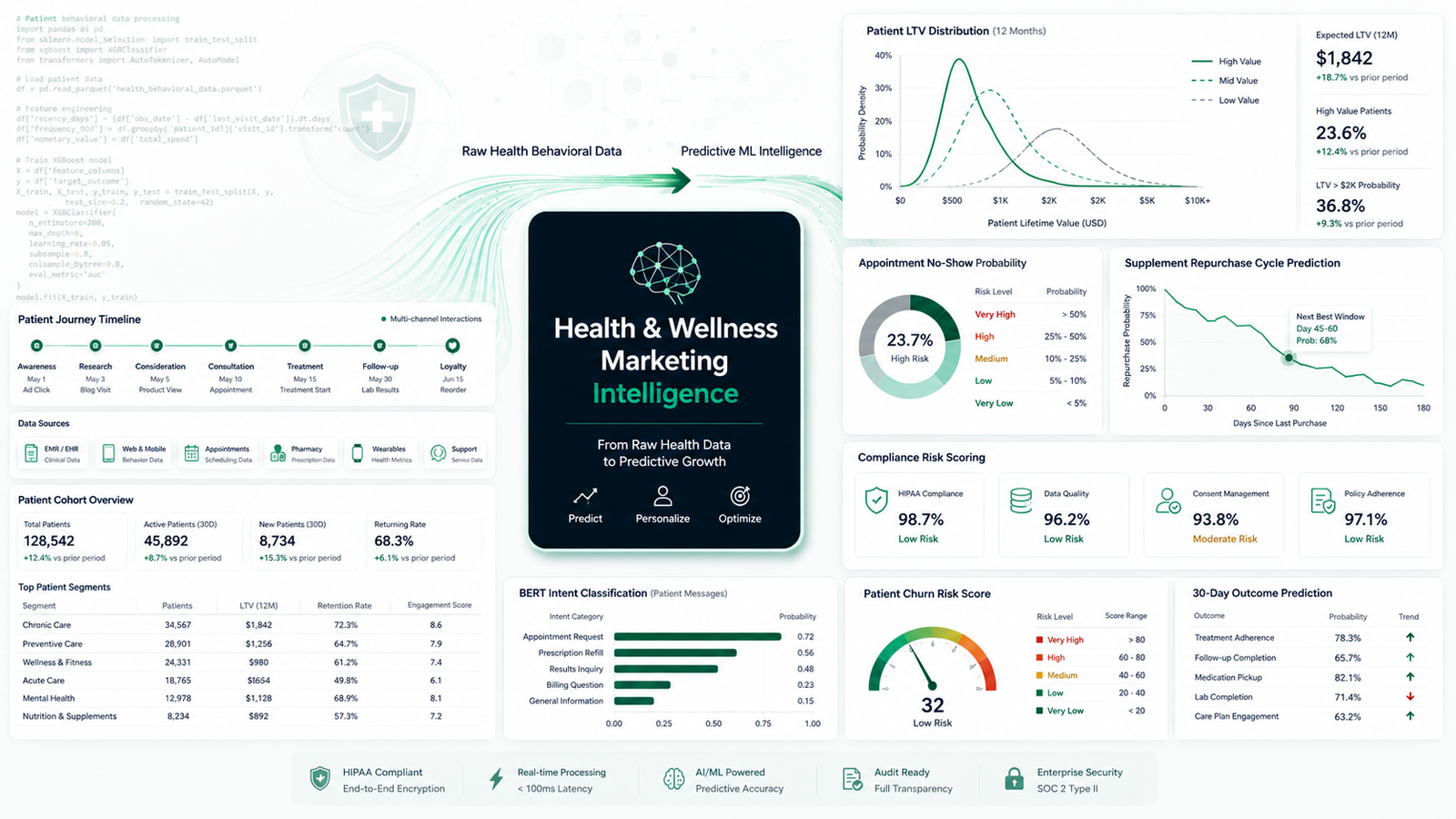
Four constraints no other consumer category faces at once
These are not obstacles. They are the parameters that define the space within which effective health marketing has to operate.
- Regulatory constraints — Advertising platforms apply stricter content policies to health and medical claims than to almost any other category. Google’s Healthcare and Medicines policy, Meta’s health and wellness restrictions, and market-specific frameworks — the ASA and MHRA in the UK, the FTC and FDA in the USA, DRAP in Pakistan — constrain both creative content and targeting methodology in ways standard approaches routinely violate.
- Trust as the primary conversion variable — Health decisions carry significantly higher emotional stakes than standard consumer purchases. The behavioural signals that predict intent are more subtle, consideration cycles are longer, and the relationship between information consumption and purchase decision is more complex than standard conversion models account for.
- Privacy sensitivity — Health data is among the most legally protected categories of personal information in every major framework. Approaches relying on health condition targeting or condition-specific behavioural data create serious legal and ethical exposure, particularly under GDPR, HIPAA and equivalents.
- Retention economics — Clinics, supplement brands, fitness platforms and mental health services depend on repeat engagement for sustainable unit economics. Single-visit or single-purchase acquisition produces poor LTV regardless of how efficiently it is executed.
Markets served
Health regulation, cultural context and privacy law differ sharply by market, and all three change what the modelling has to account for.
- Tier 1 English-speaking — United States, United Kingdom, Canada, Australia, Ireland. Clinics, supplement DTC brands, fitness platforms, mental health services, medical device companies and wellness subscription businesses operating under stringent regulatory and privacy frameworks.
- Gulf & Middle East — United Arab Emirates, Saudi Arabia, Kuwait, Qatar. Rapidly expanding markets with specific cultural considerations for health content and growing regulatory frameworks for health advertising.
- European markets — Germany, Netherlands, France, Sweden. GDPR-compliant intelligence with privacy-safe attribution and strict health claim compliance.
- Asia-Pacific — Singapore, Malaysia, Hong Kong, Australia. Businesses scaling across APAC with cross-cultural adaptation and regulatory compliance.
Seven health and wellness problems this practice solves
Real problems observed across 12+ years of health and wellness client engagements.
- Regulatory non-compliance in health advertising — Before-and-after claims, prohibited condition targeting, medical diagnoses in ad copy, outcome guarantees. Disapprovals, suspensions and regulatory notices are the predictable consequence. Compliance-aware content intelligence prevents them before publication.
- Long consideration cycles with inadequate attribution — Choosing a clinic or committing to a wellness subscription regularly takes 30 to 90 days. Platform default windows — 7-day click on Meta, 30-day on Google — miss a significant share of conversions driven by touchpoints weeks earlier.
- Trust signal optimisation failure — Health creative often fails not through poor execution but because it does not optimise for the signals health consumers require: clinical evidence, qualified credentials, authentic outcomes and third-party validation. Frameworks built for ecommerce do not account for this.
- Supplement repurchase cycle mismanagement — Most supplement brands manage repurchase through generic sequences timed to average consumption rates, rather than individual-level prediction based on each customer’s actual purchase history and consumption rate.
- Clinic and appointment no-show economics — No-shows and last-minute cancellations often run at 15–25% of scheduled appointments. Predictive modelling enables targeted reminders, deposit triggers and scheduling optimisation without adding friction for reliable patients.
- Patient acquisition cost without LTV context — Optimising for acquisition cost alone systematically under-invests in the channels producing the highest lifetime value patients, while over-investing in those producing cheap initial appointments with poor retention.
- Mental health marketing sensitivity — Therapy platforms, counselling and psychiatric practices face the most stringent content and targeting restrictions of any sub-vertical, combined with the highest emotional stakes for the audience. Standard performance approaches are frequently inappropriate, both ethically and practically.
Why health marketing needs a different intelligence layer
Placeholder — no video yet. Delete this box and drop in the Elementor Video widget when the recording is ready, or hide this whole section from Advanced → Responsive until then.
The Cognitive Marketing Engine applied to health and wellness
The four-loop framework powering this practice, applied with health and wellness-specific diagnostic logic, data sources and optimisation targets.
Health diagnostics
Health causal strategy
Health programmatic execution
Health continuous optimisation
AI agents in health marketing: where autonomy is appropriate
Marketing AI agents come in two architectures. Workflow agents — n8n, Make.com, Zapier — run a sequence defined in advance when a trigger fires. Autonomous agents decide their own next step from live data, which requires a model underneath. Two capability layers serve both: MCP for governed access to booking systems, CRM and analytics, and skills for packaged, repeatable expertise.
Health is the vertical where the boundary matters most, because the cost of getting it wrong is regulatory rather than merely financial.
| Decision | Architecture that fits | Why |
|---|---|---|
| Appointment no-show risk | Autonomous — the model scores each booking from scheduling and behavioural history | A rule can remind everyone; it cannot tell who actually needs a deposit |
| Supplement repurchase timing | Autonomous — individual consumption cycle prediction per customer | A rule fires at an average interval, which is wrong for most customers |
| Patient LTV-based bidding | Autonomous — predicted lifetime value fed into Smart Bidding | A rule optimises appointment cost, which is the wrong target |
| Pre-publication policy check | Workflow, with a classifier behind it — content is held until it passes | Ideal for a gate; the classification itself needs a model |
| Reminder and follow-up sequences | Workflow — booking confirmed, sequence fires on a defined schedule | Ideal for a rule; the risk scoring comes from the model |
| Anything involving a health condition | Neither — condition-level targeting and personalisation stay out of scope entirely | This is a legal boundary, not an optimisation decision |
What is deliberately not automated
- Any use of health condition data for targeting. This is a legal boundary in every major framework, not a performance trade-off to be tuned.
- Final approval of health claims. A classifier can flag policy risk before publication; a person, and where required a qualified practitioner, signs off on what is claimed.
- Clinical or diagnostic language. Generated at scale this creates regulatory exposure far faster than it creates efficiency.
- Mental health audience messaging. The emotional stakes and restriction levels make automated generation inappropriate regardless of what the platform permits.
The full channel-by-channel breakdown sits in the AI agents section.
Health and wellness marketing intelligence solutions
The solution suite across six intelligence categories, mapped specifically to health and wellness vertical dynamics.
Predictive intelligence for health and wellness
- Health CLV prediction — BG/NBD + Gamma-Gamma with healthcare extensions. Patient and customer lifetime value modelling for clinics, wellness services and supplement brands, accounting for the multi-visit, multi-product nature of health relationships.
- Health churn prediction — LSTM + healthcare behavioural signals. Patient disengagement prediction identifying those at risk of lapsing between appointments or not returning for follow-up, with enough lead time for proactive outreach.
- Appointment no-show prediction — XGBoost on scheduling + behavioural data. Individual no-show probability enabling targeted pre-appointment intervention, deposit triggers and scheduling optimisation.
- Supplement repurchase prediction — BG/NBD + individual consumption modelling. Individual-level repurchase timing based on actual purchase history and product consumption rate, enabling precisely timed reorder communication.
- Health segmentation — DBSCAN + health behaviour clustering. Segmentation based on behavioural signals — treatment preferences, category engagement, content consumption — without using sensitive condition data.
- Health sales forecasting — Temporal Fusion Transformer + seasonal demand. Appointment demand and supplement sales forecasting accounting for seasonal health patterns, launch cycles and market-specific trends.
Organic growth intelligence for health and wellness
- Health SEO intelligence — SBERT + health query intent classification. Search intent vector drift detection, particularly important where Google applies elevated YMYL scrutiny and intent classification errors carry heavier ranking consequences.
- Health content intelligence — UMAP + HDBSCAN topic clustering. Topical saturation mapping across health content libraries, identifying over-saturated topics and genuine informational demand gaps.
- Health AEO optimisation — Transformer-based answer engine optimisation. Structuring health content to be selected as the authoritative answer in AI-generated responses across AI Overviews, ChatGPT and Perplexity.
- Health authority mapping — Graph theory + eigenvector centrality. Internal link authority distribution so the highest clinical-authority and commercial-value pages receive proportionate equity.
Paid search intelligence for health and wellness
- Health Google Ads intelligence — Compliance-aware bidding + LTV integration. Google Ads management with compliance-first creative validation, LTV-weighted conversion values, and targeting that operates within protected health information constraints.
- Health pCLV bidding — BG/NBD patient LTV + Smart Bidding. Patient lifetime value fed into Smart Bidding, optimising for a long-term relationship rather than a single appointment booking.
- Health PPC portfolio — Markowitz optimisation for health campaigns. Cross-campaign budget optimisation balancing acquisition, brand and competitive defence campaigns with mathematical efficiency modelling.
Media buying intelligence for health and wellness
- Health paid social intelligence — Compliance-aware Meta + TikTok. Advertising with compliance-validated creative frameworks, first-party audience targeting that avoids prohibited condition signals, and Conversions API for privacy-compliant attribution.
- Health creative intelligence — CLIP + trust signal feature extraction. Which trust signals, visual elements and formats generate the highest engagement among health audiences, given the specific trust architecture of health decision-making.
- Health social signal engineering — Bayesian probabilistic CAPI matching. Post-iOS14 signal restoration using privacy-compliant probabilistic matching, without relying on health-sensitive individual-level data.
- Health attribution latency modelling — Time-to-conversion hazard functions. Attribution window extension capturing the full contribution of touchpoints across 30 to 90+ day decision timelines.
Content marketing intelligence for health and wellness
- Health content attribution — Markov chain + Shapley value. Fractional attribution across the multi-touchpoint health journey, showing which educational content and clinical evidence assets genuinely drive bookings and purchases.
- Health content compliance — BERT-based policy classification. Pre-publication integrity checking against Google Ads policies, Meta health restrictions and market-specific regulatory requirements.
- Health topical authority — UMAP + semantic gap analysis. Identifying the clinical and wellness topics where authoritative content will most efficiently improve organic visibility.
- Health micro-engagement dropout — Survival analysis on BigQuery data. Reader dropout modelling on health educational content, identifying where engagement is lost and content structure should change.
Omnichannel data intelligence for health and wellness
- Health attribution intelligence — Shapley value + Markov chain. Privacy-compliant cross-channel attribution independent of platform self-reported credit, and designed around health-specific data handling requirements.
- Health privacy-safe budget allocation — Bayesian Marketing Mix Modeling. Cross-channel allocation on aggregated time-series data with no individual-level health data processing, suitable for the most stringent privacy regimes.
- Health incremental lift — Synthetic controls + matched market testing. Causal contribution of marketing to bookings, supplement sales and subscription conversions, with evidence defensible to practice owners and finance teams.
- Health cross-device intelligence — DBSCAN entity resolution + privacy-safe graphing. Cross-device journey mapping using probabilistic identity resolution, without processing sensitive health data at individual level.
Health and wellness technology stack
The platform and tool infrastructure applied to these engagements. Selected per engagement, never applied as a checklist.
- Practice management & booking — Mindbody, Jane App, Cliniko, Calendly, Acuity Scheduling, Zocdoc integration, custom booking system APIs
- Health ecommerce — Shopify for supplement DTC, WooCommerce, Magento with health compliance plugins
- Email & patient communication — Klaviyo, ActiveCampaign, Mailchimp, HubSpot CRM, practice-specific patient communication platforms
- Analytics & attribution — Google Analytics 4 in privacy-hardened configuration with no protected health information transmitted, Google BigQuery, Looker Studio, and privacy-first alternatives such as Matomo and Plausible where a stricter posture is required
- Paid media — Google Ads under the Healthcare and Medicines policy, Meta Ads under health and wellness restrictions, TikTok Ads health category, LinkedIn Ads for B2B health
- Data & ML infrastructure — Python, XGBoost, PyTorch, Scikit-learn, Prophet, privacy-preserving ML frameworks and federated approaches for sensitive contexts
Ideal client profile
This engagement model is built for a specific kind of health and wellness business. Saying so plainly saves both sides months.
- Clinics and medical practices with significant appointment volume, where patient LTV modelling, no-show prediction and retention intelligence materially improve practice economics
- Supplement and nutraceutical DTC brands where repurchase prediction, churn detection and compliance-aware paid media are the primary performance levers
- Fitness and wellness subscription platforms where churn prediction, engagement modelling and LTV-based bidding determine long-term unit economics
- Mental health service providers requiring ethical, compliance-aware intelligence that respects both regulatory constraint and audience sensitivity
- Health technology and digital health companies needing intelligence across complex multi-stakeholder sales cycles
- International health brands expanding across Tier 1 markets under several simultaneous regulatory frameworks
The honest answers to health and wellness client questions
Health advertising is restricted on Meta and Google. How do you navigate this?
Regulatory constraints are parameters, not obstacles. Compliance-aware content intelligence — BERT-based policy classification validating creative before publication — ends the reactive cycle of disapprovals by catching violations before they reach the platform. First-party audience targeting replaces prohibited condition targeting with behavioural and contextual signals that are both compliant and frequently better at reaching high-intent audiences.
Our patient acquisition cost looks reasonable but the practice is not growing. What is happening?
Acquisition cost optimised without LTV modelling systematically acquires the cheapest patients rather than the most valuable ones — and the cheapest are frequently those with the lowest retention. LTV-based bidding reallocates budget toward the channels producing the highest lifetime value patients, which are almost never the same as those producing the lowest initial appointment cost.
We cannot share patient data for modelling. Can you still work with us?
Yes. Bayesian MMM operating on aggregated time-series data, federated approaches that never move raw patient records, and differential privacy techniques for sensitive datasets all enable sophisticated modelling without individual-level data sharing. The methods are chosen for the privacy posture your regulatory context requires.
Can you guarantee improved patient acquisition or supplement sales?
No specific outcome guarantee is made. What is guaranteed is rigorous diagnosis of the problems limiting current performance — attribution gaps, compliance violations restricting delivery, LTV misalignment in targeting, or retention intelligence gaps — with statistical evidence of the magnitude of each before any intervention is implemented.
Can AI agents run health marketing automatically?
Partly, and the split is stricter here than in any other vertical. Workflow agents handle reminders, follow-up sequences and reporting well. No-show risk, repurchase timing and LTV bidding need autonomous agents with a model underneath. Health claims, clinical language and anything touching condition data stay with a person — those are regulatory boundaries, not optimisation problems.
Do you work with health businesses in Pakistan as well as internationally?
Yes. The regulatory detail differs — DRAP governs health product claims in Pakistan, while the ASA and MHRA apply in the UK and the FTC and FDA in the USA — but the underlying modelling is the same. The qualifier is data volume rather than geography: modelling needs enough appointment or transaction history to be statistically meaningful.

Usman Saeed
AI-Driven Digital Marketing Intelligence Consultant & Growth Engineer in Pakistan. Usman Saeed specializes in engineering resilient digital growth architectures — helping enterprise brands eliminate tracking data drops, secure conversion signals, and maximize profitability through E-commerce Engineering, server-side Signal Engineering, and Predictive Intelligence. With 12+ years of experience and advanced data science expertise, marketing guesswork is replaced with mathematical precision — automated systems that bridge execution with business intelligence, ensuring your investment delivers measurable scale.
Where to go next
The health engagement starts with your data, and with compliance
The first conversation covers booking data, attribution gaps and current ad compliance status. If your data cannot support the modelling, you will be told that directly.