
Predictive Intelligence: Marketing Decisions Backed by Probability
Seven custom models that answer the expensive question before the budget moves
Career figures, not model results. What any model achieves for you is established by the data audit and backtests on your data.
Reactive Marketing Is Expensive Pattern-Matching With a Delay
Most businesses run marketing in the rear-view mirror: last month’s traffic, conversions and churn decide next month’s plan. The numbers aren’t wrong. They just arrive after the decision they should have informed was already made and paid for.
Churn
By the time churn shows in a retention report, the customers have already gone.
Lifetime value
By the time LTV drops, the wrong customers were already acquired at full cost.
Conversion
By the time conversion falls, budget was spent on traffic that was never going to buy.
Creative
By the time returns fall, the creative has fatigued past recovery.
Reactive marketing wastes money confidently, because the dashboard always shows a number, and a number always feels like evidence. Moving to predictive isn't a tooling upgrade. It changes where in the sequence the decision gets made.
What Predictive Intelligence Actually Means Here
Not AI tools. Not dashboards with “predictive” in the sales copy. In this practice it means four families of method, used together, applied as custom models built on your raw data with advanced data science, and supervised and reviewed by me as data scientist and consultant. The combination is what separates it from the “AI-powered” label on every SaaS product.
Learning from history
Models trained on past behaviour that produce validated probability scores for future outcomes, spotting patterns no person could see at scale.
Learning from sequences
Not just what a customer did, but the order they did it in, and what that sequence says about their next move.
Thinking in probabilities
Behaviour treated as a range of likely outcomes, not a yes/no rule, so every answer comes with how sure it is.
Proving cause
Going past correlation to show what actually caused an outcome, and what a valid intervention would look like.
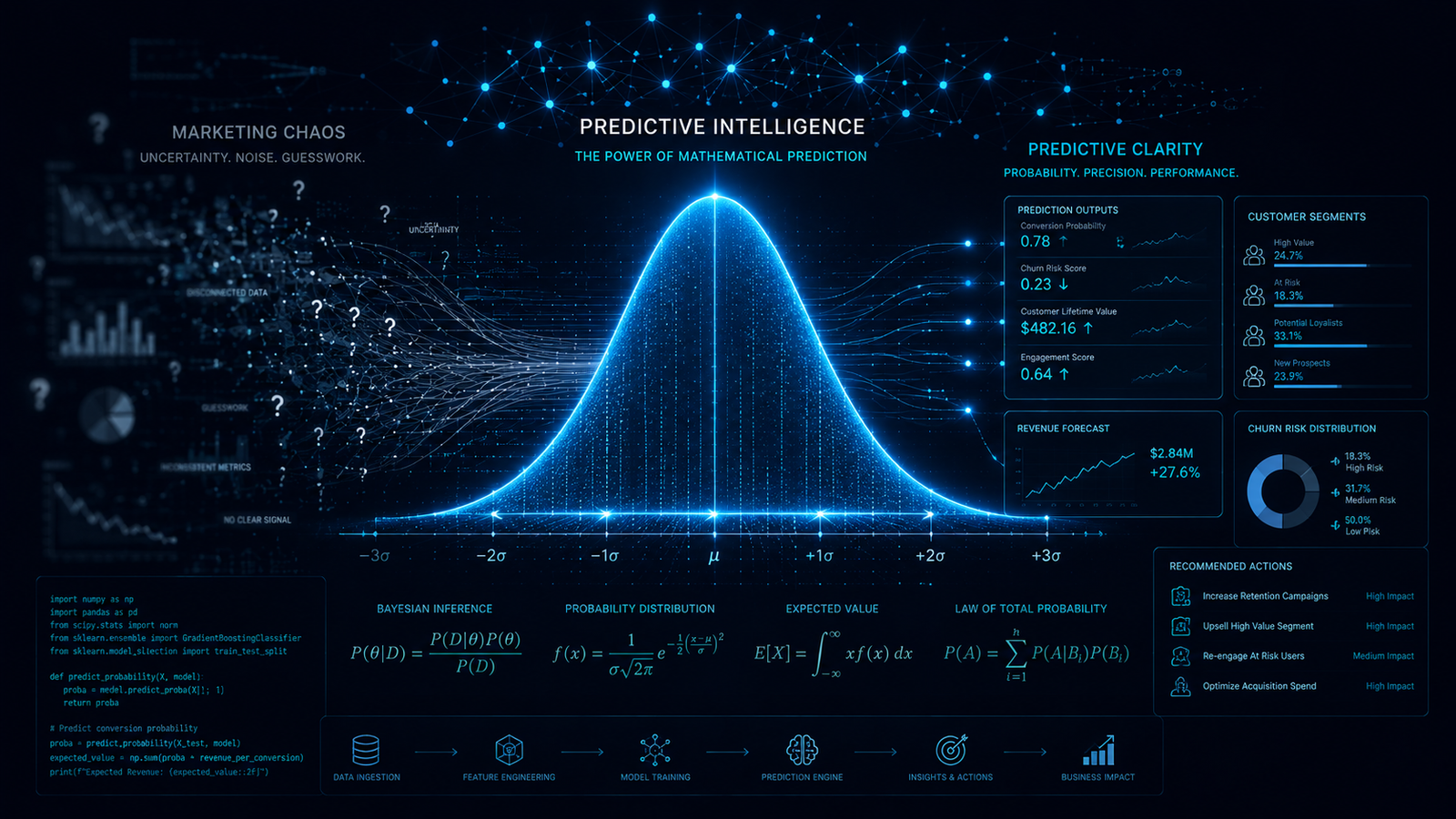
A prediction engine built around your business
Your first-party data goes in; custom models score value, risk and likelihood; the outputs flow into the tools where decisions happen; and every model is backtested before it touches budget.
Each solution below is a separate custom build, chosen by what your data can actually support, never a pre-packaged product.
How a predictive model changes when a decision gets made
A short walkthrough of moving a marketing decision earlier in the sequence, and what a mathematically proven diagnosis looks like when results disappoint.
What Happens When the Results Disappoint
Data science doesn’t control market outcomes; it explains them. That’s the most important thing on this page. If a model is deployed correctly and results still disappoint, the model’s value isn’t diminished: that’s exactly when it becomes visible.
"The market was difficult."
"The algorithm changed." "Competition increased." No evidence, no proof: an explanation nobody can check, which is another way of saying an excuse.
Show why, with evidence
Was it pricing? A server issue suppressing conversion? A demand shift no marketing could overcome? The data separates these, and each implies a different action.
No specific outcome is promised: results depend on product, pricing, market and competition, most of which sit outside any marketing system. What the maths supplies is a defensible diagnosis either way, which protects a marketing budget from being cut for reasons that were never marketing.
Why AI Prompts Can't Replace a Data Pipeline
People reasonably ask why this can’t be done with prompts in ChatGPT or Claude. The answer is about architecture, not how capable those models are. A language model generates likely text; a pipeline processes your data, on a schedule, with checks attached.
What a prompt doesn't do
- Pull raw server logs and scan tens of thousands of clicks for anomalies
- Process live Search Console data at scale, on a schedule
- Fit a value model on your live transaction database
- Run a model trained on your own customers' behaviour
- Measure lift against a real experimental holdout
The distinction that matters
A prompt is an instruction. A pipeline is infrastructure that runs against live data, on a schedule, with monitoring and validation built in.
Marketers talk about data. Growth engineers build the systems that process it. Language models still have a role, inside agents that operate these pipelines (covered below). The point is where they fit, not whether they're useful.
The Predictive Intelligence Solution Suite
Seven solutions, each with its own detailed page, grouped by the business question they answer. Each page covers how the model works, how it’s proven, what data it needs, and where its outputs are used. Which ones apply to you is decided by your data, not by this list.
Customer Lifetime Value
Forecasts the future revenue of every customer, so bids, retention spend and discounts are decided before budget is committed, and sent to ad platforms as the value to bid on.
Churn Prediction
Flags customers at real risk of leaving weeks before it shows, and separates the ones you can still save from those who'd stay anyway.
Conversion Rate Prediction
Scores the chance each visitor or lead converts, including traffic ad platforms can't see, for lead routing, on-site action and better bidding signals.
Sales Forecasting
Forecasts sales as a range, with holidays, promotions and your local calendar, for stock, budget, hiring and cash flow.
Customer Segmentation
Behavioural groups built on how customers actually buy, tested to prove they're real and refreshed as customers change.
Recommendation Systems
The right product for each shopper on site, in email and in ads, margin- and stock-aware, proven on extra revenue.
Marketing Mix Modeling
Measures what each channel, online and offline, really contributed, without cookies, and shows where the next budget increment belongs.
Why it's on its own
MMM works on aggregated weekly totals, not individual customers, so it's the privacy-safe counterweight to every user-level model above it.
Used together: LTV, churn and conversion say who is worth spending on; MMM says where that spend should go; forecasting says how much to plan for.
Further Capabilities That Don't Have Their Own Page
These are applied inside engagements rather than sold separately, and they’re often the highest-value work in a project. Several are specific to markets and business models that generic predictive tools ignore.
Return (RTO) prediction
Cash-on-delivery returns destroy unit economics. Scoring return risk before dispatch allows verification calls, payment nudges or holds. Built for Pakistani and South Asian COD operations.
Persuadability targeting
Separates customers an offer will actually change from those who'd convert anyway or never will. Used for retention, win-back and bid adjustments.
Margin-safe discounting
Finds who genuinely needs an incentive, and where margin is being given away for nothing to people who'd pay full price.
Anomaly & fraud detection
Surfaces bot traffic, fraudulent clicks, broken pipelines and genuine market shifts that dashboards quietly absorb.
Incrementality testing
Holdout and matched-market experiments: the only valid way to show an activity caused an outcome rather than just moved with it.
Stock-aware ad spend
Connects demand forecasts to media buying: less spend on products near stock-out, more on high-margin, well-stocked lines.
Also applied where the data supports it: silent-dropout estimation for customers who never formally cancel, budget allocation borrowed from portfolio thinking in finance, and manipulation checks during big promotional windows. Which apply is decided by the audit, not by what reads well here.
Who Predictive Intelligence Is Built For
This isn’t built for local small businesses, and saying so early saves everyone time. It fits organisations where prediction translates directly into revenue, which usually means meaningful data volume and a decision expensive enough to be worth modelling.
High-revenue e-commerce
Roughly $500K annual revenue and above, where margin, retention and lifetime value affect profit, not just top-line sales.
Growth-stage SaaS
Where churn, trial conversion and value-based bidding separate sustainable unit economics from growth at any cost.
B2B lead generation
Where lead quality, pipeline speed and marketing's causal share of closed revenue are what get discussed.
Performance agencies
Who need to prove incremental value to clients with rigour, not correlation charts and screenshots.
Enterprise marketing teams
Who must defend budget to CFOs and boards with validated evidence, not vanity metrics.
International operators
Brands across Pakistan, the UK, USA, UAE, Canada and Turkey, delivered remotely from Lahore.
How an Engagement Actually Begins
Every engagement starts with a data architecture audit: a diagnostic of your data infrastructure that identifies which solutions genuinely apply, and sets the baseline everything afterwards is measured against. See the full engagement process.
Your data, as it really is
What you hold and where, how reliably customers match across systems, whether order history is deep enough to model, and where signal is lost between site, store and ad platforms.
A ranked shortlist
The solutions that apply, with reasons; a baseline to judge later work against; and a clear statement of what your data can't yet support.
Recommend everything
Usually two or three solutions apply and the rest don't, and sometimes the honest finding is that infrastructure work comes first.
Where AI Agents Fit Into Predictive Intelligence
A SaaS tool is someone else’s generic model. An AI agent is your own model, kept running. Predictive Intelligence decides what to build; agents keep it working between reviews. They’re autonomous, built from data science and marketing work, and every action is reviewed. More on the AI agents hub.
What the agents do
- Refits models when a customer group drifts away from what the model learned
- Flags divergence between predicted and realised outcomes before it costs money
- Escalates anomalies that don't match any known pattern
- Checks every run: validation gates and outlier rules, before scores reach your tools
What stays with a person
- Deciding a model has stopped describing the business. After a new product, price or market.
- Choosing what to optimise. Highest revenue isn't always right once margin, returns and support cost count.
- Owning the privacy position. What's collected, on what legal basis, with what consent.
- Calling it off. If a model can't beat a simple baseline, someone has to stop the spend.
Predictive Intelligence: The Questions Serious Clients Ask
Who actually buys this? It looks very advanced.
Not a local small business. The right client is a funded e-commerce brand, a growth-stage SaaS company, a performance agency or an enterprise marketing team, where prediction turns into measurable revenue. Those clients exist in Pakistan, the UK, the USA, the UAE and beyond.
What guarantee is there that results will come?
None, and no honest practitioner offers one. Outcomes depend on product, pricing, market and competition. What is committed to is rigour, full data transparency, and a clear, evidenced explanation of why an outcome happened, whether or not it met expectations.
Do you use a predictive tool or platform?
No. Every solution is a custom model built on your raw data with advanced data science, backtested before it’s used, and supervised and reviewed by me as data scientist and consultant. You own the models, the code and the outputs.
Why can't ChatGPT or Claude do this with prompts?
Because it’s a different kind of thing. A language model generates likely text; it doesn’t run models on your live transaction database or push scores into ad platforms on a schedule. A prompt is an instruction; a pipeline is infrastructure.
This is very different from traditional digital marketing. Will our team follow it?
Deliverables are written for two audiences at once: the technical team that needs the method and the executives who need the business impact. Probabilities become revenue projections, anomalies become cost estimates.
Does Predictive Intelligence still help if the market is down?
Yes, in the way that matters most. When conditions prevent a good outcome, the modelling shows marketing wasn’t the cause, and that evidence protects your budget from being cut for the wrong reasons.
Which solution should we start with?
That’s what the data audit decides. Starting from a solutions page instead of your data is how teams end up with a sophisticated model answering a question nobody acts on.
Do you work with businesses outside Pakistan?
Yes. Delivery is remote from Lahore, for clients across Pakistan, the UK, USA, UAE, Canada and Turkey. Working hours overlap comfortably with the Gulf and the UK, and partly with US mornings.

AI-driven digital marketing intelligence consultant. 12+ years in digital marketing, 100+ clients across 15 industries and 6 markets, a Master's in Computer Science and MPhil / MS Data Science (AI). Every predictive model is built, checked and reviewed by me personally, with no hand-off to an account manager.
Where to Go Next
Start Where the Data Says to Start
A data architecture audit shows what you actually hold, which of these solutions your situation genuinely supports, and where the baseline sits, including when the honest answer is that infrastructure comes first.