
Research: AI-Driven Marketing Science Backed by Peer Review
This practice doesn't just apply research, it writes it: three papers in international peer review, an MS in Data Science (AI) on the thesis track, and a six-domain roadmap, all built from questions that came out of real client accounts.
Three papers in international peer review: lead scoring, high-value e-commerce customers, and multi-touch attribution.
An MS in Data Science (AI) on the thesis track, built on a Master's in Computer Science, with every course mapped to client work.
A six-domain roadmap, from causal intelligence to AI search and agent reliability, and the tools coming out of it.
Data Over Opinion, Tested Properly
Experience tells you what usually works. Research tells you whether it really does, and under what conditions. The aim is for every model-driven claim to be methodologically defensible, not just based on years in the job.
Practice
A recurring problem shows up across client accounts.
Research
A method is designed and tested to answer it.
Peer review
Other researchers check whether the method holds up.
Client work
What holds up goes back into the accounts.
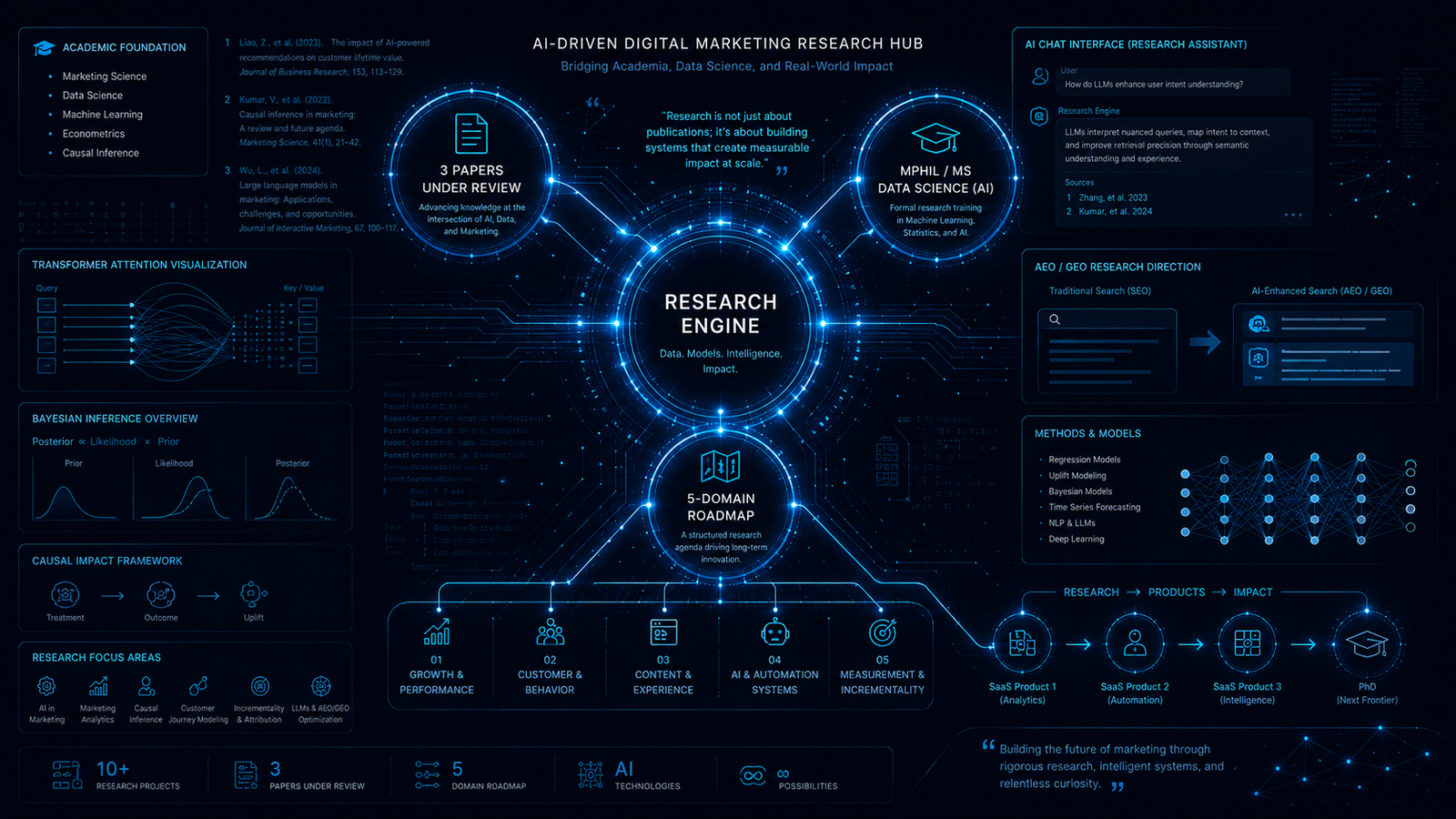
Papers, degree, roadmap
What's been written, where it's studied, and where it's heading, all connected to the same client problems.
How it started: My Story.

Three Papers Under International Peer Review
Each started as a client question. Full summaries on Research Papers.
AI-driven lead scoring
Predicting which leads will really convert, using machine learning on behaviour rather than fixed rules.
Read the summary 02In peer review · 2026High-value e-commerce customers
Deep learning on the order of shopper actions, to spot valuable customers early.
Read the summary 03In peer review · 2026Multi-touch attribution
Estimating each touchpoint's incremental contribution, instead of trusting platform reports.
Read the summaryMS Data Science (AI), on the Thesis Track
Built on a Master’s in Computer Science (2015–2017), with PhD applications planned for 2027. Details on Academic Journey.
Four areas, all in use
Advanced NLP, advanced machine learning, algorithm analysis, and data tools, each mapped to a client problem it already solves.
Research that travels to practice
Predictive intelligence for digital marketing: a model, then a framework, then a service, then a product.
Why a marketing practitioner writes research
A few minutes on the papers, the degree, the roadmap, and how all three feed back into client work.
Six Research Domains for the Next Five to Ten Years
Each domain has three open questions. The full roadmap is on Research Interests.
Predictive & causal intelligence
Predicting value and proving cause as tracking shrinks.
NLP & content integrity
Checking content before it causes problems.
AEO, GEO & LLMO
Being cited by AI answers, not just ranked.
Framework extensions
Making the Cognitive Marketing Engine more accurate.
Product research
Turning validated research into affordable tools.
Agent reliability
Open questions about autonomous agents.
How the Research Shapes Client Work
Every loop of the Cognitive Marketing Engine rests on a piece of the research.
| Framework loop | Method family | Research foundation |
|---|---|---|
| Loop 1 · Diagnostic | Language models for intent drift; anomaly detection | NLP coursework; content integrity research |
| Loop 2 · Blueprint | Bayesian marketing mix modeling; journey attribution | Paper 03; causal intelligence domain |
| Loop 3 · Deployment | Propensity scoring sent to ad platforms | Paper 01; machine learning coursework |
| Loop 4 · Scaling | Customer value and dropout models; retraining on drift | Paper 02; framework extensions domain |
What Research Changes for a Client
And for AI agents: an autonomous agent is only as good as the model, objective and evaluation underneath it, which is exactly what research builds. More on the AI agents hub.
Original research
Not just reading others' papers.
Graduate coursework
The maths behind the methods.
Traceable reasoning
From research to strategy, step by step.
A PhD trajectory
Applications planned for 2027.
Products from research
Tools built on validated methods.
Research Practice: FAQs
What research has Usman Saeed published?
Three papers are under international peer review in 2026, on lead scoring, high-value e-commerce customers and multi-touch attribution. None is published yet; the page will be updated when they are.
How is research different from just being experienced?
Experience shows what usually works; research tests whether it really does, and makes the method open to checking by others.
Does the research delay client work?
No. It runs alongside client work, and the questions come from live accounts.
Do AI agents replace the need for research?
No. Autonomous agents depend on a model, an objective and a way to evaluate them, all of which research provides.
Why does an AI digital marketing expert in Pakistan do academic research?
Because model-driven recommendations should be defensible, and research is how that’s tested, wherever the practice is based.

Practitioner and researcher. 12+ years in digital marketing, 100+ clients across 15 industries and 6 markets, a Master's in Computer Science and MS Data Science (AI). Certified by Google, Meta, Semrush, HubSpot and Ahrefs.
Ready to See How This Applies to Your Business?
Start with a free audit. If your data can support it, the methods behind this research can be applied to your marketing.