
How LinkedIn Posts Influence AI Search Results
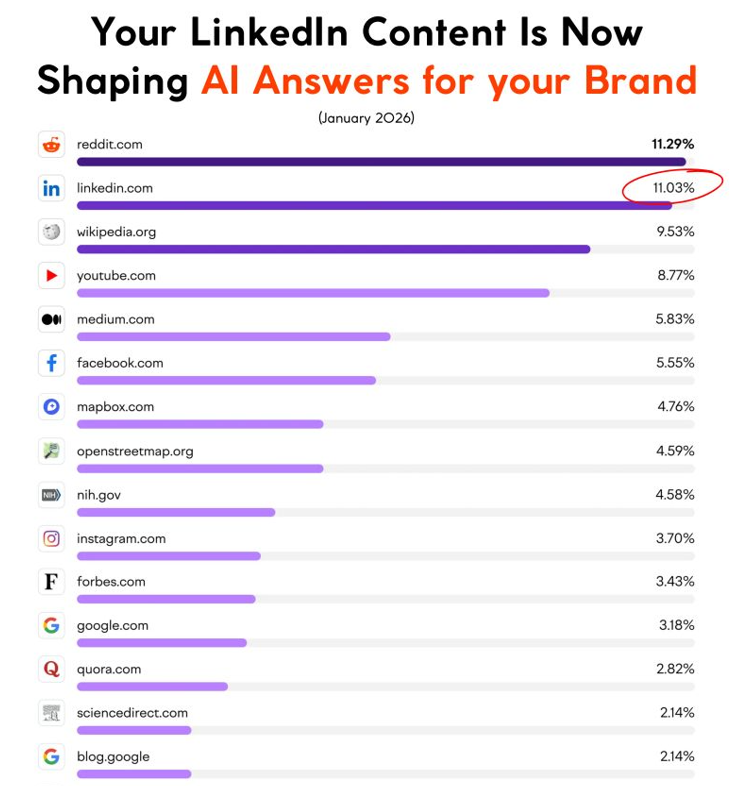
Most professionals still think of LinkedIn as a social media platform — a place to post career updates, celebrate milestones, and scroll through industry news. But something significant is happening beneath the surface.
AI-powered search engines are increasingly citing LinkedIn posts as trusted information sources. Studies analyzing thousands of AI-generated answers show LinkedIn among the most frequently cited domains. That’s not a coincidence — it’s a structural shift in how AI systems evaluate and surface knowledge on the web.
If AI models are quoting LinkedIn posts to answer questions, does that mean LinkedIn is quietly becoming part of the internet’s knowledge layer?
The answer may be yes. And if it is, your LinkedIn content strategy needs a serious rethink.
LinkedIn Was Built as Social Media — But Something Is Changing
LinkedIn’s original design was straightforward: build a professional network, share updates, get hired. For years, success on the platform was measured in connection requests, follower growth, and engagement — likes, comments, reshares.
But AI search is rewriting the rules of what makes a content platform valuable. The emerging distinction isn’t between social and professional — it’s between social platforms and knowledge platforms.
Social platforms host conversations. Knowledge platforms host expertise. LinkedIn, almost by accident, has become both.
The professionals who use LinkedIn most effectively aren’t just broadcasting updates. They’re documenting frameworks, breaking down complex ideas, sharing hard-won insights from real projects. That type of content is structurally different from a status update — and AI systems are starting to notice.
The Rise of AI Search Engines
Traditional search gave you ten blue links and asked you to figure out the answer yourself. AI search gives you the answer — sourced, synthesized, and delivered in plain language.
Tools like ChatGPT, Perplexity AI, and Claude are changing how people find information. Instead of browsing through results, users ask questions and receive direct, structured answers pulled from across the web.
To generate those answers, AI systems do something traditional search engines largely don’t: they prioritize sources that explain things clearly. Not just pages that rank high for keywords, but content that actually teaches — that breaks down concepts, provides context, and answers questions in a human-readable way.
This shift has profound implications. Content quality — specifically explanatory quality — matters more than ever. And it opens the door for platforms like LinkedIn, which host enormous volumes of expert-authored content, to become meaningful sources for AI-generated answers.
Why LinkedIn Content Is Increasingly AI-Friendly
LinkedIn’s content ecosystem has matured significantly. What began as a resume repository has become a genuine publishing platform for professional insight. Several characteristics make LinkedIn posts particularly well-suited to AI citation systems:
1. Clear, Accessible Explanations. LinkedIn’s format rewards brevity and clarity. Posts that perform well tend to explain complex ideas in plain language — exactly the kind of content AI systems extract and cite.
2. Verified Real-World Expertise. Unlike anonymous forum posts, LinkedIn content is tied to professional identities. When a CMO writes about marketing strategy or an engineer explains a technical concept, there’s an implicit authority signal AI systems can evaluate.
3. Practical, Experience-Based Insights. LinkedIn’s culture rewards authenticity. Posts that share real experiences — lessons learned, mistakes made, frameworks developed in practice — carry the specific, grounded detail that AI models find credible.
4. Question-Based Content Formats. Many high-performing LinkedIn posts are structured around questions: What is X? How does Y work? Why does Z happen? This format aligns almost perfectly with the question-and-answer architecture of AI search queries.
AI systems don’t just want information — they want explanations. LinkedIn, at its best, delivers exactly that.
LinkedIn as a Distributed Knowledge Layer
Here’s a concept worth sitting with: LinkedIn may be evolving into a distributed knowledge layer for professional expertise — a structured repository of real-world insight that sits beneath the social surface.
Consider what lives in LinkedIn’s content ecosystem today: industry frameworks developed by practitioners, strategic analyses written by executives, technical explanations from engineers and product leaders, educational threads breaking down complex market dynamics, and case studies from founders with first-hand experience.
This is not social content in the traditional sense. It’s documented professional knowledge — produced at scale, updated continuously, and tied to verifiable identities.
For AI systems looking for authoritative sources on professional topics — marketing, technology, finance, management, entrepreneurship — LinkedIn is a remarkably dense source of structured expertise. That’s not an accident of the algorithm. It’s a natural result of what the platform has become.
What This Means for Marketers and Content Creators
The implications of this shift are significant. If AI search engines are citing LinkedIn posts when answering questions about your industry, then every piece of content you publish may be doing more than building followers. It could be directly shaping:
- The AI-generated answers your prospects encounter when researching problems you solve
- The brand perception built into AI knowledge summaries about your space
- Your authority signal in automated research workflows used by buyers and decision-makers
This creates a new category of opportunity for thought leaders and content strategists. The question is no longer just “Will this post go viral?” — it’s “Will this post become part of the authoritative record on this topic?”
That’s a fundamentally different creative brief.
How to Optimize LinkedIn Content for AI Visibility
Optimizing for AI citation isn’t about gaming an algorithm. It’s about producing content that is genuinely useful, clearly explained, and structurally sound.
1. Teach, don’t just post. Move from announcement-mode to education-mode. Posts that explain concepts, frameworks, or processes are knowledge content. AI systems prioritize the latter over opinion and news.
2. Structure around specific questions. Frame content around what your audience is actually asking. Posts that open with “What is…”, “How does…”, or “Why does…” align directly with AI search query formats.
3. Bring genuine expertise. Don’t summarize what you’ve read — share what you know. Original frameworks, proprietary data points, and first-person case studies carry a credibility weight that aggregated content simply doesn’t.
4. Write with logical structure. AI models extract meaning more effectively from well-organized content. Clear openings, logical progression, and clean conclusions all help. Avoid burying the key insight in a wall of text.
5. Optimize for knowledge, not virality. Viral content hooks emotionally. Knowledge content leads with clarity, specificity, and substance. In the AI search era, knowledge content has compounding value that viral content doesn’t.
The Future: Where Thought Leadership Meets AI Search
We’re at the beginning of a significant transition in how professional knowledge is discovered and consumed.
For decades, the game was Google: rank high, drive traffic. The goal was visibility in a list of links. AI search changes the model. The goal is now to become part of the answer — to be cited, not just ranked.
This creates a new opportunity for professionals who have been building expertise-based content on LinkedIn. Instead of only competing for Google rankings, their content may also influence AI-generated summaries in early research phases, knowledge bases that AI tools reference for industry questions, and automated research outputs that increasingly replace traditional search-and-read workflows.
The professionals and brands who understand this shift early will have a meaningful advantage — not because they’ll game the AI systems, but because they’ll be doing what those systems reward: producing genuinely useful, expertly authored, clearly explained content on topics that matter.
Conclusion: The Knowledge Layer Is Being Built Right Now
LinkedIn may no longer be just a social platform. Increasingly, it is a place where experts explain ideas, industries document their evolution, and AI systems find authoritative answers.
The professionals who recognize this shift — and who treat their LinkedIn presence as a contribution to a living professional knowledge base, not just a social feed — are positioning themselves for influence that extends well beyond engagement metrics.
If AI models are already learning from LinkedIn posts, the real question isn’t whether this is happening. It’s whether you’re contributing content worth learning from.
The knowledge layer is being built right now. The only question is who’s building it.