What Is Programmatic Advertising? How It Works, Key Platforms & Why It Matters in 2026
Programmatic advertising has become one of the most important — and most misunderstood — terms in digital marketing. It appears in agency pitch decks, media plans, and marketing budgets across virtually every industry. Yet for many advertisers, business owners, and marketing professionals who are new to the discipline, the mechanics of how programmatic buying actually works remain opaque.
This guide cuts through the jargon and gives you a clear, comprehensive understanding of what programmatic advertising is, how the automated ad buying ecosystem functions, what the key programmatic platforms are, what it costs, what the real benefits of programmatic advertising are, and how it fits into a modern digital marketing strategy. Whether you are evaluating programmatic advertising for the first time or looking to deepen your existing knowledge, this guide covers everything you need.
Table of Contents
- What Is Programmatic Advertising?
- Programmatic Advertising vs. Display Advertising: Key Differences
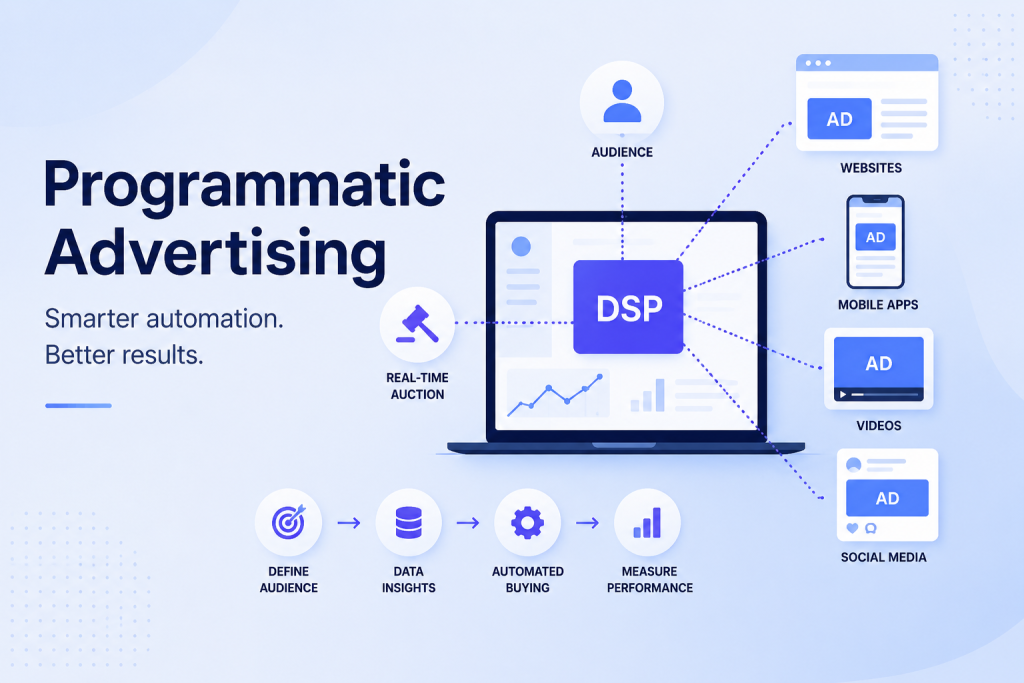
- How Programmatic Advertising Works: The Technology Stack
- Types of Programmatic Advertising Buying Models
- Programmatic Advertising Platforms: SSPs, DSPs, and Ad Exchanges
- How Much Does Programmatic Advertising Cost?
- The 5 Key Benefits of Programmatic Advertising
- Programmatic Advertising Ad Formats
- Real-World Programmatic Advertising Examples
- How to Build a Programmatic Advertising Strategy
- FAQs: Programmatic Advertising
- Conclusion
1. What Is Programmatic Advertising?
Programmatic advertising is the automated buying and selling of digital ad inventory using algorithmic technology, artificial intelligence, and real-time data to match the right ad impression to the right user at the right moment. Unlike traditional media buying — which required manual negotiation between advertisers and publishers, fixed pricing agreements, and lengthy insertion order processes — programmatic advertising automates all of these decisions in milliseconds, using live audience data and algorithmic bid management to determine which ad placement to serve to which user.
The word programmatic refers specifically to the process by which ads are bought and sold — not to the format of the ad itself. Think of programmatic as the brain that decides which ad to show, to whom, where, and when. The ad creative — a display banner, a video ad, a native ad — is the body that executes that decision. Programmatic technology handles the buying decision; the ad format handles the user experience.
Before programmatic advertising existed, buying a display ad on a website required a human negotiation — a media buyer would contact a publisher, negotiate pricing, agree on a placement, and execute a contract. Programmatic replaced that entire process with an automated auction that completes in less time than it takes to blink — roughly 100 milliseconds.
At its core, programmatic advertising operates on a simple principle: instead of buying ad space on a specific website, you are buying access to a specific audience wherever that audience happens to be across the internet. This shift — from placement-based buying to audience-based buying — is what makes programmatic advertising so powerful for digital marketers who need to reach precisely defined target audiences at scale.
2. Programmatic Advertising vs. Display Advertising: Key Differences
The terms programmatic advertising and display advertising are frequently used interchangeably — but they refer to completely different things. Understanding the distinction is fundamental to understanding how the digital advertising ecosystem works.
| Factor | Programmatic Advertising | Display Advertising |
| What it refers to | HOW ads are bought (the process) | WHAT the ad looks like (the format) |
| Core function | Automated buying using data and algorithms | Visual ad units served on websites and apps |
| Targeting capability | Audience-level targeting across all platforms | Placement-level within a single network |
| Inventory scope | Open web via DSPs and ad exchanges | Typically one ad network (e.g., Google Display) |
| Buying method | Real-time bidding, PMPs, preferred deals | Manual placement or single-network automation |
| Ad format | Can be display, video, native, audio, CTV | Usually banners, images, HTML5 rich media |
The simplest way to remember this distinction: display advertising describes a format — visual banners and images that appear on websites. Programmatic advertising describes a method — the automated, data-driven process of buying and placing ad impressions across the web. You can run programmatic display advertising (using programmatic technology to buy display ad inventory, but programmatic advertising can also encompass video, audio, native, connected TV (CTV), and other digital ad formats.
3. How Programmatic Advertising Works: The Technology Stack
The programmatic advertising ecosystem operates through a chain of interconnected technology platforms that work together in real time to match ad inventory with advertiser demand. Understanding this chain — from the publisher’s website to the advertiser’s DSP — is the key to understanding how programmatic advertising actually works.
Here is how the programmatic auction process unfolds, from the moment a user loads a webpage to the moment an ad appears:
- User loads a webpage — When a visitor arrives on a publisher’s website, the publisher’s ad server detects that an ad slot is available and generates a bid request.
- Bid request sent to the SSP — The publisher’s Supply-Side Platform (SSP) broadcasts the bid request to connected ad exchanges and demand-side platforms, including information about the ad placement, the website context, and anonymized audience data.
- DSPs evaluate and bid — Each advertiser’s Demand-Side Platform (DSP) receives the bid request, evaluates whether the impression matches its targeting parameters (audience, geography, device, context, time of day), and submits a real-time bid if the impression is a match.
- Winning bid selected — The ad exchange runs a second-price auction — the highest bidder wins the impression but pays one cent above the second-highest bid, not their maximum bid — in milliseconds.
- Ad delivered to user — The winning advertiser’s ad is instantly retrieved and displayed in the ad slot. The entire process from bid request to ad display takes less than 100 milliseconds — well before the webpage has finished loading.
The entire programmatic auction — bid request, DSP evaluation, auction, winner selection, and ad delivery — happens in under 100 milliseconds. By the time you finish reading this sentence, thousands of programmatic auctions will have already completed across the internet.
4. Types of Programmatic Advertising Buying Models
Not all programmatic advertising uses the same buying model. There are four primary methods through which programmatic ad inventory is purchased — each with different levels of inventory access, pricing structures, and audience targeting capabilities:
1. Real-Time Bidding (RTB) — The Open Marketplace
Real-time bidding is the most common and widely available programmatic buying method). It operates on an open auction basis — any advertiser with a DSP connection can participate, and ad impressions go to the highest bidder in real time. The open marketplace offers the widest inventory reach and the lowest minimum spend requirements, making it accessible to advertisers of all sizes). The trade-off is high competition and less predictability in CPM pricing).
2. Private Marketplace (PMP)
Private marketplace advertising operates on a curated, invite-only basis). Publishers offer premium ad inventory to a selected group of advertisers through a closed auction environment. PMP deals typically command higher CPMs than open marketplace RTB — but the premium inventory quality, brand safety controls, and reduced ad fraud risk justify the premium pricing for brand-conscious advertisers.
3. Preferred Deals (Spot Buying)
Preferred deals — also called spot buying or non-guaranteed premium — give specific advertisers the right of first refusal on premium ad inventory before that inventory is offered in a private or open marketplace). There is no guaranteed inventory volume — the advertiser can choose to take the ad slot or pass, at which point it moves to the PMP or RTB pool. Preferred deals offer a balance between premium access and flexibility that suits advertisers who want first look at quality inventory without a committed volume guarantee.
4. Programmatic Guaranteed
Programmatic guaranteed deals resemble traditional direct media buys — but executed through programmatic infrastructure). The publisher and advertiser agree in advance on a fixed price, a guaranteed volume of impressions, and specific targeting parameters). Unlike the other programmatic buying models, there is no auction bidding — the deal is fixed, the inventory is reserved, and both parties have certainty on price and delivery. Programmatic guaranteed is typically used by large advertisers who need predictable reach and premium placement certainty for brand campaigns.
| Buying Model | Access Type | Inventory Level | Best For |
| RTB Open Market | Open auction | Massive scale | Reach & awareness campaigns |
| Private Marketplace (PMP) | Invite-only | Premium, curated | Brand safety, premium placements |
| Preferred Deals | First refusal | Premium, flexible | First look at top inventory |
| Programmatic Guaranteed | Direct / fixed | Reserved premium | Large brand campaigns with certainty |
5. Programmatic Advertising Platforms: SSPs, DSPs, and Ad Exchanges
The programmatic advertising ecosystem is powered by three types of technology platforms that sit between advertisers and publishers, facilitating the automated buying and selling of ad inventory):
Supply-Side Platforms (SSPs)
Supply-Side Platforms — also called Sell-Side Platforms — are the technology publishers use to make their ad inventory available to programmatic buyers. SSPs allow publishers to set minimum bid floors, control which advertisers can access their inventory, and block specific ad categories or brands from appearing on their site. Leading SSPs include Google Ad Manager, PubMatic, Magnite, Index Exchange, OpenX, and TripleLift). Video-specific SSPs include SpotX, Teads, and SpringServe.
Demand-Side Platforms (DSPs)
Demand-Side Platforms are the technology advertisers and media buyers use to purchase programmatic ad inventory across multiple publishers and ad exchanges simultaneously. DSPs connect to ad exchanges and SSPs, evaluate available impressions against advertiser targeting criteria, and submit bids in real time). The leading DSPs for digital advertisers include:
- Google Display & Video 360 (DV360) — Google’s enterprise programmatic DSP, tightly integrated with Google Analytics, Google Ads, and YouTube advertising
- The Trade Desk — the leading independent DSP, widely used by agencies and sophisticated advertisers for open internet programmatic campaigns
- Amazon DSP — provides access to Amazon’s first-party purchase data and Amazon-owned ad inventory, ideal for ecommerce advertisers
- Adobe Advertising Cloud, MediaMath, StackAdapt, Criteo, AdRoll, Quantcast — each offering specialized targeting capabilities and inventory access
Ad Exchanges
Ad exchanges are the neutral marketplaces where SSPs and DSPs connect and programmatic auctions take place. They function as the clearing house for real-time ad transactions — publishers flow their available inventory into the ad exchange via their SSP, and advertisers bid through their DSP). Leading ad exchanges include Google Ad Exchange, Xandr (Microsoft), OpenX, PubMatic, Index Exchange, Magnite, and Amazon.
As an advertiser, you will primarily interact with DSPs. You don’t need to manage SSPs (those are for publishers) or ad exchanges directly (your DSP connects to them on your behalf). Choosing the right DSP is your most important platform decision — it determines which inventory you can access, what targeting data you can use, and how transparent your reporting will be.
6. How Much Does Programmatic Advertising Cost?
One of the most common misconceptions about programmatic advertising is that it requires a large budget. In reality, programmatic advertising is accessible to businesses of virtually any size — from small local businesses to global enterprise brands). The cost of programmatic advertising is shaped by several variables:
| Cost Factor | Impact on CPM | Typical Range |
| Standard open marketplace RTB | Low competition, broad audiences | $0.50 – $2.00 CPM |
| Premium / private marketplace | Higher quality, lower fraud risk | $5.00 – $20.00 CPM |
| Niche or specialist audiences | Higher demand for limited supply | $10.00 – $50.00+ CPM |
| Connected TV (CTV) | Premium inventory, high engagement | $15.00 – $50.00+ CPM |
| Video (pre-roll, mid-roll) | Higher attention, stronger recall | $5.00 – $30.00 CPM |
The standard CPM range for programmatic display advertising in the open marketplace is typically between $0.50 and $2.00 per thousand impressions — making it one of the most cost-efficient awareness channels available to digital advertisers). Even a modest programmatic advertising budget of a few hundred dollars per month can generate meaningful audience reach when targeting is well-configured and creative is compelling.
Pro Tip: Start with open marketplace RTB to understand how your audience responds to programmatic formats and refine your targeting. Once you have baseline performance data, consider upgrading specific placements to private marketplace deals for improved brand safety and inventory quality.
7. The 5 Key Benefits of Programmatic Advertising
For digital marketers and advertisers evaluating whether to incorporate programmatic advertising into their marketing mix, understanding the genuine benefits of programmatic advertising is essential for making an informed decision.
Benefit 1: Massive Scale with Precise Audience Targeting
The defining advantage of programmatic advertising is the ability to reach massive audiences while maintaining precise audience targeting). Because DSPs connect to thousands of publishers and ad exchanges simultaneously, programmatic campaigns can reach virtually any target audience across the open internet — without requiring individual publisher relationships for each site. And because those impressions are targeted by audience signals — demographics, interests, browsing behavior, location, device, and more — you are not simply buying ad space). You are buying access to the specific people most likely to respond to your message.
Benefit 2: Cost-Efficient Awareness at Any Budget Level
With programmatic CPMs starting as low as $0.50 per thousand impressions, programmatic advertising is one of the most cost-efficient awareness tactics available. Unlike search advertising where cost-per-click rates can be several dollars or more for competitive keywords, programmatic display allows small and medium businesses to generate significant brand exposure without requiring enterprise-level budgets. Paired with programmatic retargeting, even modest campaigns can guide potential customers through a multi-touch purchase journey.
Benefit 3: Real-Time Data and Rapid Optimization
Because programmatic platforms operate on real-time bidding, campaign performance data is available in near-real time. Media buyers can monitor impressions, click-through rates, conversion data, and audience engagement metrics as campaigns run, and adjust bids, audience targeting, creative assets, and placements without waiting for a reporting cycle to close. This agility — the ability to pivot rapidly based on live data — is one of the most significant competitive advantages that programmatic advertising offers over traditional media buying.
Benefit 4: First-Party Data Activation
In an era of third-party cookie deprecation and privacy-first digital advertising, first-party data is more valuable than ever — and programmatic advertising is one of the most effective channels for activating it. Advertisers can securely upload customer email lists, CRM data, and website visitor segments to their DSP and use that first-party data to target existing customers, suppress converted users, and build lookalike audiences to find new customers who share characteristics with their best existing ones.
Benefit 5: Cross-Device and Cross-Format Campaign Strategy
Modern consumers move fluidly between devices — beginning a research journey on their smartphone, continuing on their desktop, and converting via their tablet. Programmatic advertising enables cross-device tracking and targeting that follows the user across these touchpoints, providing a coherent multi-device brand experience). Combined with access to display, video, native, audio, and CTV programmatic formats, programmatic advertising enables truly integrated cross-channel campaigns that digital marketing strategies can leverage across the full customer journey.
8. Programmatic Advertising Ad Formats
Programmatic advertising supports a broader range of ad formats than most advertisers realize. The days of programmatic being synonymous with banner display ads are long past — modern programmatic platforms can deliver:
- Display ads — traditional banner ads, rectangular formats, rich media units, and expandable ads in standard IAB sizes
- Video ads — pre-roll, mid-roll, out-stream, and in-banner video across desktop and mobile
- Native ads — content-matching ad units that blend with the editorial context of the publisher’s website, including sponsored content, recommendation widgets, and in-feed native formats
- Audio ads — served across streaming music platforms, podcasts, and digital radio via programmatic audio buying
- Connected TV (CTV) ads — video ad units served across smart TVs, streaming devices, and OTT platforms like Hulu, Peacock, and Pluto TV via programmatic CTV buying
- Digital out-of-home (DOOH) — programmatic placements on digital billboards, transit screens, and digital signage networks
For digital marketing campaigns with awareness objectives, the expanding range of programmatic ad formats means that programmatic strategy can now reach audiences across virtually every digital touchpoint in their daily lives — from their morning podcast commute to their evening streaming session).
9. Real-World Programmatic Advertising Examples
Abstract explanations of programmatic advertising become much clearer when you see how real brands have applied programmatic targeting to deliver relevant, well-timed ad experiences. Here are three examples that illustrate how programmatic signals translate into smarter advertising):
The Amanda Foundation: Behavior-Matched Animal Adoption Ads
This Los Angeles animal shelter used programmatic behavioral data to serve personalized adoption ads that matched specific animals to individual users based on their browsing behavior and interests). A user who had been researching large dog breeds was served an ad featuring large dogs available for adoption; a user interested in cats received cat-focused adoption ads). This behavioral targeting dramatically improved ad relevance and adoption response rates — demonstrating how programmatic audience data transforms generic charity advertising into precisely targeted emotional communication.
Geico Insurance: True Cross-Platform Programmatic Coverage
Geico uses programmatic advertising to maintain brand presence across television, display, social media, and streaming platforms — with creative assets carefully calibrated to the platform context and target audience demographics. This is a textbook example of cross-channel programmatic strategy — using AI-driven ad buying to maintain consistent brand exposure at mass scale while adapting messaging to each channel’s audience.
Brilliant Earth: Contextual and Behavioral Retargeting
Brilliant Earth, the fine jewelry brand, used programmatic retargeting to serve highly contextual ads to website visitors based on the specific products they had browsed. A visitor who had viewed engagement rings but had not purchased was later served an ad with the message “Drop a Hint” — recognizing from behavioral signals that the viewer might not be the buyer and redirecting the ad message accordingly. This is programmatic advertising at its most sophisticated: using real-time behavioral data to deliver precisely the right message to precisely the right person.
10. How to Build a Programmatic Advertising Strategy
For advertisers new to programmatic, building a programmatic advertising strategy from scratch can feel overwhelming — the ecosystem is complex, the platform options are numerous, and the terminology is dense). Here is a practical step-by-step framework to get started:
- Define your campaign objective — programmatic advertising is primarily an awareness and consideration channel. It excels at building brand recognition, growing audience reach, and initiating retargeting journeys. If your primary campaign goal is direct lead generation or immediate conversion, search advertising via PPC is typically more efficient as a starting point.
- Choose your DSP — select a Demand-Side Platform that aligns with your budget, inventory needs, and technical capabilities. Google DV360 is well-suited for Google-ecosystem advertisers; The Trade Desk is preferred by independent agencies and sophisticated media teams. StackAdapt and AdRoll offer more accessible self-serve options for smaller budgets.
- Build your audience segments — define your target audiences using available DSP data, including first-party data uploads, in-market segments, interest-based targeting, and contextual signals. Layer multiple audience signals for more precise targeting.
- Develop format-appropriate creative — produce ad creative in multiple sizes and formats suited to your chosen programmatic inventory. For display programmatic, standard IAB banner sizes (300×250, 728×90, 160×600, 320×50) are essential. For video programmatic, produce 15-second and 30-second pre-roll formats.
- Set up conversion tracking — implement DSP tracking pixels and conversion events on your website before your campaign goes live. Without conversion tracking, you cannot measure whether programmatic advertising is driving business outcomes.
- Start with open marketplace RTB — begin with the open marketplace to establish performance baselines, then graduate to private marketplace deals for your highest-performing audience segments.
- Optimize based on performance data — monitor CTR, viewability rates, conversion rates, and frequency capping actively. Programmatic campaigns require ongoing management and optimization, not passive observation.
Building and managing a high-performing programmatic strategy requires platform expertise, audience data knowledge, and creative optimization skills that develop over time. Working with a specialist digital marketing agency in Pakistan or PPC management team gives you access to experienced programmatic practitioners who can build the campaign architecture, configure targeting, and manage ongoing optimization from day one.
11. FAQs: Programmatic Advertising
What is programmatic advertising in simple terms?
Programmatic advertising is the automated process of buying and selling digital ad space using software, algorithms, and real-time data to match ads to audiences instantly. Instead of manually negotiating with publishers, advertisers use Demand-Side Platforms (DSPs) to bid for ad impressions in real-time auctions — with the entire process completing in milliseconds.
How is programmatic advertising different from Google Ads?
Google Ads is a specific advertising platform operated by Google, primarily focused on search intent and Google’s own ad inventory (Search, Display Network, YouTube, Gmail). Programmatic advertising refers to the broader automated buying methodology used across the entire open internet through DSPs that connect to multiple ad exchanges and thousands of publishers. Google’s DV360 is itself a programmatic DSP — so programmatic advertising is the category, and Google Ads is one player within it.
Is programmatic advertising suitable for small businesses?
Yes — programmatic advertising is suitable for businesses of any size). With CPMs starting as low as $0.50, even small budget campaigns can generate meaningful audience reach). The key for small businesses is to focus on tight audience targeting and use programmatic retargeting to re-engage website visitors who did not convert on their first visit.
What is real-time bidding (RTB) in programmatic advertising?
Real-time bidding (RTB) is the open auction method through which most programmatic ad inventory is bought and sold. When a user loads a webpage, the publisher’s SSP sends a bid request to connected DSPs, which evaluate the impression and submit bids within milliseconds). The highest bidder wins the impression and their ad is served). The entire process completes in under 100 milliseconds — before the webpage has finished loading.
What is a DSP in programmatic advertising?
A Demand-Side Platform (DSP) is the technology advertisers use to purchase programmatic ad inventory across multiple publishers and ad exchanges simultaneously. DSPs manage audience targeting, real-time bid submission, budget pacing, and campaign performance reporting). Leading DSPs include Google Display & Video 360, The Trade Desk, Amazon DSP, StackAdapt, and AdRoll.
What is a private marketplace (PMP) in programmatic?
A Private Marketplace (PMP) is an invite-only programmatic auction where premium publishers offer their best ad inventory to a curated group of selected advertisers. PMP deals command higher CPMs than open marketplace RTB but offer better brand safety, higher inventory quality, and reduced ad fraud exposure — making them valuable for brand-conscious advertisers prioritizing quality over volume.
How does programmatic advertising use first-party data?
First-party data — customer email lists, CRM data, website visitor behavior — can be uploaded securely to a DSP and used to target existing customers with programmatic ads, suppress converted users from acquisition campaigns, and build lookalike audiences to find new potential customers who share characteristics with your best existing ones. This capability makes programmatic advertising particularly powerful for ecommerce brands with rich customer data to activate.
Can a digital marketing agency manage programmatic advertising for my business?
Yes — and given the platform complexity and data requirements of programmatic advertising, working with an expert digital marketing agency or PPC management agency is often the most efficient path to programmatic campaign success). An experienced team will select the right DSP, configure audience targeting, develop creative, set up conversion tracking, and manage ongoing campaign optimization — ensuring your programmatic advertising budget is working as hard as possible.
12. Conclusion: Programmatic Advertising Is the Foundation of Modern Digital Media Buying
Programmatic advertising has fundamentally transformed how digital media is bought and sold — replacing manual insertion orders, fixed placement negotiations, and guesswork-based audience selection with data-driven automation, real-time decision making, and audience-level precision that was simply not possible a decade ago.
For businesses in Pakistan and around the world, programmatic advertising offers a genuinely compelling combination: massive reach at efficient CPM costs, precise audience targeting using behavioral and demographic data, real-time optimization based on live performance signals, and cross-channel flexibility across display, video, native, audio, and connected TV). The cost barrier to entry is lower than most advertisers assume, and the targeting precision is higher than most traditional media channels can match.
What separates effective programmatic advertisers from those who waste budget is strategy and expertise: clear campaign objectives, well-defined audience segments, quality creative assets, robust conversion tracking, and active ongoing optimization. Programmatic advertising amplifies whatever strategy you bring to it — which is exactly why the most successful programmatic campaigns are those built on the clearest digital marketing strategy foundations.
Ready to explore programmatic advertising for your business? Whether you’re starting from scratch or looking to improve existing programmatic campaigns, our team can build the strategy, select the right platforms, and manage ongoing optimization for measurable results.
PPC Marketing Agency Pakistan | Digital Marketing Services | SEO Services Lahore | Visit Homepage

I’m Usman Saeed, a digital marketing expert with over 10 years of experience helping businesses grow online through SEO, Google Ads, social media marketing, and conversion strategies. I’ve worked with national and international clients across various industries and now focus on combining digital marketing with AI and data science to create smart, automated solutions. Through my platform UsmanSaeed.net, I aim to help businesses in Pakistan and beyond achieve real growth with the latest tools, strategies, and personalized support.